Temperature18 – 24 °C
Natural range
- Pakistan area
- India area
- Asia area
CyprinidsConservation status: Least concern LC
Other scientific names: Barilius rerio, Brachydanio frankei, Brachydanio rerio, Cyprinus chapalio, Cyprinus rerio, Danio frankei
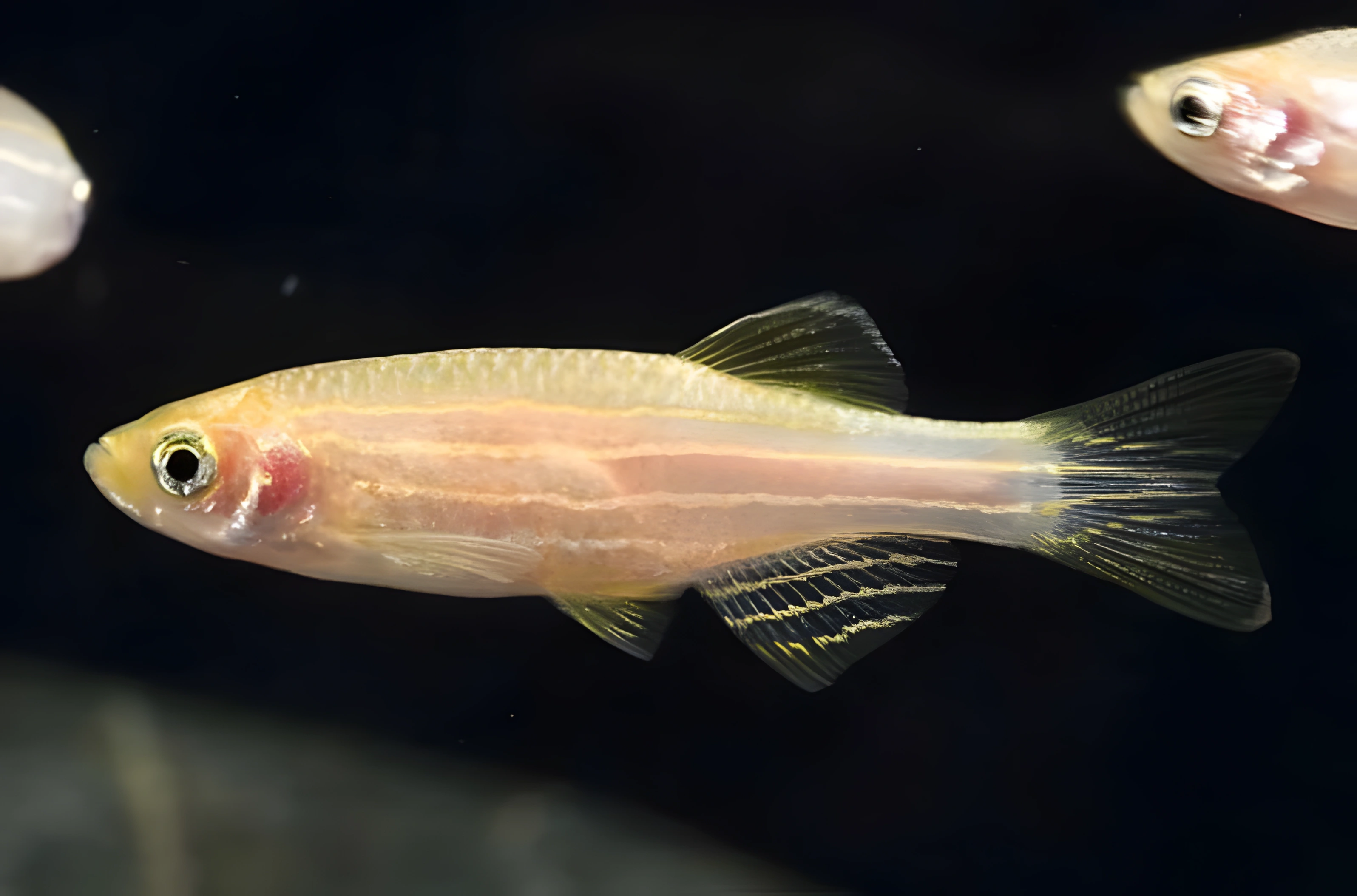
The Albino Zebra Danio, scientifically known as Danio rerio, is a member of the Cyprinidae family. This fish is a natural morphological form of the Zebra Danio and is found in the wild. Its key difference from its relatives is the complete absence of pigmentation, which makes the stripes on its body distinctly white rather than dark. Being an active and peaceful fish, it can become a true adornment for any tropical aquarium. It looks particularly striking when kept together with the classic Zebra Danio, which adds a special charm to the aquarium.
- Required aquarium volume
- 40 L
- Size in aquarium
- 6 cm
- Temperature
- 18 – 24 °C
- Temperament
- Peaceful, active/mobile
Parameters
Water pHSlightly acidic (6) – Slightly alkaline (8)
Water dHSoft (5) – Very hard (19)
Water salinityno salt (freshwater)
Size in aquarium6 cm
Lifespan4 years
TemperamentPeaceful, active/mobile
Toward small fishnot a predator
Required aquarium volume40 L
Lightingmoderate (regular)
Substratesandy (regular, light)
Water flowmoderate
FeedingAny (universal)
CareSchooling (usually from 5–6 individuals and more)
Description
The Albino Zebra Danio has a slender, slightly compressed body, the length of which usually does not exceed 6 cm. However, in very large tanks, such as ponds, these fish can reach somewhat larger sizes. Some Danio subspecies have small barbels located at the end of each lip. Their lifespan can reach up to 4 years. The coloration of this fish is light, creamy, with characteristic white stripes that run from the head to the tail.
Habitat
The history of the Zebra Danio's description began in 1822 thanks to the researcher Hamilton. The habitat range of this species extends across Asia, from Pakistan to India. The Albino Danio is a natural morphological form, successfully adapted from the wild for aquarium keeping. In nature, these fish prefer river channels and ponds. During the rainy season, when meadows and rice fields in rural areas are flooded, danios move into these temporary bodies of water where they spawn, after which they return to the main water bodies. They prefer clean, flowing water and shaded areas with abundant aquatic vegetation. It is important to consider certain requirements and conditions for their keeping.
Behavior and Compatibility
This peaceful and very compatible fish belongs to schooling species, so it is recommended to keep them in groups of no fewer than 5 individuals. Danios lead an active lifestyle, and when choosing tank mates, preference should be given to fish with a similar temperament, as they can cause distress to slow-moving species. Co-housing with large or predatory fish is strictly not recommended, as danios can easily become their prey.
Care and Maintenance
Danios do not require special keeping conditions and tolerate fluctuations in water hardness and pH levels well. The water in the aquarium must be impeccably clean, without visible suspended particles. Given that these fish are often kept in aquariums of 40 L or more, to prevent the accumulation of nitrates and phosphates, it is necessary to change up to 50% of the water volume monthly. Due to their ability to live at low temperatures, the aquarium may not need a heating system. However, danios are prone to jumping out of the water, so a lid on the aquarium is a mandatory condition. Most of the time, these fish spend in the upper and middle layers of the water, needing sufficient space for swimming and hiding places, which can be created with thickets of plants placed along the side and back walls of the tank. Lighting should be moderate, as excessively bright light can cause the fish's coloration to fade and cause them undue discomfort. Sand or fine dark gravel is preferred as a substrate.
Diet
In a home aquarium, these fish readily eat all types of dry commercial foods. An important condition is that the offered food must be floating and remain on the water surface. To enrich their diet, live or freeze-dried foods such as brine shrimp, bloodworms, or mosquito larvae can be used. Feeding is recommended 2–3 times a day, offering portions that the fish can consume within 3 minutes.
Breeding and Reproduction
Females of this species are noticeably larger than males, which, in turn, are distinguished by more graceful forms. As a rule, two fish form a pair that can last throughout their lives. For successful breeding, it is recommended to use a separate tank, at the bottom of which a substrate of balls 1–2 cm in size or similar-sized pebbles is laid. First, the female is introduced into the tank, and the next day, the male. The stimulus for spawning is the addition of several glasses of cold water, simulating the rainy season. The female lays eggs, which the male fertilizes. The eggs roll between the stones or balls, where fry subsequently appear. After spawning, the parents are immediately removed back to the main aquarium, as they are prone to eating their offspring.
Diseases
The fish demonstrates high endurance, and under optimal keeping conditions, health problems are generally absent. However, if water quality deteriorates, the Albino Danio becomes more vulnerable to Ichthyophthirius. More detailed information on possible diseases can be found in the section “Diseases of aquarium fish.” It is important to consider these features.
How to choose
When purchasing, choose active, mobile individuals with clean fins free of damage, growths, or spots. Avoid fish with signs of emaciation, sunken bellies, or unnatural behavior, for example, if the fish stays at the bottom, tips on its side, or constantly hides in corners. In the store, the fish should look healthy and react to external stimuli. Inspect the aquarium for dead individuals, as the presence of corpses in the general tank can indicate poor water quality or infectious diseases that can be transmitted to new pets.
Frequently asked questions
The essentials: size, tank volume, water parameters and care
How big does Albino Zebra Danio get?
An adult reaches 6 cm in length. Plan the tank around the maximum size: the fish quickly outgrows a cramped setup.
What size aquarium does Albino Zebra Danio need?
The minimum recommended volume is 40 L. A smaller tank speeds up nitrate build-up and raises stress levels.
What water parameters does Albino Zebra Danio need?
Temperature 18–24 °C, pH 6–8, hardness 5–19 dGH. Stability matters more than exact values: sudden swings are harder on the fish than a small deviation from the ideal.
How long does Albino Zebra Danio live?
Around 4 years when kept properly. Lifespan depends directly on tank volume, water quality and a varied diet.
Is Albino Zebra Danio aggressive?
Temperament: peaceful, active/mobile. Keep this in mind when choosing tank mates.
How many Albino Zebra Danio should be kept together?
Recommended setup: schooling (usually from 5–6 individuals and more). Ignoring this is a common cause of stress and disease.
What does Albino Zebra Danio eat?
Diet type: any (universal). Feed small portions that are finished within a couple of minutes — overfeeding does more harm than underfeeding.
What is the scientific name of Albino Zebra Danio?
The scientific name of the species is Danio rerio, family Cyprinids (Cyprinidae). It also appears in the literature as: Barilius rerio, Brachydanio frankei, Brachydanio rerio.