Temperature20 – 26 °C
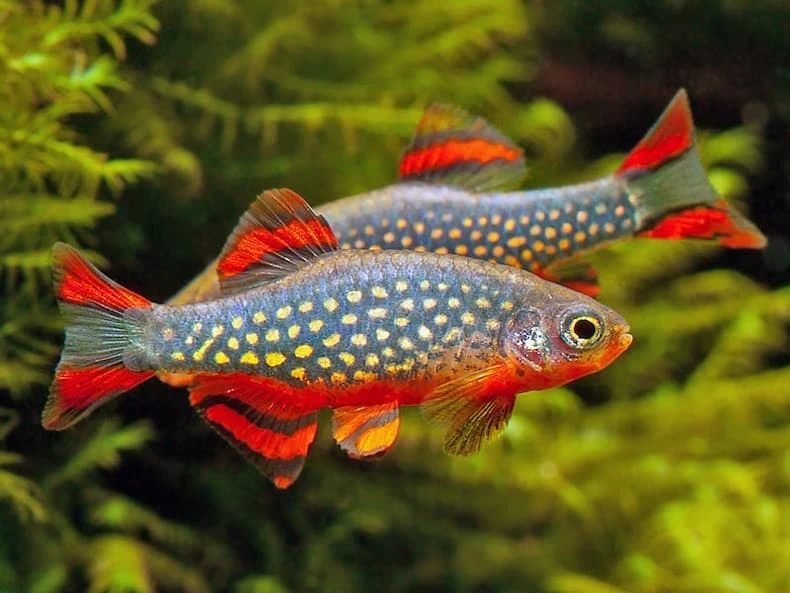
Other scientific names: Celestichthys margaritatus
The Celestial Pearl Danio, or Galaxy Rasbora (scientific name — Danio margaritatus), belongs to the family Cyprinidae. Sometimes, the Russian transliteration of the Latin name, Danio margaritatus, is used to refer to this species.
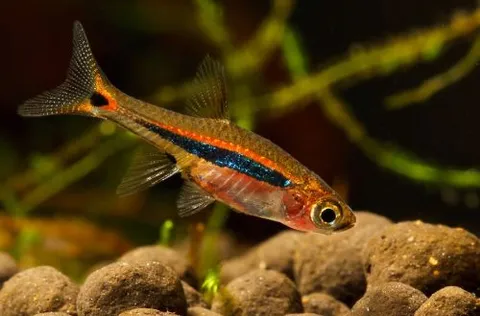
Adults grow to about 2 cm in length. Their miniature size and appearance initially resembled members of the genus Rasbora, which led to their original name "Microrasbora." After more detailed research, the species was reclassified as Danio. The coloration of the Celestial Pearl Danio is unique. Males feature a steel or dark blue body adorned with a pattern of light yellowish speckles, creating the impression of a starry sky and justifying the galaxy analogy. During spawning, their belly may acquire a reddish tint. The pectoral fins are an exception; the other fins and tail are decorated with broad red stripes. Females, in contrast, have less vibrant coloration; their body is blue-green, and the light speckles are not as distinct. Female fins have pale red spots. Additionally, females are typically somewhat larger than males.
The natural habitat of this species is located in Southeast Asia, in the territories of eastern Myanmar and the northern regions of Thailand. The fish inhabits the Salween River basin, also known as the Thanlwin. Celestial Pearl Danios are typically found in shallow, marshy areas of rivers with abundant aquatic vegetation.
These active schooling fish require careful selection of tank mates, given their small size. Large or aggressive species, as well as many catfish, can pose a threat to the Celestial Pearl Danio. Good compatibility is achieved only with fish of comparable size, such as other Rasboras, Danios, or many livebearers. Within the species, competition between males is observed, which can sometimes appear quite fierce, surprisingly so for such tiny fish. To prevent potential problems, the school size should be maintained at no less than 20 individuals. In such a large group, the males' attention is dispersed among many conspecifics, ensuring relative safety for weaker individuals.
Despite the miniature size of the Celestial Pearl Danio, a small group of these fish requires an aquarium of at least 40 liters. This requirement is due to the behavioral characteristics of the males, which will be discussed below. For decoration, it is recommended to use dark substrate, various snags, and dense thickets of aquatic plants, including floating species. Dried tree leaves are used to create a natural ambiance; as they decompose, they impart a slight tea tint to the water. Stability of water parameters within the acceptable range of temperature, pH, and GH is a key condition for successful keeping. To maintain these conditions, the aquarium is equipped with a heater and a filtration system. In some cases, a simple air-driven sponge filter is sufficient. With a large number of plants, especially at night, additional aeration is advisable. This will help reduce the risk of suffocation for the fish, as plants stop photosynthesis in the dark, begin to absorb oxygen, and release carbon dioxide.
In a home aquarium, these fish readily accept most common foods. The diet should be varied and include dry, frozen, and live foods. The intensity of their coloration directly depends on the quality of their diet. Since the fish feed both in the water column and near the bottom, it is recommended to use foods that gradually sink.
Breeding this species is not difficult; under favorable conditions, spawning occurs regularly and does not require special preparatory measures from the aquarist. For example, the first instance of breeding in an artificial environment was recorded in 2006 in England, in the Bolton Museum aquarium, just two weeks after wild individuals arrived in the country. During the breeding period, the fish scatter several dozen eggs among vegetation. They do not have developed parental instincts, and there is no care for the offspring. The incubation period for the eggs is about 72 hours, its duration depending on water temperature. After another 3–4 days, the fry begin to swim freely. Additional information on Danio breeding is available. It is important to note that if the fry are not transferred to a separate tank, their chances of surviving to adulthood are slim. Fry become food for other fish and have difficulty finding suitable nutrition. It is recommended to feed fry specialized powdered foods, suspensions, or live Artemia nauplii.
In a balanced aquarium ecosystem, when species-specific requirements are met, diseases are rare. Most often, health problems arise due to deterioration of the habitat, contact with infected fish, or injuries. If this cannot be avoided and the fish shows clear signs of illness, medication may be required.
When purchasing, choose active individuals with clean fins and no visible body damage. Avoid fish with signs of emaciation, sunken bellies, or unnatural behavior, such as constantly hovering near the surface or bottom alone. A healthy Celestial Pearl Danio should have vibrant coloration appropriate to its sex and show interest in its conspecifics. Since the fish are timid, they may temporarily hide in the store, but they should show feeding activity when food is offered.
The essentials: size, tank volume, water parameters and care
An adult reaches 2 cm in length. Plan the tank around the maximum size: the fish quickly outgrows a cramped setup.
The recommended volume is 40 L. A smaller tank speeds up nitrate build-up and raises stress levels.
Temperature 20–26 °C, pH 6–7, hardness 2–15 dGH. Stability matters more than exact values: sudden swings are harder on the fish than a small deviation from the ideal.
Around 4 years when kept properly. Lifespan depends directly on tank volume, water quality and a varied diet.
Temperament: peaceful (regular). Keep this in mind when choosing tank mates.
Recommended setup: large group (10+ individuals). Ignoring this is a common cause of stress and disease.
Diet type: small / appropriate size / pieces. Feed small portions that are finished within a couple of minutes — overfeeding does more harm than underfeeding.
The scientific name of the species is Danio margaritatus, family Cyprinids (Cyprinidae). It also appears in the literature as: Celestichthys margaritatus.
Matched by family, categories and overlapping keeping conditions
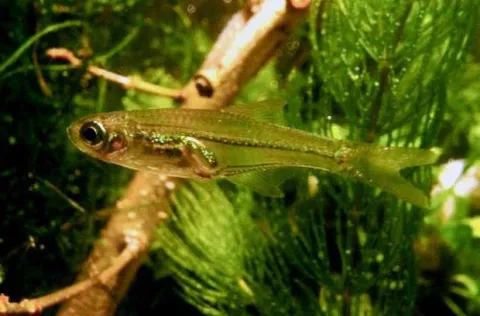
Microdevario gatesi
A member of the Cyprinidae family, Gates' Danio, scientifically named Microdevario gatesi, was named in honor of Gordon E. Gates, the person responsible for its discovery. Prior to 2009, this fish was traditionally…
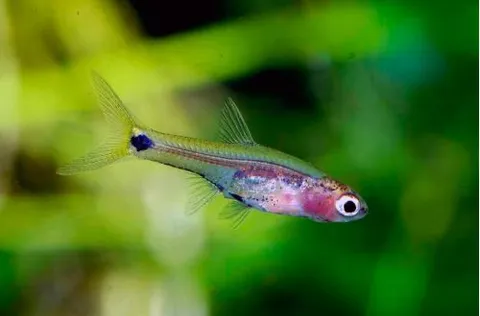
Barboides gracilis
A member of the Cyprinidae family, known as Barboides gracilis or the gracile barb, stands out for its modest size. Thanks to this quality, this fish is perfectly suited for keeping in nano-aquariums. With optimal…
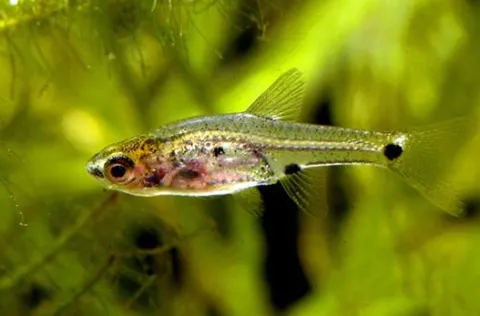
Boraras micros
Boraras micros, also known as the Dwarf Rasbora, belongs to the family Cyprinidae. Despite its rather modest coloration, which makes this species not the most sought-after among aquarists, these fish are quite capable…
Boraras urophthalmoides
Boraras urophthalmoides, known as the Firefly Rasbora, belongs to the family Cyprinidae. This fish is characterized by its miniature size, bright and vibrant coloration, and high activity. Its keeping and breeding do…