Temperature24 – 28 °C
Natural range
- Lake Malawi area
- Malawi area
- Mozambique area
- Tanzania area
CichlidsConservation status: Least concern LC
Other scientific names: Maylandia crabro, Melanochromis crabro
Pseudotropheus crabro, also known as the Chameleon Cichlid or Bumblebee Cichlid, has the scientific name Pseudotropheus crabro and belongs to the family Cichlidae. This fish is a representative of the Mbuna cichlid group. Its behavior is often characterized as quarrelsome and aggressive, which can complicate the selection of tank mates. However, for experienced aquarists, its keeping and breeding do not present particular difficulties.
- Required aquarium volume
- 180 L
- Size in aquarium
- 12 – 15 cm
- Temperature
- 24 – 28 °C
- Temperament
- Aggressive / incompatible / unfriendly
Parameters
Water pHSlightly alkaline (7.6) – Alkaline (8.8)
Water dHMedium hardness (10) – Very hard (25)
Water salinityno salt (freshwater)
Size in aquarium12 – 15 cm
Lifespan10 years
TemperamentAggressive / incompatible / unfriendly
Toward small fishnot a predator
Required aquarium volume180 L
Lightingmoderate (regular)
Substratesand or gravel + stones/boulders
Water flowweak or moderate
FeedingSmall / appropriate size / pieces
CareHarem (1 male and several females)
Description
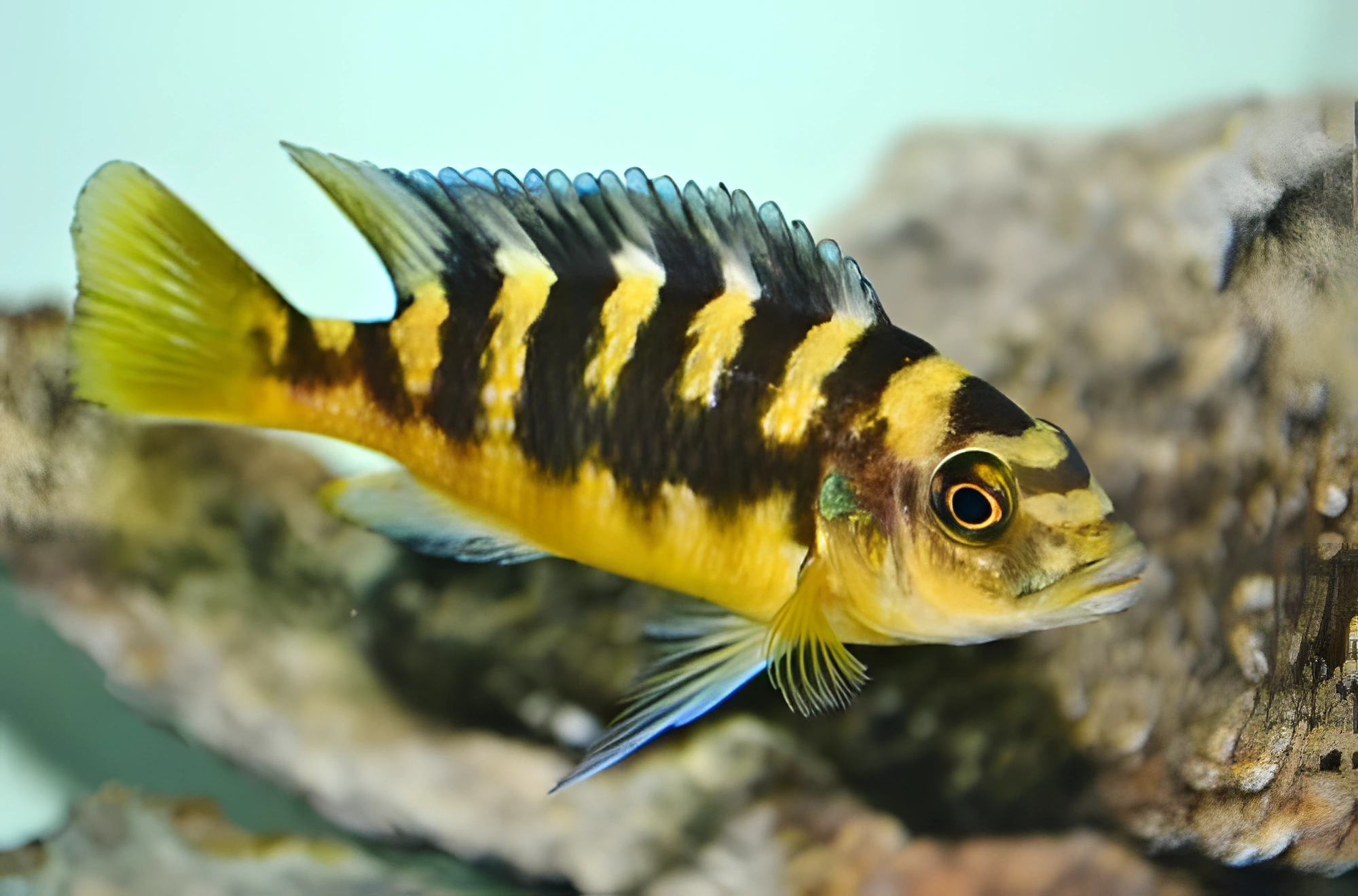
Adult males can reach a length of 15 cm, while females grow up to 12 cm. The primary coloration is yellow, with bluish tints along the fin edges. Rows of black stripes are visible on the fish's body. Males usually have more intense coloration. The fish earned its second name, "Chameleon Cichlid," due to the remarkable ability of males to change color: during the breeding period, their coloration becomes significantly darker.
Habitat
This species is endemic to Lake Malawi in Africa, one of the largest freshwater bodies on the planet. The lake is located in three countries: Malawi, Mozambique, and Tanzania. Pseudotropheus crabro fish are found throughout the lake, most often in its central part. Their favorite habitats are regions near rocky shores, where there are many caves and grottoes that serve as excellent shelters.
Behavior and Compatibility
Dominant males show aggression towards conspecifics and potential rivals. In small aquariums, it is recommended to keep only one male surrounded by several females. The presence of sufficient hiding places is essential in this case. There have been cases of female deaths during spawning due to excessive "attention" from males. In more spacious aquariums, cohabitation with other aggressive Mbuna representatives of comparable size is possible, provided that each male has enough space to establish and guard its own territory.
Care and Maintenance
For a small group of these fish, the optimal aquarium volume starts from 180 liters. The decor can be quite simple: a sandy or gravel substrate with rock formations and stones that allow for the creation of caves and crevices. Any other decorative elements chosen by the aquarist can also serve as shelters. Live vegetation is not essential for this species, which is consistent with the characteristics of Lake Malawi's natural habitat. A key factor for successful keeping of the Bumblebee Cichlid is maintaining stable water conditions with appropriate pH and GH values. However, it should be remembered that a protein-rich diet and a significant amount of organic waste can quickly degrade water quality. To maintain the aquarium's biological system in balance, a powerful filtration system combined with regular weekly water changes (20–40% of the total volume) with fresh water will be required.
Diet
Pseudotropheus crabro is an omnivorous species. In its natural environment, this fish feeds on algae, crustaceans living on the bottom, insect larvae, as well as fry and eggs of other fish. Such a diet implies a high protein content, unlike other Mbuna group members, which primarily consume plant food. In aquarium conditions, it is important to consider these features. It is recommended to use plant-based foods that, however, should contain animal proteins, for example, from fish, shrimp, worms, or various small crustaceans.
Breeding and Reproduction
Breeding Pseudotropheus crabro in favorable conditions usually presents no particular difficulties. With the onset of the breeding season, the male darkens almost completely and begins to actively court the females. If the females do not find shelters, the consequences can be dire. A female ready to spawn accepts courtship, after which she lays 20–60 eggs. The female takes the fertilized eggs into her mouth, where they will remain throughout the incubation period. This egg-brooding mechanism is evolutionarily developed and characteristic of most Lake Malawi cichlids. Egg development takes 17 to 21 days. During this time, the female must be kept away from the male, who continues his courtship. This can be a reliable shelter, a secluded corner in the aquarium, or a separate tank with identical water parameters. After the fry emerge, the female continues to protect her offspring for several more days. The young grow quickly and require regular feeding, for example, with Artemia nauplii or ground/powdered dry foods.
Diseases
Most diseases of Malawian cichlids are often caused by unsuitable keeping conditions or poor-quality food, which frequently leads to the development of "Malawi Bloat." If the first symptoms are detected, it is necessary to check the water parameters for high concentrations of dangerous substances such as ammonia, nitrites, and nitrates. If necessary, all parameters should be normalized, and only then should treatment begin. More detailed information on symptoms and treatment methods is available in the "Aquarium Fish Diseases" section.
How to choose
When selecting specimens, pay attention to their activity and the absence of visible damage to scales or fins. Healthy fish should show curiosity, react actively to movement near the glass, and have a good appetite. Avoid purchasing fish with signs of emaciation, sunken bellies, or unnaturally bloated abdomens, which may indicate internal diseases. Given the high intraspecific aggression, it is recommended to acquire young individuals to form a group or select a harem (one male to 3–4 females) from reputable sources where the fish have been kept in suitable conditions. Avoid specimens that constantly hide in a corner of the aquarium or show signs of severe stress, as this often indicates health problems or recent suppression by dominant individuals.
Frequently asked questions
The essentials: size, tank volume, water parameters and care
How big does Bumblebee Cichlid get?
An adult reaches 12–15 cm in length. Plan the tank around the maximum size: the fish quickly outgrows a cramped setup.
What size aquarium does Bumblebee Cichlid need?
The minimum recommended volume is 180 L. A smaller tank speeds up nitrate build-up and raises stress levels.
What water parameters does Bumblebee Cichlid need?
Temperature 24–28 °C, pH 7.6–8.8, hardness 10–25 dGH. Stability matters more than exact values: sudden swings are harder on the fish than a small deviation from the ideal.
How long does Bumblebee Cichlid live?
Around 10 years when kept properly. Lifespan depends directly on tank volume, water quality and a varied diet.
Is Bumblebee Cichlid aggressive?
Temperament: aggressive / incompatible / unfriendly. Keep this in mind when choosing tank mates.
How many Bumblebee Cichlid should be kept together?
Recommended setup: harem (1 male and several females). Ignoring this is a common cause of stress and disease.
What does Bumblebee Cichlid eat?
Diet type: small / appropriate size / pieces. Feed small portions that are finished within a couple of minutes — overfeeding does more harm than underfeeding.
What is the scientific name of Bumblebee Cichlid?
The scientific name of the species is Pseudotropheus crabro, family Cichlidae. It also appears in the literature as: Maylandia crabro, Melanochromis crabro.