Temperature23 – 28 °C
Natural range
- Lake Malawi area
- Lake Nyasa area
Predators CichlidsConservation status: Least concern LC
Other scientific names: Astatotilapia livingstonii, Cyrtocara livingstonii, Haplochromis livingstoni, Hemichromis livingstonii, Paratilapia livingstonii
Nimbochromis livingstonii, the scientific name for Livingston's Cichlid, belongs to the family Cichlidae. Haplochromis livingstonii is considered an older name, as this fish is now classified under the genus Nimbochromis, so it is more accurate to use the name Nimbochromis livingstonii.
- Required aquarium volume
- 450 L
- Size in aquarium
- 25 cm
- Temperature
- 23 – 28 °C
- Temperament
- Predator, but semi-peaceful (gets along with large ones)
Parameters
Water pHNeutral (7) – Slightly alkaline (8)
Water dHMedium hardness (10) – Very hard (19)
Water salinityvery low (up to ~3 g/L)
Size in aquarium25 cm
Lifespan10 years
TemperamentPredator, but semi-peaceful (gets along with large ones)
Toward small fishpredator
Required aquarium volume450 L
Lightingmoderate (regular)
Substratesandy (regular, light)
Water flowmoderate or strong
FeedingMeat / protein (live, frozen, fresh)
CareHarem (1 male and several females)
Description
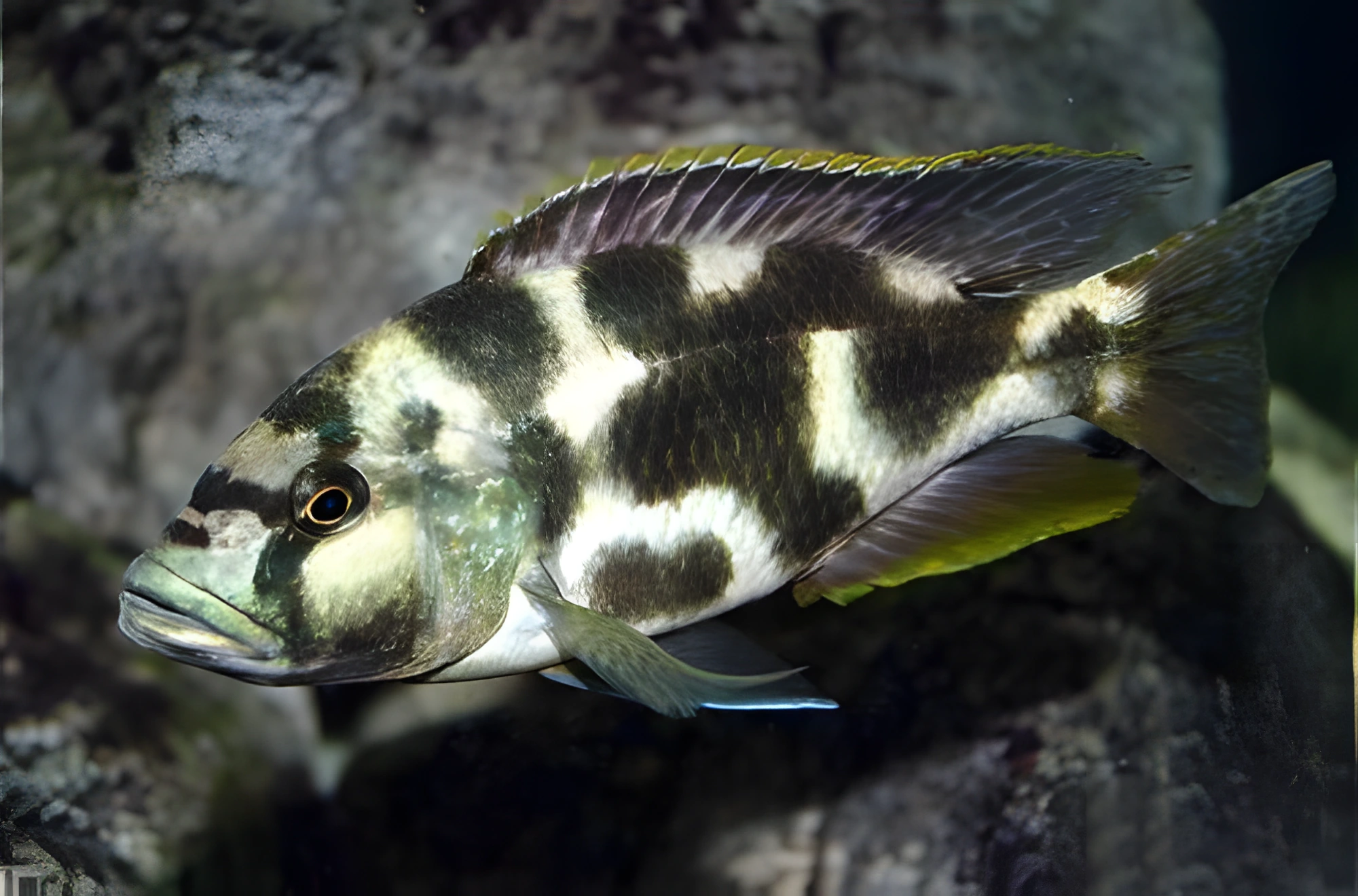
This large fish, with an elongated body and a large mouth, can grow up to 25 cm in length. Livingston's Cichlid's coloration varies from silvery to yellowish and blue hues, with contrasting, smoothly transitioning spots that form a unique pattern for each individual. The edges of the fins are often adorned with a stripe of a different color, usually orange or red. Females and juveniles are not as brightly colored as males; the latter are distinguished by a richer blue hue, which becomes even more intense during the breeding season. With its coloration and body pattern, this cichlid is similar to Nimbochromis venustus, also known as the Golden Leopard, which sometimes leads to confusion in both specialized sources and non-specialized pet stores, where they are mistakenly supplied in place of each other.
Habitat
This fish is endemic to Lake Malawi, also known as Nyasa, and is widely distributed throughout the entire body of water. It can be found both in relatively shallow waters near the shores and at depths of up to 100 meters. Such habitats are typically characterized by a soft substrate of silty mud and sand, as well as abundant vegetation, represented by plants of the genus Vallisneria.
Behavior and Compatibility
This predatory, yet peaceful species coexists well with conspecifics of similar size and temperament; however, all small fish species are perceived by them as potential food. Solitary keeping is preferable, as males show intolerance towards each other and during the spawning period can engage in deadly fights for territory and females. If breeding is planned, an optimal solution would be a group consisting of one male and several females.
Care and Maintenance
For successful keeping of Livingston's Cichlids, a spacious aquarium of at least 450 liters is necessary. A sandy substrate is preferred for decoration, supplemented by dense thickets of Vallisneria. In one area of the aquarium, it is recommended to place large rock formations and pieces of wood, such as snags or branches, to create natural shelters. The substrate should be soft sand or similar material without sharp particles that could harm the fish. The aquarium should be filled with slightly alkaline water of medium hardness. A small salt concentration of 2–3 grams per liter is permissible; more detailed information on regulating pH and dH parameters is provided in the "Hydrochemical composition of water" section. Livingston's Cichlids can adapt to lower pH values, but it should remain above neutral. To maintain high water quality and clarity, a weekly 10–20% water change of the tank volume and installation of an effective filtration system are required. It is recommended to choose the most powerful filter within your budget. Regular removal of organic debris from the substrate using a siphon is also important. In addition, the minimum necessary equipment includes heating, lighting, and aeration systems.
Diet
In their natural habitat, they feed on live fish and mollusks, but in a home aquarium, such a diet is not necessary. These fish readily eat pieces of fish meat, shrimp, and worms. It is important to include a small amount of plant supplements in their diet, for example, dried spirulina flakes. Young individuals should be fed once daily, and adults three times a week. Overfeeding is highly undesirable.
Breeding and Reproduction
Breeding this species is quite simple and does not entail particular difficulties, with the exception of the need for a very large aquarium for a group of fish, which is not always accessible to every aquarist, as a tank volume of over 500 liters is required. The fish form polygamous families, including one male and several females (preferably at least three). During the spawning period, the male acquires a more intense coloration and attracts females to the spawning site, most often flat stones on the bottom. The female lays up to 100 eggs, which she immediately collects into her mouth — this is a protective evolutionary mechanism characteristic of cichlids of African lakes. For successful fertilization, an interesting mechanism has developed: bright spots, very similar to eggs, are visible on the male's anal fin. They mislead the female, and she tries to swallow them; at this moment, the male releases milt, and fertilization occurs during respiration. The eggs remain in the female's mouth throughout the entire incubation period, and parental care continues for the first few weeks after the fry emerge. The fry should be fed finely chopped pieces of meat.
Diseases
This species is susceptible to "Malawi bloat," especially when their dietary needs are not fully met. In addition, these fish are extremely sensitive to water quality; under unfavorable conditions, cloudy eyes may occur, as well as the development of various bacterial or fungal infections. Additional information on symptoms and treatment methods is presented in the "Diseases of aquarium fish" section.
How to choose
When selecting individuals, attention should be paid to their activity and the absence of visible damage. A healthy fish should show curiosity about its surroundings, have clean fins without signs of erosion or white spots, and even breathing without rapid gill cover movements. Avoid specimens with sunken bellies or signs of emaciation, as this may indicate internal parasites or nutritional deficiencies.
- Inspect scales for the absence of ulcers, hemorrhages, and uncharacteristic growths
- Ensure eye clarity; the absence of cloudiness or bulging is an important indicator of health
- Evaluate behavior: the fish should not be apathetic, constantly hiding in a corner, or making chaotic movements
Keep in mind that Livingston's Cichlid is a large predator, so it is important to clarify the age and current diet at the store. Young individuals may be less brightly colored than adult males, which is normal. Due to similarities with other species of the genus Nimbochromis, carefully check external signs to avoid acquiring a different cichlid species.
Frequently asked questions
The essentials: size, tank volume, water parameters and care
How big does Livingston's Cichlid get?
An adult reaches 25 cm in length. Plan the tank around the maximum size: the fish quickly outgrows a cramped setup.
What size aquarium does Livingston's Cichlid need?
The minimum recommended volume is 450 L. A smaller tank speeds up nitrate build-up and raises stress levels.
What water parameters does Livingston's Cichlid need?
Temperature 23–28 °C, pH 7–8, hardness 10–19 dGH. Stability matters more than exact values: sudden swings are harder on the fish than a small deviation from the ideal.
How long does Livingston's Cichlid live?
Around 10 years when kept properly. Lifespan depends directly on tank volume, water quality and a varied diet.
Is Livingston's Cichlid aggressive?
Temperament: predator, but semi-peaceful (gets along with large ones). This is a predatory species — any fish small enough to fit in its mouth will eventually be eaten.
How many Livingston's Cichlid should be kept together?
Recommended setup: harem (1 male and several females). Ignoring this is a common cause of stress and disease.
What does Livingston's Cichlid eat?
Diet type: meat / protein (live, frozen, fresh). Feed small portions that are finished within a couple of minutes — overfeeding does more harm than underfeeding.
What is the scientific name of Livingston's Cichlid?
The scientific name of the species is Nimbochromis livingstonii, family Cichlids (Cichlidae). It also appears in the literature as: Astatotilapia livingstonii, Cyrtocara livingstonii, Haplochromis livingstoni.