Temperature20 – 30 °C
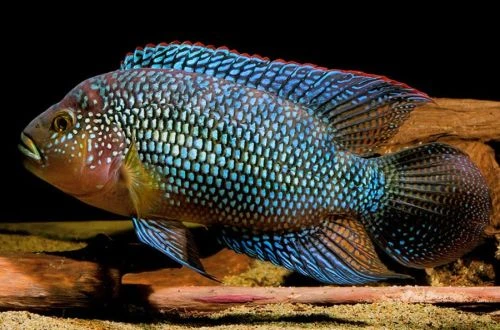
Other scientific names: Archocentrus octofasciatus, Cichlasoma biocellatum, Cichlasoma hedricki, Cichlasoma octofasciatus, Cichlosoma biocellatum, Heros octofasciatus
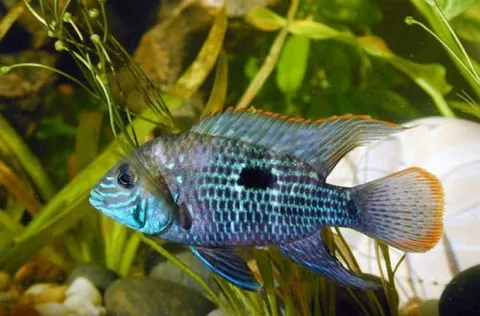
The scientific name Rocio octofasciata belongs to the Cichlidae family. In the world of aquarium enthusiasts, it is most commonly known as the Jack Dempsey Cichlid or the "Morning Dew" Cichlid. Another common name is the Eight-banded Cichlasoma. The first part of the name, "Jack Dempsey," was given to the fish in honor of the legendary American boxer, which is attributed to its feisty temperament and impressive appearance. The second part, "Rocio," which translates to "dew," is related to the unique speckled pattern on the fish's flanks.
Adult specimens of this fish can reach 20 cm in length. Their body is characterized by a stocky build, a strong head, and well-developed fins. Their coloration is dominated by turquoise and yellowish hues. There is also a blue variation of this cichlid, believed to have emerged as a result of ornamental selection from a natural mutation. Sexual dimorphism in these fish is not pronounced, making it difficult to distinguish males from females. One noticeable external feature that can help differentiate them is the pointed anal fin with a reddish fringe in males.
The natural habitat of this fish is Central America, predominantly the Atlantic coast, covering territory from Mexico to Honduras. It prefers the lower reaches of rivers that flow into the ocean, and is also found in artificial canals, lakes, and ponds. These cichlids can often be found in large irrigation ditches located near agricultural lands. Today, thanks to introduction, wild populations of Rocio octofasciata have spread across almost all continents, and they are even occasionally recorded in bodies of water in southern Russia.
This fish is distinguished by its belligerent and quarrelsome nature, displaying aggression towards both its own kind and other fish. Coexistence is only possible at a young age, after which they should be separated—either individually or in pairs (male/female). When kept in a community tank, it's recommended to choose tank mates that are significantly larger than the Jack Dempsey Cichlid, ideally about 1.5 times its size. Smaller fish are likely to become targets of aggression.
For a single pair of these cichlids, an aquarium of at least 250 liters is required. A sandy substrate is recommended, supplemented with large smooth stones and medium-sized driftwood. Lighting should be subdued. Live plants are welcome, but preference should be given to those that float at the surface, as rooted plants are likely to be uprooted by such active fish. Water parameters such as pH and dGH can have quite broad acceptable values, and the comfortable temperature also allows for significant variation, which simplifies water preparation. Nevertheless, the Jack Dempsey Cichlid shows high sensitivity to water quality. Missing a weekly tank cleaning is enough for the concentration of organic waste to exceed acceptable levels, which will inevitably negatively affect the fish's well-being.
This omnivorous species readily consumes a variety of high-quality foods, including dry, frozen, and live foods, as well as vegetable supplements. Specialized foods developed for Central American cichlids will be the optimal choice.
Breeding usually presents no difficulties. It is recommended to start with a group of young individuals, from which a stable pair will eventually form. Spawning occurs on a pre-cleaned substrate, such as a flat stone. The female lays up to 800 eggs, which are fertilized by the male. The incubation period lasts from 3 to 5 days, after which larvae appear. Both parents show pronounced care for their offspring: they guard the clutch and fry, and can also crush food for feeding the young. Artemia nauplii are used to feed the fry. It is important not to remove all offspring from the aquarium, as this can lead to a loss of parental instinct and outbreaks of aggression between partners.
The main cause of most diseases in these fish is unsuitable keeping conditions and poor-quality nutrition. If initial symptoms are observed, it is first necessary to check water parameters and the concentration of dangerous substances such as ammonia, nitrites, and nitrates. If the indicators deviate from the norm, they should be brought back into order, and only then should treatment begin.
When choosing a fish, pay attention to the individual's activity and appearance. Healthy specimens have bright coloration, clean fins without signs of damage, film, or ulcers. It is important to avoid fish with signs of emaciation, sunken bellies, or unnatural behavior, such as apathy or constantly staying at the water's surface. In the store, evaluate the conditions in the aquarium: water cleanliness and the absence of dead individuals nearby. Young fish often show shyness, but they should show interest in food. When purchasing, it is recommended to clarify the conditions in which the fish were kept to minimize stress during relocation.
The essentials: size, tank volume, water parameters and care
An adult reaches 15–20 cm in length. Plan the tank around the maximum size: the fish quickly outgrows a cramped setup.
The recommended volume is 250 L. A smaller tank speeds up nitrate build-up and raises stress levels.
Temperature 20–30 °C, pH 6.5–8, hardness 5–21 dGH. Stability matters more than exact values: sudden swings are harder on the fish than a small deviation from the ideal.
Around 10 years when kept properly. Lifespan depends directly on tank volume, water quality and a varied diet.
Temperament: aggressive / incompatible / unfriendly. Keep this in mind when choosing tank mates.
Recommended setup: pair (male/female). Ignoring this is a common cause of stress and disease.
Diet type: meat / protein (live, frozen, fresh). Feed small portions that are finished within a couple of minutes — overfeeding does more harm than underfeeding.
The scientific name of the species is Rocio octofasciata, family Cichlids (Cichlidae). It also appears in the literature as: Archocentrus octofasciatus, Cichlasoma biocellatum, Cichlasoma hedricki.
Matched by family, categories and overlapping keeping conditions
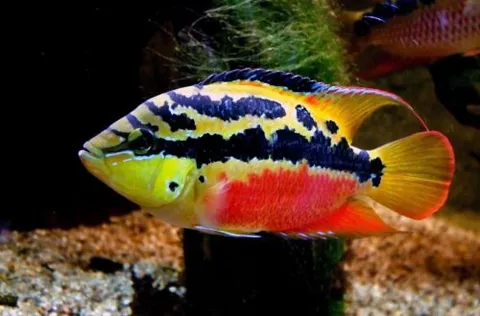
Trichromis salvini
Trichromis salvini, or Salvin's Cichlid, belongs to the family Cichlidae. Previously, this species was known as Cichlasoma salvini, before the classification was revised. It is characterized by a complex temperament and…
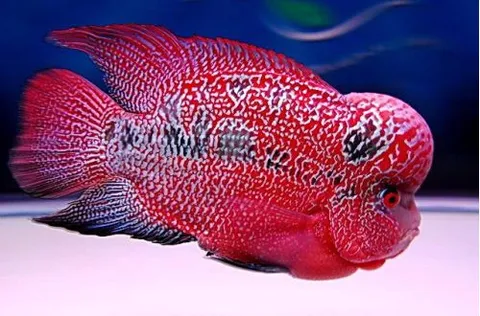
Amphilophus hybrid
The Cichlidae family includes a remarkable representative — the Flowerhorn, also known as the Flowerhorn Cichlid. This fish stands out for its vibrant coloration and unusual shape, making it an excellent choice for…
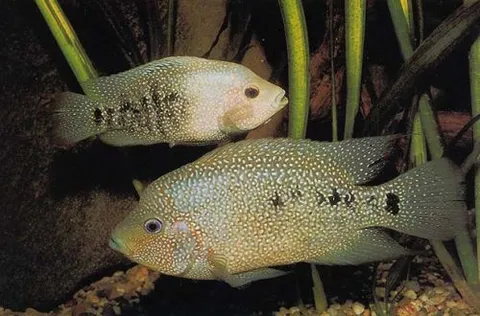
Herichthys cyanoguttatus
Herichthys cyanoguttatus, known as the diamond cichlid, belongs to the family Cichlidae. It is an energetic and temperamental fish, exhibiting complex behaviors, especially concerning parental care. Keeping this species…
Andinoacara rivulatus
Andinoacara rivulatus, more commonly known as the Turquoise Acara, belongs to the Cichlidae family. This large and strikingly beautiful fish, however, is characterized by pronounced aggression and requires keeping in a…