Temperature20 – 26 °C
Natural range
- Yucatán Peninsula area
- Mexico area
- Guatemala area
CichlidsConservation status: Least concern LC
Other scientific names: Cichlasoma hyorhynchum, Cichlasoma meeki, Herichthys meeki, Thorichthys helleri
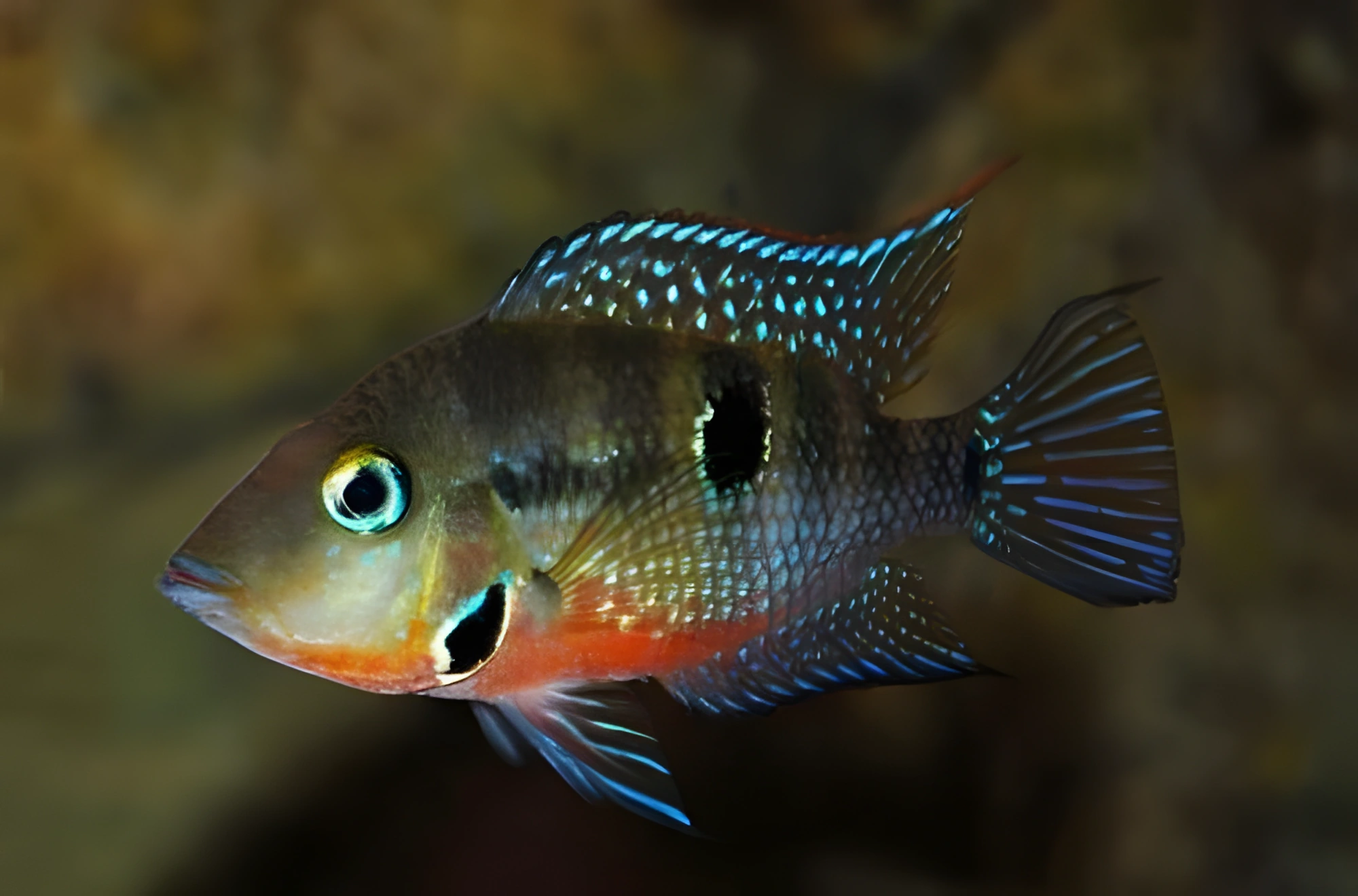
Thorichthys meeki, also known as the Firemouth Cichlid, bears the scientific name Thorichthys meeki and belongs to the family Cichlidae. This species attracts the attention of aquarists, especially American cichlid enthusiasts, due to its original and expressive coloration. The fish is characterized by a rather peaceful disposition and undemanding care, which allows it to be successfully kept both in a species-specific tank and in a community with other suitable species. It was named in honor of Seth Eugene Meek, an American ichthyologist who authored the first work dedicated to the fish of Mexico.
- Required aquarium volume
- 200 L
- Size in aquarium
- 12 cm
- Temperature
- 20 – 26 °C
- Temperament
- Semi-peaceful (including aggression during spawning / intraspecific conflicts)
Parameters
Water pHNeutral (7) – Slightly alkaline (8.5)
Water dHMedium hardness (8) – Medium hardness (10)
Water salinityincreased (10–15 g/L)
Size in aquarium12 cm
Lifespan10 years
TemperamentSemi-peaceful (including aggression during spawning / intraspecific conflicts)
Toward small fishnot a predator
Required aquarium volume200 L
Lightingmoderate (regular)
Substratesandy (regular, light)
Water flowmoderate
FeedingAny (universal)
CareMixed (solitary / pair / group)
Description
This is a fish with a high, slightly elongated body and a noticeable, large head. In males, the dorsal and anal fins appear elongated and pointed. The coloration is characterized by blue tones, with several dark spots located in the center of the body, as well as indistinct transverse stripes. A notable feature is the bright red coloration of the lower part of the body.
Habitat
The natural habitat of this species covers the Yucatán Peninsula, located in modern-day Mexico and Guatemala. Thorichthys meeki inhabits lowland rivers with moderate currents, preferring shallow waters no deeper than 1.5 meters. This fish is adapted to changes in water conditions, easily tolerating water turbidity and brackishness. Thanks to this resilience, it can be found in deltaic areas of rivers and small lagoons formed at the boundary where fresh and salty Atlantic waters mix.
Behavior and Compatibility
These fish prefer to stay in groups, but keeping them in pairs is also possible. Thorichthys meeki is a monogamous and territorial species, actively guarding its space and offspring. During the breeding season, its behavior becomes more aggressive, and it may attack other tank inhabitants. Therefore, in small aquariums, it is not recommended to introduce other fish of similar size. In general, the compatibility of this species with many fish is good, provided they are large enough not to be accidentally eaten.
Care and Maintenance
For keeping a single pair of adult fish, an aquarium of at least 200 L will be required. In terms of decor, preference is given to robust plants with strong root systems. Various shelters are an essential design element. In addition to traditional decorations such as castles or sunken ships, ceramic flower pots or sections of plastic pipes can be used, which can look quite organic in some aquarium compositions. Snags, tree branches, and intertwined roots will not only enrich the interior but also serve as excellent substrates for algae growth, which is a valuable natural food source. For the substrate, coarse sand supplemented with several smooth boulders is recommended. Although the fish can adapt to a wide range of pH values, soft water with a neutral reaction is preferred. 15–20% of the water volume should be replaced weekly. Detailed information on water parameters and methods for their regulation can be found in the “Hydrochemical composition of water” section. The standard equipment set for keeping includes a filtration system, lighting, a heater, and aeration.
Diet
In natural conditions, Thorichthys meeki feeds on various small crustaceans and plant detritus, often sifting through the substrate with its mouth to find food. In aquarium conditions, these fish readily accept any high-quality commercial foods, such as pellets and flakes. Their diet can also be diversified with live foods: Daphnia, mosquito larvae, small earthworms, and bloodworms. It is very important to supplement their diet with plant-based additives or ensure they are already present in the composition of dry food.
Breeding and Reproduction
Successful breeding of this species is possible with strict adherence to a proper diet, which, in addition to dry food, should include meaty products, as well as maintaining high water quality. The male and female form a stable pair, laying eggs on a flat surface, such as a stone or even the aquarium glass. The male then fertilizes the eggs by moving along the clutch. The total number of eggs laid can reach several hundred. During the incubation period, the female remains near the clutch, protecting it from potential threats, while the male patrols the entire territory. After hatching, which usually occurs after 4–5 days, the fry begin to swim freely. The parents continue to protect the offspring for several more weeks, after which it is advisable to transfer the fry to a separate aquarium. Interestingly, young individuals of this species can sometimes eat their first brood.
Diseases
This species is quite hardy, and health problems usually only arise with significant deterioration of living conditions, insufficient or poor-quality nutrition, or contact with infected fish. More detailed information on disease symptoms and treatment methods can be found in the "Aquarium Fish Diseases" section.
How to choose
When selecting individuals, pay attention to their activity and the cleanliness of their skin. Healthy fish show curiosity, have bright coloration without spots, films, or fin damage, and actively respond to food. Avoid specimens with signs of emaciation, sunken bellies, or unnaturally bloated abdomens, which may indicate internal diseases.
- Examine the condition of the eyes: they should be clear, without cloudiness or opacities.
- Observe their behavior: the fish should not constantly hide in a corner or make chaotic movements.
- Check for the absence of visible parasites on the body and gill covers, which should lie flat against the body when calm.
Frequently asked questions
The essentials: size, tank volume, water parameters and care
How big does Thorichthys meeki get?
An adult reaches 12 cm in length. Plan the tank around the maximum size: the fish quickly outgrows a cramped setup.
What size aquarium does Thorichthys meeki need?
The minimum recommended volume is 200 L. A smaller tank speeds up nitrate build-up and raises stress levels.
What water parameters does Thorichthys meeki need?
Temperature 20–26 °C, pH 7–8.5, hardness 8–10 dGH. Stability matters more than exact values: sudden swings are harder on the fish than a small deviation from the ideal.
How long does Thorichthys meeki live?
Around 10 years when kept properly. Lifespan depends directly on tank volume, water quality and a varied diet.
Is Thorichthys meeki aggressive?
Temperament: semi-peaceful (including aggression during spawning / intraspecific conflicts). Keep this in mind when choosing tank mates.
How many Thorichthys meeki should be kept together?
Recommended setup: mixed (solitary / pair / group). Ignoring this is a common cause of stress and disease.
What does Thorichthys meeki eat?
Diet type: any (universal). Feed small portions that are finished within a couple of minutes — overfeeding does more harm than underfeeding.
What is the scientific name of Thorichthys meeki?
The scientific name of the species is Thorichthys meeki, family Cichlids (Cichlidae). It also appears in the literature as: Cichlasoma hyorhynchum, Cichlasoma meeki, Herichthys meeki.