Temperature18 – 22 °C
GoldfishConservation status: Least concern LC
Other scientific names: Carasius auratus, Carassius buergeri, Carassius burgeri, Carassius carassius, Carassius chinensis, Carassius coeruleus
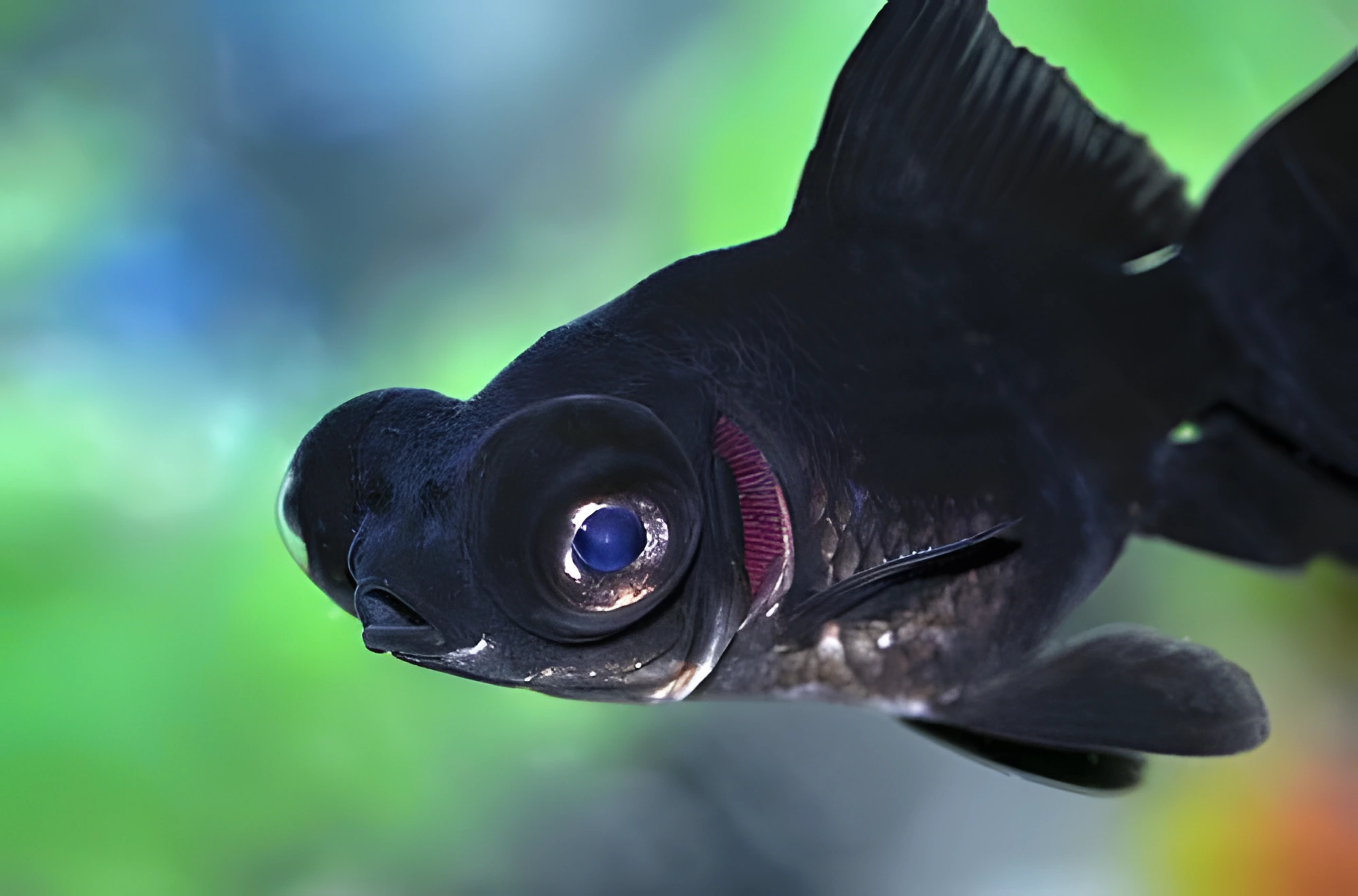
Among the varieties of Telescope Goldfish, the Black Moor stands out, known as the Black Moor Goldfish. This fish is easily recognized by its short, rounded or egg-shaped body and characteristic large eyes that noticeably protrude from the sides of its head. Its fins, long and flowing, often resemble a butterfly, although veil-tailed forms can occasionally be found. Interestingly, young individuals initially have a dark bronze coloration and do not yet possess protruding eyes. Over time, their color changes, acquiring a rich velvety-black hue. However, it is worth remembering that this expressive coloration is not always retained in adult fish, especially if they are over 13-15 years old or if keeping conditions, such as temperature, are not optimal. For example, in water that is too warm, the Black Moor Goldfish may lose its deep color and become gray.
- Required aquarium volume
- 40 L
- Size in aquarium
- 10 cm
- Temperature
- 18 – 22 °C
- Temperament
- Peaceful (regular)
Parameters
Water pHSlightly acidic (6) – Slightly alkaline (8)
Water dHSoft (5) – Very hard (19)
Water salinityno salt (freshwater)
Size in aquarium10 cm
Lifespan15 years
TemperamentPeaceful (regular)
Toward small fishnot a predator
Required aquarium volume40 L
Lightingmoderate (regular)
Substrateany (no restrictions)
Water flownone or stagnant (no flow)
FeedingAny (universal)
CarePair (male/female)
Description
The Black Moor Goldfish is a selective breeding form of goldfish with a characteristic egg-shaped body and long, often veil-like fins. The main feature of the species is its large, protruding telescopic eyes, which develop as it matures. The coloration is velvety black, sometimes with a bluish or bronze tint. Adult specimens reach 15–20 cm in length. Sexual differences become noticeable during spawning: males develop small white tubercles on their gill covers and pectoral fins, while females appear more rounded.
Habitat
This species is not found in the wild, as it is the result of centuries of selective breeding, originating from the goldfish (Carassius auratus). In natural conditions, the ancestors of goldfish inhabit freshwater bodies in Asia. In an aquarium environment, Telescope Goldfish are adapted to cool water, but require stable parameters without sharp temperature fluctuations.
Behavior and Compatibility
These are peaceful and slow-moving fish, prone to calm swimming. Due to the specific structure of their eyes, their vision is severely limited, making them vulnerable and slow when searching for food. It is recommended to keep them in species-specific tanks or with other slow-moving goldfish varieties. Active or aggressive fish that might snatch food or damage their sensitive eyes should not be housed with them.
Care and Maintenance
A spacious aquarium with effective filtration is required for keeping these fish, as they produce a lot of organic waste. The decor should exclude sharp stones, driftwood, and decorations that could damage the fish's eyes or fins. Recommended water parameters: temperature 18–22 °C, pH 6.0–8.0, hardness 5–19 dGH. It is better to use plants with tough leaves, as the fish may nibble on them or uproot them.
Diet
Omnivorous fish that require a varied diet. The basis of their diet should be high-quality dry foods in the form of sinking pellets, as telescopes have difficulty collecting food from the surface due to their poor eyesight. The diet must be supplemented with plant-based foods, such as blanched lettuce leaves or peas, as well as live or frozen foods. It is important to avoid overfeeding to prevent digestive system diseases.
Breeding and Reproduction
Breeding is possible in a separate spawning tank with a large number of fine-leaved plants. A gradual increase in water temperature to 20–24 °C and frequent water changes serve as a stimulus for spawning. After spawning, the parents should be removed to prevent them from eating the eggs. Fry are fed specialized starter foods, Artemia nauplii, or "infusoria."
Diseases
These fish are susceptible to diseases caused by poor water quality, including bacterial infections and eye damage. Due to their body structure, swim bladder problems, manifested by impaired coordination, are common. Prevention involves regular water changes, maintaining substrate cleanliness, and a balanced diet that prevents air swallowing during feeding.
How to choose
When purchasing, choose active individuals with clean fins and symmetrical, undamaged eyes. Avoid fish with signs of lethargy, film on the body, or an unnaturally bloated abdomen. It is important to ensure that the fish's eyes do not have cloudy spots or mechanical damage, as they are extremely sensitive and heal poorly.
Frequently asked questions
The essentials: size, tank volume, water parameters and care
How big does Black Moor Goldfish get?
An adult reaches 10 cm in length. Plan the tank around the maximum size: the fish quickly outgrows a cramped setup.
What size aquarium does Black Moor Goldfish need?
The minimum recommended volume is 40 L. A smaller tank speeds up nitrate build-up and raises stress levels.
What water parameters does Black Moor Goldfish need?
Temperature 18–22 °C, pH 6–8, hardness 5–19 dGH. Stability matters more than exact values: sudden swings are harder on the fish than a small deviation from the ideal.
How long does Black Moor Goldfish live?
Around 15 years when kept properly. Lifespan depends directly on tank volume, water quality and a varied diet.
Is Black Moor Goldfish aggressive?
Temperament: peaceful (regular). Keep this in mind when choosing tank mates.
How many Black Moor Goldfish should be kept together?
Recommended setup: pair (male/female). Ignoring this is a common cause of stress and disease.
What does Black Moor Goldfish eat?
Diet type: any (universal). Feed small portions that are finished within a couple of minutes — overfeeding does more harm than underfeeding.
What is the scientific name of Black Moor Goldfish?
The scientific name of the species is Carassius auratus, family Cyprinids (Cyprinidae). It also appears in the literature as: Carasius auratus, Carassius buergeri, Carassius burgeri.