Temperature21 – 26 °C
Natural range
- Central America area
- South America area
LivebearersConservation status: Least concern LC
Other scientific names: Gambusia modesta, Gambusia plumbea, Lembesseia parvianalis, Mollienesia altissima, Mollienesia macrura, Mollienesia pallida
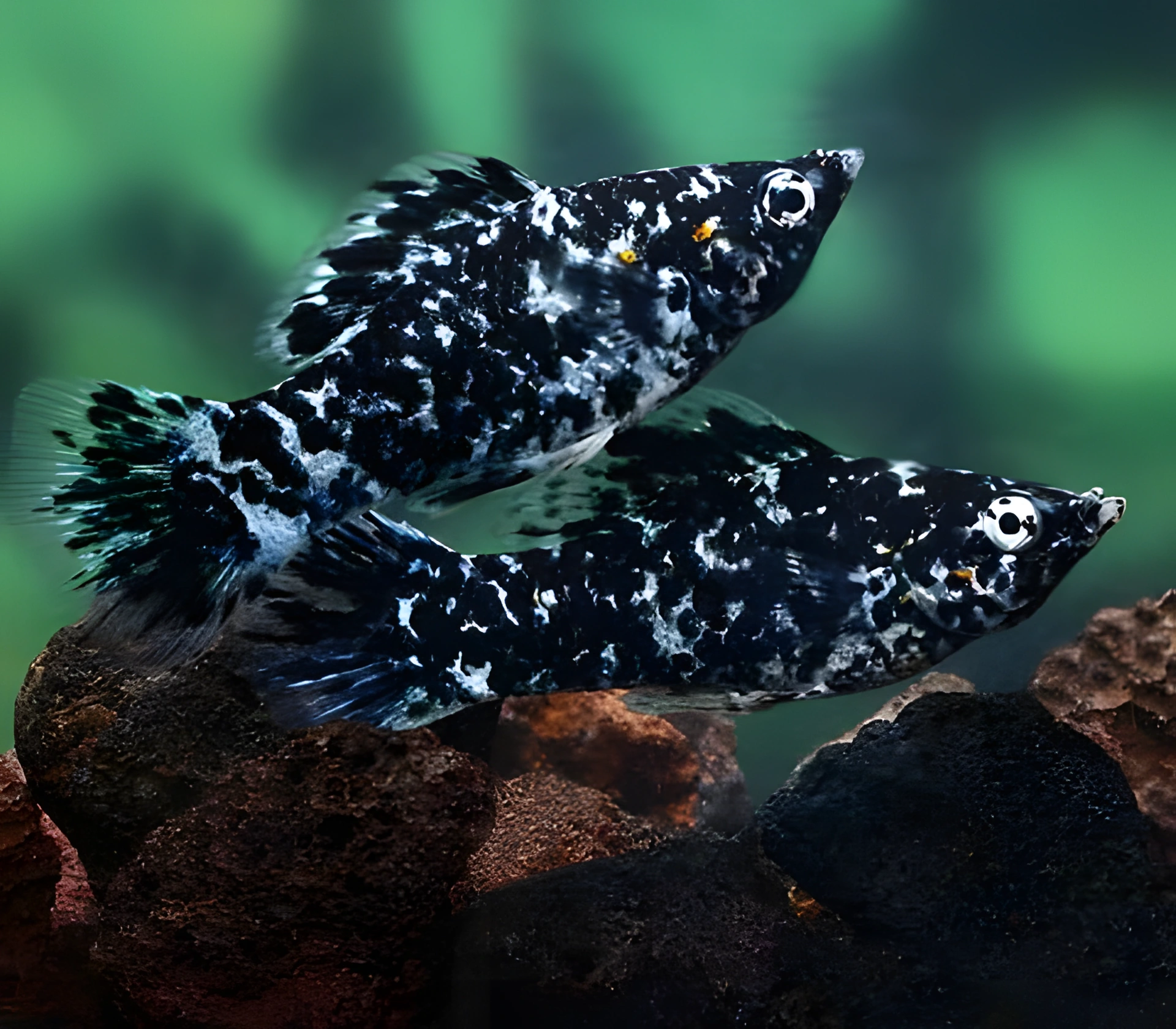
The collective term “black and white molly” usually refers to several selective breeding forms, distinguished by their characteristic body coloration, where white and black tones predominate. Examples of such forms include the Dalmatian Molly and the Marble Molly.
- Required aquarium volume
- 150 L
- Size in aquarium
- 12 – 18 cm
- Temperature
- 21 – 26 °C
- Temperament
- Peaceful (regular)
Parameters
Water pHNeutral (7) – Slightly alkaline (8.5)
Water dHMedium hardness (11) – Very hard (30)
Water salinitymoderate (5–10 g/L)
Size in aquarium12 – 18 cm
Lifespan3 years
TemperamentPeaceful (regular)
Toward small fishnot a predator
Required aquarium volume150 L
Lightingany
Substrateany (no restrictions)
Water flowweak
FeedingMixed diet (meat + plant-based)
CareMixed (solitary / pair / group)
Description
The Black and White Molly is a selectively bred form of Poecilia sphenops, featuring a contrasting coloration that combines black and white areas. The fish has a dense, elongated body, compressed laterally, with a rounded or lyre-shaped caudal fin. Males are smaller and possess a gonopodium—a modified anal fin that serves as an organ for internal fertilization. Females are noticeably larger, more robust, with a more rounded abdomen.
Habitat
The wild species Poecilia sphenops inhabits freshwater and brackish waters of Central and South America, including river estuaries and coastal lagoons. In their natural environment, these fish are adapted to hard, alkaline water. In a home aquarium, maintaining stable water parameters is critically important for them, as selectively bred forms are more sensitive to environmental quality than their wild ancestors.
Behavior and Compatibility
When choosing tank mates, preference should be given to non-aggressive, peaceful species that can comfortably live in similar conditions. Examples include other livebearers, such as guppies, swordtails, and platies. Within a group of Mollies, males often compete for the attention of females. If the aquarium is small, it is recommended to form a group with a predominance of females.
Care and Maintenance
Regardless of the specific species from which a particular breed with this coloration originated, there are no significant differences in their care requirements. The only distinction lies in the minimum aquarium size. For example, varieties derived from Poecilia sphenops will be content with a tank volume of 80 to 100 liters. At the same time, descendants of Poecilia velifera will require an aquarium of at least 150 liters for a group of 3–4 individuals, as these fish can reach lengths of up to 18 cm. In general, favorable conditions for all these fish include an aquarium with warm water, characterized by a slightly alkaline reaction and high general hardness. It is desirable to have areas densely planted with aquatic plants. Plants not only serve as hiding places but also provide an additional food source. Brief information: otherwise, an aquarium with warm, slightly alkaline water with high general hardness is considered a favorable habitat.
Diet
The diet of Mollies must include plant components. If the food offered does not fully satisfy their nutritional needs, the fish are very likely to start damaging aquarium plants. The optimal choice is specialized foods developed for this species and offered by many manufacturers. Such foods are usually available in popular forms, such as flakes or pellets. Aqvium flake food for aquarium fish. Evaluate our new product, which has become a bestseller on Ozon with a rating of 4.9. Flake food is suitable for most aquarium fish. The raw material is manufactured according to new European Union standards (EU 2018/848). Contains vitamins A, C, D3, E, and Omega 3-6. Buy on Ozon.
Breeding and Reproduction
In suitable environmental conditions and with a balanced diet, these fish regularly produce offspring. Each new generation can appear every one to two months. Mollies give birth to fully formed fry, bypassing the egg-laying stage. However, they lack developed parental instincts, so the young often become easy prey for adult fish. If the goal is to save the entire brood, the fry will need to be moved to a separate tank.
Diseases
The species is prone to diseases if care conditions are violated, especially with low hardness and temperature values. Ichthyophthiriasis (white spots on the body), fungal infections (saprolegniasis), and fin rot are common. Prevention includes maintaining stable water hardness, regular weekly water changes of 25% of the volume, and monitoring for sudden temperature fluctuations. If signs of illness appear, adding aquarium salt at a concentration of 1–3 g/L is permissible.
How to choose
When choosing, pay attention to the fish's activity: healthy individuals are mobile, have no visible fin damage, ulcers, or plaque on their scales. Avoid fish with clamped fins, rapid breathing, or an unnaturally bloated abdomen. It is important to inspect the aquarium in the store for dead individuals, as this indicates poor keeping conditions or infections. It is recommended to purchase individuals from the same group to minimize stress during adaptation.
Frequently asked questions
The essentials: size, tank volume, water parameters and care
How big does Black and White Molly get?
An adult reaches 12–18 cm in length. Plan the tank around the maximum size: the fish quickly outgrows a cramped setup.
What size aquarium does Black and White Molly need?
The minimum recommended volume is 150 L. A smaller tank speeds up nitrate build-up and raises stress levels.
What water parameters does Black and White Molly need?
Temperature 21–26 °C, pH 7–8.5, hardness 11–30 dGH. Stability matters more than exact values: sudden swings are harder on the fish than a small deviation from the ideal.
How long does Black and White Molly live?
Around 3 years when kept properly. Lifespan depends directly on tank volume, water quality and a varied diet.
Is Black and White Molly aggressive?
Temperament: peaceful (regular). Keep this in mind when choosing tank mates.
How many Black and White Molly should be kept together?
Recommended setup: mixed (solitary / pair / group). Ignoring this is a common cause of stress and disease.
What does Black and White Molly eat?
Diet type: mixed diet (meat + plant-based). Feed small portions that are finished within a couple of minutes — overfeeding does more harm than underfeeding.
What is the scientific name of Black and White Molly?
The scientific name of the species is Poecilia sphenops, family Poeciliidae. It also appears in the literature as: Gambusia modesta, Gambusia plumbea, Lembesseia parvianalis.