Temperature22 – 26 °C
Natural range
- Paraguay River Basin
- Guaporé River
- Paraguay area
- Brazil area
CharacinsConservation status: Least concern LC
Other scientific names: Gymnocothymbus ternetzii, Tetragonopterus ternetzi
The Black Tetra, also known as the Black Skirt Tetra or Black Widow Tetra, has the scientific name Gymnocorymbus ternetzi and belongs to the Characidae family. This fish is an excellent choice for beginner aquarists due to its high hardiness, low maintenance requirements, and ease of breeding in a home aquarium. In addition, the Black Tetra is attractive for its active behavior and rather interesting appearance.
- Required aquarium volume
- 60 L
- Size in aquarium
- 5 cm
- Temperature
- 22 – 26 °C
- Temperament
- Peaceful, active/mobile
Parameters
Water pHSlightly acidic (6) – Slightly alkaline (8)
Water dHSoft (5) – Very hard (19)
Water salinityno salt (freshwater)
Size in aquarium5 cm
Lifespan7 years
TemperamentPeaceful, active/mobile
Toward small fishnot a predator
Required aquarium volume60 L
Lightingdimmed
Substraterocky (rock formations, boulders, etc.)
Water flowweak
FeedingAny (universal)
CareSchooling (usually from 5–6 individuals and more)
Description
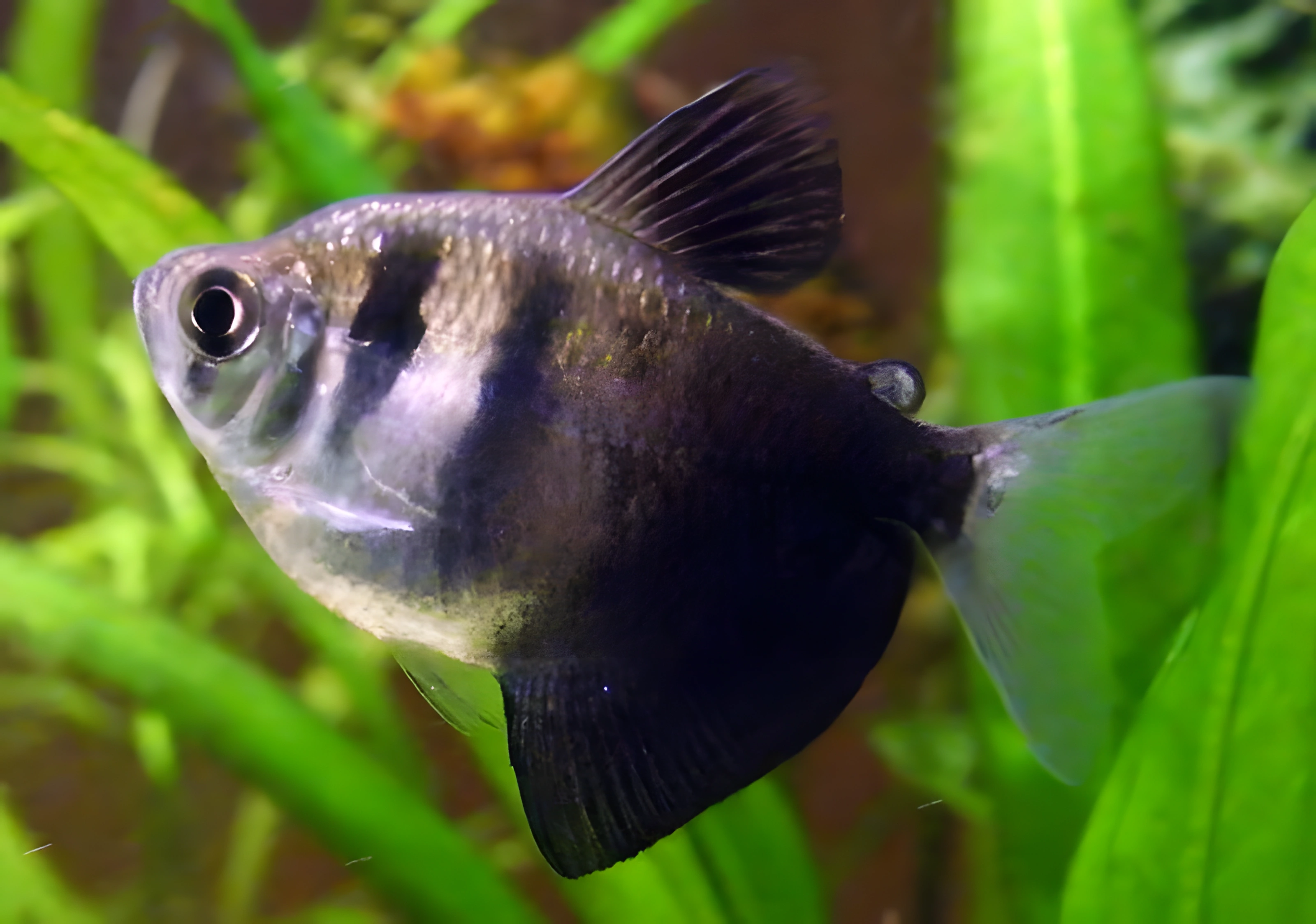
The Black Tetra has a high, laterally compressed body, and its size in an aquarium rarely exceeds 5.5 cm. Distinctive features include two clear vertical bands on the front part of the body, as well as large dorsal and anal fins. The size and shape of these fins resemble a lush skirt, which, combined with the fish's dark coloration, led to the name "Black Widow." With age, the Black Tetra's coloration usually becomes lighter.
Differences between male and female Black Tetras are evident in the shape and size of their fins. In males, the dorsal fin is more pointed, and the anal fin is uneven in height—it is longer near the belly and noticeably lower towards the tail. In females, the "skirt" (anal fin) is usually symmetrical, and they also have a larger abdomen.
Habitat
The Black Tetra was first described by Belgian zoologist Albert Boulenger in 1895. Its natural habitat is in South America, in the river basins of Paraguay and Brazil, such as the Guaporé. Here, the fish inhabits the upper layers of slow-moving waters, preferring small, shaded forest rivers and streams. The Black Tetra's diet in the wild consists of small worms, crustaceans, and insects.
Behavior and Compatibility
The Black Tetra is an active schooling species, so it is recommended to keep them in groups of at least 8 individuals. With fewer fish, they may become excessively timid. Their activity somewhat decreases with age. When choosing tank mates, select fish of similar size and temperament; it is strongly not recommended to house Black Tetras with smaller species.
Care and Maintenance
A key requirement for keeping Black Tetras is ensuring water purity. An efficient filter and regular water changes (25%-50% of the volume every two weeks) successfully handle this task. Given that this fish prefers subdued light, additional lighting may not be necessary if the aquarium is in a well-lit room. Otherwise, special lamps will be indispensable. In terms of aquarium decor, low-growing plants planted in groups are welcome; preference should be given to shade-loving species that thrive in low light. The bottom should ideally be covered with dark fine gravel or coarse sand, and driftwood, pieces of wood, and intertwined roots can be used as decorations.
Diet
Although in its natural environment the Black Tetra primarily feeds on high-protein food, in a home aquarium it readily accepts dry commercial foods such as flakes and granules. A wide range of specialized foods for Tetras is available on the market, enriched with all necessary elements, including freeze-dried products from crustaceans and zooplankton. For dietary variety, bloodworms or large daphnia can be offered periodically.
Breeding and Reproduction
Spawning of Black Tetras is preferably organized in a separate tank, as this species tends to eat its own fry. A 20-liter volume is sufficient for a breeding tank, with the water composition being identical to that of the main aquarium. Equipment required includes a filter, heater, air stone, and light source. The decor should include groups of low-growing plants and a sandy bottom. Spawning can begin at any moment, signaled by the female's enlarged abdomen, which indicates readiness for the pair to be moved to a separate tank. After some time, the female releases eggs into the water, and the male fertilizes them. The entire process occurs over plant thickets, where the eggs subsequently settle. If plants are planted in several groups, the pair may lay eggs in multiple areas. Upon completion of spawning, the adult fish are returned to the main aquarium. It is recommended to cover the breeding tank with a towel for a couple of days, during which the fry will hatch. At this point, lighting must be turned on, otherwise the fry will not be able to find food in dim light or darkness. Fry should be fed micro-foods or Artemia nauplii.
Diseases
When optimal keeping conditions are met, the risk of disease in Black Tetras is extremely low. However, under unfavorable conditions, they may be susceptible to typical diseases of tropical aquarium fish. Detailed information on symptoms and treatment methods can be found in the "Aquarium Fish Diseases" section.
How to choose
When choosing Black Tetras, prioritize active individuals with clean scales and undamaged fins. Avoid fish with signs of lethargy, white film on the body, ulcers, or an unnaturally swollen abdomen. Healthy Black Tetras should show curiosity, stay in a school, and react quickly to external stimuli.
It is important to note that artificially colored or genetically modified individuals are often found in stores. When purchasing such fish, it is recommended to carefully inspect them for any skin damage resulting from the coloring procedure. If possible, ask the seller about the keeping conditions and diet the fish are accustomed to, to minimize stress during their transfer to a new aquarium.
Frequently asked questions
The essentials: size, tank volume, water parameters and care
How big does Black Tetra get?
An adult reaches 5 cm in length. Plan the tank around the maximum size: the fish quickly outgrows a cramped setup.
What size aquarium does Black Tetra need?
The minimum recommended volume is 60 L. A smaller tank speeds up nitrate build-up and raises stress levels.
What water parameters does Black Tetra need?
Temperature 22–26 °C, pH 6–8, hardness 5–19 dGH. Stability matters more than exact values: sudden swings are harder on the fish than a small deviation from the ideal.
How long does Black Tetra live?
Around 7 years when kept properly. Lifespan depends directly on tank volume, water quality and a varied diet.
Is Black Tetra aggressive?
Temperament: peaceful, active/mobile. Keep this in mind when choosing tank mates.
How many Black Tetra should be kept together?
Recommended setup: schooling (usually from 5–6 individuals and more). Ignoring this is a common cause of stress and disease.
What does Black Tetra eat?
Diet type: any (universal). Feed small portions that are finished within a couple of minutes — overfeeding does more harm than underfeeding.
What is the scientific name of Black Tetra?
The scientific name of the species is Gymnocorymbus ternetzi, family Characidae. It also appears in the literature as: Gymnocothymbus ternetzii, Tetragonopterus ternetzi.