Temperature20 – 28 °C
Natural range
- Atlantic coast of Central and North America area
- Mexico area
- Guatemala area
- Southern United States
LivebearersConservation status: Data deficient DD
Other scientific names: Platypoecilus aurata, Platypoecilus cyanellus, Platypoecilus maculatus, Platypoecilus nigra, Platypoecilus pulchra, Platypoecilus rubra
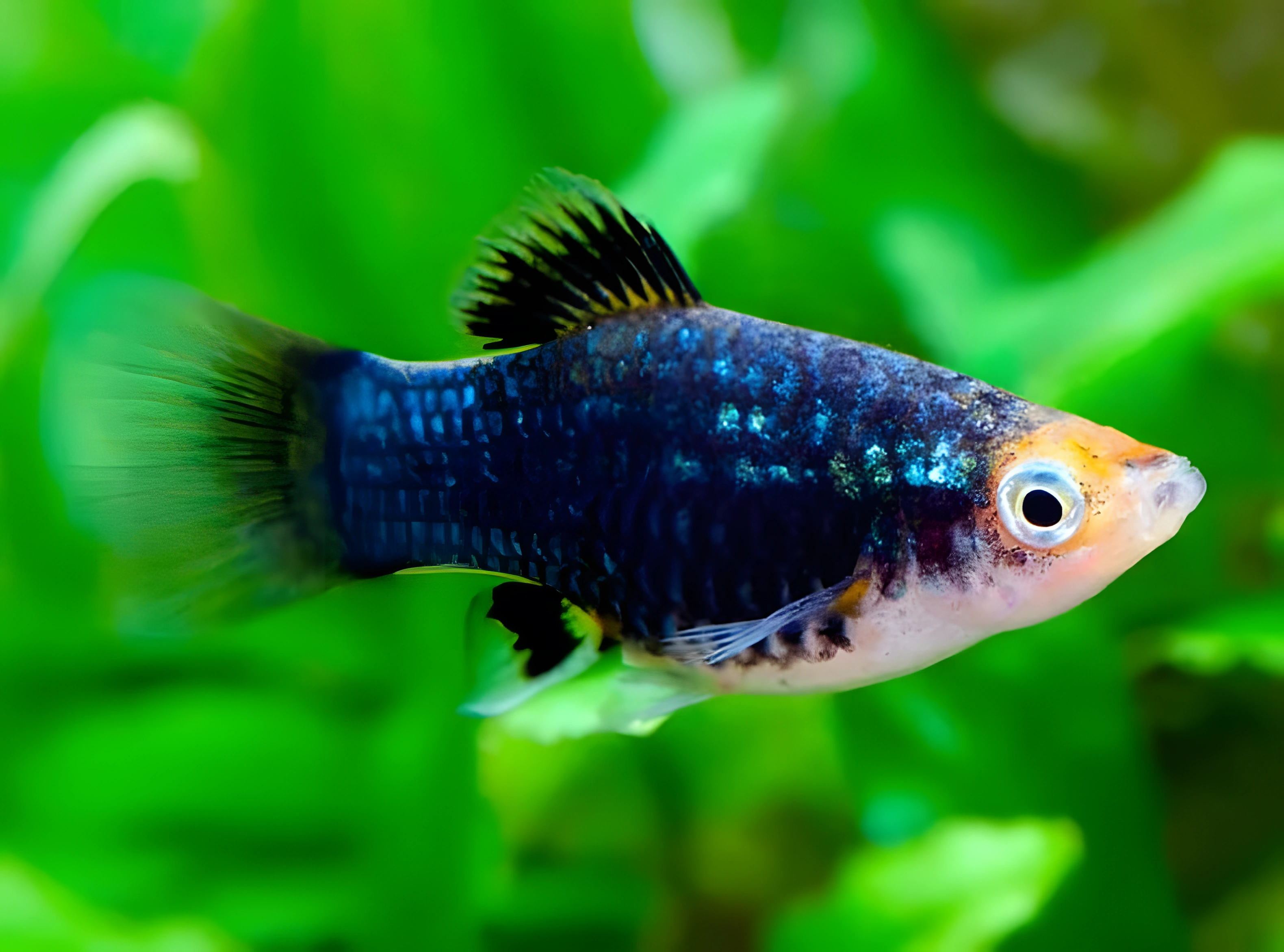
Platy Black is the trade name for this variety of Black Platy in the English-speaking market. This fish is not found in nature, as it is an artificially bred color variation derived from the common Platy (Xiphophorus maculatus). Despite its name, black, although dominant in coloration, does not cover the entire body surface; typically, the belly, head, tail, and fins are colored in lighter shades.
- Required aquarium volume
- 60 L
- Size in aquarium
- 5 – 7 cm
- Temperature
- 20 – 28 °C
- Temperament
- Peaceful (regular)
Parameters
Water pHNeutral (7) – Slightly alkaline (8.2)
Water dHMedium hardness (9) – Very hard (19)
Water salinityincreased (10–15 g/L)
Size in aquarium5 – 7 cm
Lifespan3 years
TemperamentPeaceful (regular)
Toward small fishnot a predator
Required aquarium volume60 L
Lightingweak (low)
Substrateany (no restrictions)
Water flowweak or moderate
FeedingAny (universal)
CareMixed (solitary / pair / group)
Description
The Black Platy is a selective breeding form characterized by a predominance of deep black pigment in its body coloration. These fish have a dense, shortened body and a wide caudal fin. Adult specimens reach 5–7 cm in length. Sexual dimorphism is pronounced: females are noticeably larger and more robust, while males are smaller, slimmer, and possess a specialized reproductive organ — the gonopodium, which is a modified anal fin.
Habitat
In nature, the species Xiphophorus maculatus inhabits the waters of the Atlantic coast of Central and North America, including Mexico, Guatemala, and the southern states of the USA. The fish prefer still or slow-moving waters: swamps, lagoons, and river lowlands, often with dense vegetation and silty bottoms. They can adapt to water with increased mineralization where rivers flow into the ocean.
Behavior and Compatibility
This is a peaceful and active species, suitable for community tanks. Platies prefer to stay in the middle and upper layers of the water. They coexist well with similarly sized, calm fish such as guppies, mollies, swordtails, and various characin species. Intraspecific aggression is virtually absent, but it is recommended to keep them in groups where the number of females outnumbers males.
Care and Maintenance
When keeping a group of 3–4 fish, optimal conditions can be provided in an aquarium of 50–60 liters, preferably with abundant vegetation. Dense thickets of aquatic plants provide females with shelter from excessive male attention, and also allow males to maintain some distance from each other, which helps reduce competition. Therefore, for small aquariums, it is recommended to form a "harem" type group, where there are several females per male. These fish prefer warm, slightly alkaline water with high carbonate hardness (KH). Maintaining water quality at the proper level, without excessive accumulation of organic waste, is achieved through continuous operation of the filtration system and regular aquarium maintenance. Regarding feeding, these fish accept most popular foods available in live, frozen, freeze-dried, and dry forms (flakes, pellets). It is advisable to include plant-based supplements in their diet, for example, spirulina flakes, or to use products that already contain such components. Foods specifically developed for Platies, offered by many well-known manufacturers, will be an excellent choice. If there is a deficiency of plant components in their diet, the fish may damage the soft parts of aquarium plants, compensating for this lack. Aqvium flake food for aquarium fish. Check out our new product, which has become a bestseller on Ozon with a rating of 4.9. Flake food is suitable for most aquarium fish. The raw material is produced in accordance with new European Union standards (EU 2018/848). Contains vitamins A, C, D3, E, and Omega 3-6. Buy on Ozon. Breeding / Reproduction. The Black Platy, like other representatives of its species, is characterized by active reproduction. An adult female can produce new offspring every 1–2 months. The egg stage is absent: fry are born fully formed. It is recommended to transfer the fry to a separate aquarium, as adult fish may exhibit predatory instincts towards them.
Diet
Platies are omnivorous and in nature feed on small insects, larvae, and algae. In aquarium conditions, the diet should be balanced and include both high-quality dry foods (flakes, pellets) and plant-based supplements. Regular presence of fiber is necessary for the normal functioning of the gastrointestinal tract. Periodic feeding with live or frozen foods such as Artemia, bloodworms, or Daphnia is welcome.
Breeding and Reproduction
The species is ovoviviparous, which greatly simplifies breeding. Fertilization occurs inside the female's body, after which she carries the fry for 4–6 weeks. The fertility of one female can reach up to 80 fry per litter. To preserve the offspring, it is recommended to use a breeding tank with dense thickets of fine-leaved plants, where the fry can hide from their parents, who are prone to cannibalism.
Diseases
Platies have strong immunity but are sensitive to water quality and sudden parameter fluctuations. When kept in excessively soft water or with poor filtration, the fish become susceptible to bacterial infections and fin rot. Prevention includes weekly water changes, maintaining stable temperature, and using quality food. At the first signs of illness, a short-term increase in temperature and slight salting of the water sometimes helps.
How to choose
When purchasing, choose active fish with clean scales and intact fins. Healthy platies show interest in food and do not have signs of emaciation or a bloated abdomen (except for pregnant females). Avoid individuals with clamped fins, white film on the body, or unnatural spots. It is advisable to acquire fish from aquariums with conditions similar to those that will be in your tank.
Frequently asked questions
The essentials: size, tank volume, water parameters and care
How big does Black Platy get?
An adult reaches 5–7 cm in length. Plan the tank around the maximum size: the fish quickly outgrows a cramped setup.
What size aquarium does Black Platy need?
The minimum recommended volume is 60 L. A smaller tank speeds up nitrate build-up and raises stress levels.
What water parameters does Black Platy need?
Temperature 20–28 °C, pH 7–8.2, hardness 9–19 dGH. Stability matters more than exact values: sudden swings are harder on the fish than a small deviation from the ideal.
How long does Black Platy live?
Around 3 years when kept properly. Lifespan depends directly on tank volume, water quality and a varied diet.
Is Black Platy aggressive?
Temperament: peaceful (regular). Keep this in mind when choosing tank mates.
How many Black Platy should be kept together?
Recommended setup: mixed (solitary / pair / group). Ignoring this is a common cause of stress and disease.
What does Black Platy eat?
Diet type: any (universal). Feed small portions that are finished within a couple of minutes — overfeeding does more harm than underfeeding.
What is the scientific name of Black Platy?
The scientific name of the species is Xiphophorus maculatus, family Poeciliidae. It also appears in the literature as: Platypoecilus aurata, Platypoecilus cyanellus, Platypoecilus maculatus.