Temperature21 – 28 °C
Natural range
- Orinoco River Basin
- Rio Negro Basin
- Colombia area
- Venezuela area
CharacinsConservation status: Least concern LC
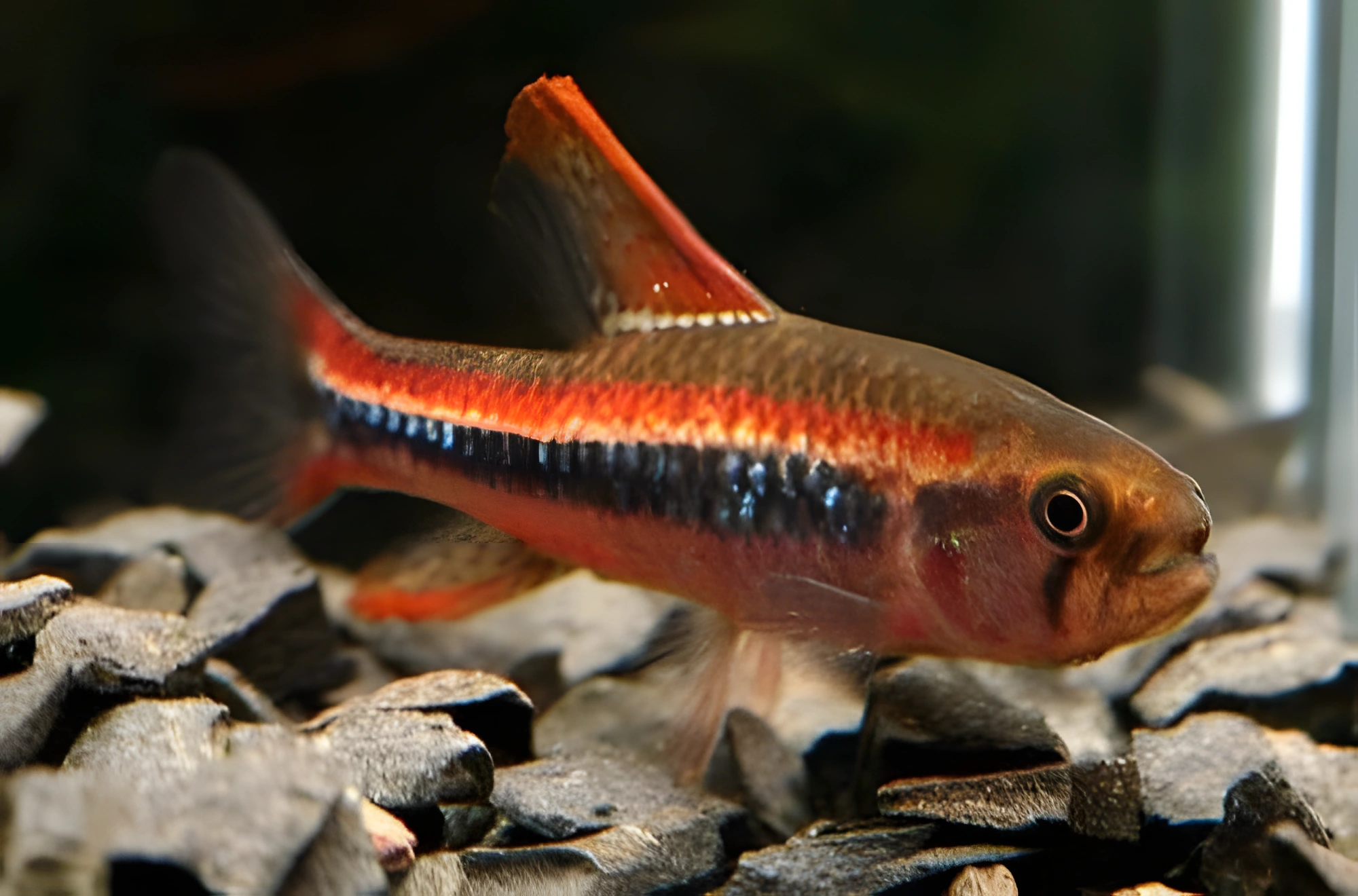
Poecilocharax weitzmani, also known as the Black Morpho Tetra or Weitzman's Pencilfish, belongs to the family Crenuchidae. It is rarely found in home aquariums due to its high level of care difficulty. This species is not recommended for beginner aquarists.
- Required aquarium volume
- 40 L
- Size in aquarium
- 4 – 5 cm
- Temperature
- 21 – 28 °C
- Temperament
- Semi-peaceful (including aggression during spawning / intraspecific conflicts)
Parameters
Water pHAcidic (3) – Neutral (6.5)
Water dHVery soft (0) – Soft (5)
Water salinityno salt (freshwater)
Size in aquarium4 – 5 cm
Lifespan5 years
TemperamentSemi-peaceful (including aggression during spawning / intraspecific conflicts)
Toward small fishnot a predator
Required aquarium volume40 L
Lightingdimmed
Substrateany (no restrictions)
Water flowweak
FeedingMeat / protein (live, frozen, fresh)
CareHarem (1 male and several females)
Description
Adults grow to 4–5 cm in length. Males are typically larger and more brightly colored than females, and also have more developed dorsal and anal fins. Body coloration varies from gray to red, with a characteristic broad black stripe running from the head to the tail. Transparent fins are adorned with a pattern of small dark speckles.
Habitat
These fish are native to South America. They inhabit several large river systems, such as the Orinoco and Rio Negro, in Colombia, Venezuela, Guyana, and the northern states of Brazil. They prefer slow-flowing channels and streams located under the dense canopy of tropical forests as their habitat. Their typical biotope is characterized by sandy-silty substrates covered with a thick layer of fallen leaves and numerous snags. The water in such places acquires a rich brown hue due to the abundance of decomposing plant organic matter. The combination of shade from trees and dark water creates very dim lighting.
Behavior and Compatibility
Males of this species exhibit territoriality and aggression towards each other; in confined spaces, rather fierce conflicts are inevitable. Females, on the other hand, are peaceful. In small tanks, it is preferable to keep only one pair (male/female) or a group consisting of a harem. These fish are compatible with other species of comparable size, but cohabitation with other territorial fish should be avoided. Due to its predatory nature, the Black Morpho Tetra can pose a threat to very small fish.
Care and Maintenance
For a pair of these fish, the ideal aquarium volume starts from 40–50 liters. Given their behavioral characteristics (which will be discussed later), if two or more males are kept, each requires a bottom area of at least 30 cm x 30 cm. To simplify calculations, you can use the following proportion: for one male – 40 liters, for two males – add another 40 liters to this volume, and so on. Aquarium decor includes soft sandy substrate, but fine gravel is also acceptable. It is desirable to place snags, imitating tree roots and branches, as well as shade-loving plants, aquatic mosses, or ferns. These decorative elements will serve as excellent hiding places. An important technique for recreating natural conditions is to add dried leaves of certain trees to the aquarium. As they decompose, they enrich the water with tannins, which is an integral part of the natural habitat for the Black Morpho Tetra, and also give the water a characteristic brown tint. Instead of leaves, specialized essences can be used: just a few drops of such products can replace a handful of leaves. The fish are sensitive to both the quality and hydrochemical composition of the water. Optimal conditions for them are created in very acidic and soft water. To maintain these low pH and dGH values, it is necessary to install a filter equipped with a filtering material capable of acidifying the water, as well as a reverse osmosis system to soften it. Regular aquarium maintenance plays a key role, as it prevents the accumulation of organic waste, which can provoke sharp fluctuations in the concentrations of nitrogen cycle products such as ammonia, nitrites, and nitrates.
Diet
This species is carnivorous. In the wild, its diet consists of aquatic insect larvae, small crustaceans, and worms. In a home aquarium, it is necessary to provide an appropriate diet, offering live or frozen foods such as Artemia, Daphnia, bloodworms, and similar items.
Breeding and Reproduction
Successful breeding attempts are infrequent, but with some experience, spawning can be achieved. Favorable conditions for spawning include soft, acidic water and a protein-rich diet. With the onset of the breeding season, the fish's coloration becomes more intense. The male chooses a suitable shelter that will become the spawning site. Experienced aquarists often use hollow PVC tubes, placing them among plants, which creates a kind of cave. The female usually lays 50 to 100 eggs, attaching them to the walls of the shelter. After spawning, the female leaves, and the male remains to guard the clutch throughout the incubation period, which lasts 4–5 days. During this time, he may well begin courting another partner. Fry should be moved to a separate aquarium with identical water parameters to prevent predation by adult fish. From the first days of life, they are able to accept micro-foods, such as Artemia nauplii.
Diseases
Specific diseases that manifest exclusively in this fish species have not been recorded. When proper keeping conditions are maintained — stable water quality, balanced nutrition, absence of conflicting tank mates — health problems usually do not arise. The main cause of diseases is the deterioration of conditions, which leads to a weakening of immunity, making the fish vulnerable to ubiquitous infections. If signs of illness such as lethargy, emaciation, refusal to eat, or clamped fins are observed, the basic water parameters should be checked immediately. Often, normalizing living conditions contributes to self-recovery. However, if the fish is severely weakened or has obvious injuries, medication may be required. More detailed information on symptoms and treatment methods can be found in the “Aquarium Fish Diseases” section.
How to choose
When selecting individuals, attention should be paid to their activity and skin cleanliness. A healthy fish should show curiosity, have no visible injuries, ulcers, white spots, or signs of emaciation. Avoid buying fish that appear sluggish, constantly lie on the bottom, or have unnaturally clamped fins. Given the territorial nature of males, they may show aggression towards each other in the store, which is normal, but the fish should not have torn fins or signs of serious fights. It is recommended to acquire individuals that are already adapted to captive conditions and accept offered food, as wild specimens can be sensitive to changes in water parameters and stress during transportation.
Frequently asked questions
The essentials: size, tank volume, water parameters and care
How big does Black Morpho Tetra get?
An adult reaches 4–5 cm in length. Plan the tank around the maximum size: the fish quickly outgrows a cramped setup.
What size aquarium does Black Morpho Tetra need?
The minimum recommended volume is 40 L. A smaller tank speeds up nitrate build-up and raises stress levels.
What water parameters does Black Morpho Tetra need?
Temperature 21–28 °C, pH 3–6.5, hardness 0–5 dGH. Stability matters more than exact values: sudden swings are harder on the fish than a small deviation from the ideal.
How long does Black Morpho Tetra live?
Around 5 years when kept properly. Lifespan depends directly on tank volume, water quality and a varied diet.
Is Black Morpho Tetra aggressive?
Temperament: semi-peaceful (including aggression during spawning / intraspecific conflicts). Keep this in mind when choosing tank mates.
How many Black Morpho Tetra should be kept together?
Recommended setup: harem (1 male and several females). Ignoring this is a common cause of stress and disease.
What does Black Morpho Tetra eat?
Diet type: meat / protein (live, frozen, fresh). Feed small portions that are finished within a couple of minutes — overfeeding does more harm than underfeeding.
What is the scientific name of Black Morpho Tetra?
The scientific name of the species is Poecilocharax weitzmani, family Crenuchidae.