Temperature20 – 26 °C
Natural range
- Amazon River Basin
- Orinoco River Basin
- Gulf of Paria area
- Guyana area
CatfishConservation status: Least concern LC
Other scientific names: Pimelodus clarias, Pseudorhamdia macronema, Pseudorhamdia piscatrix, Silurus clarias
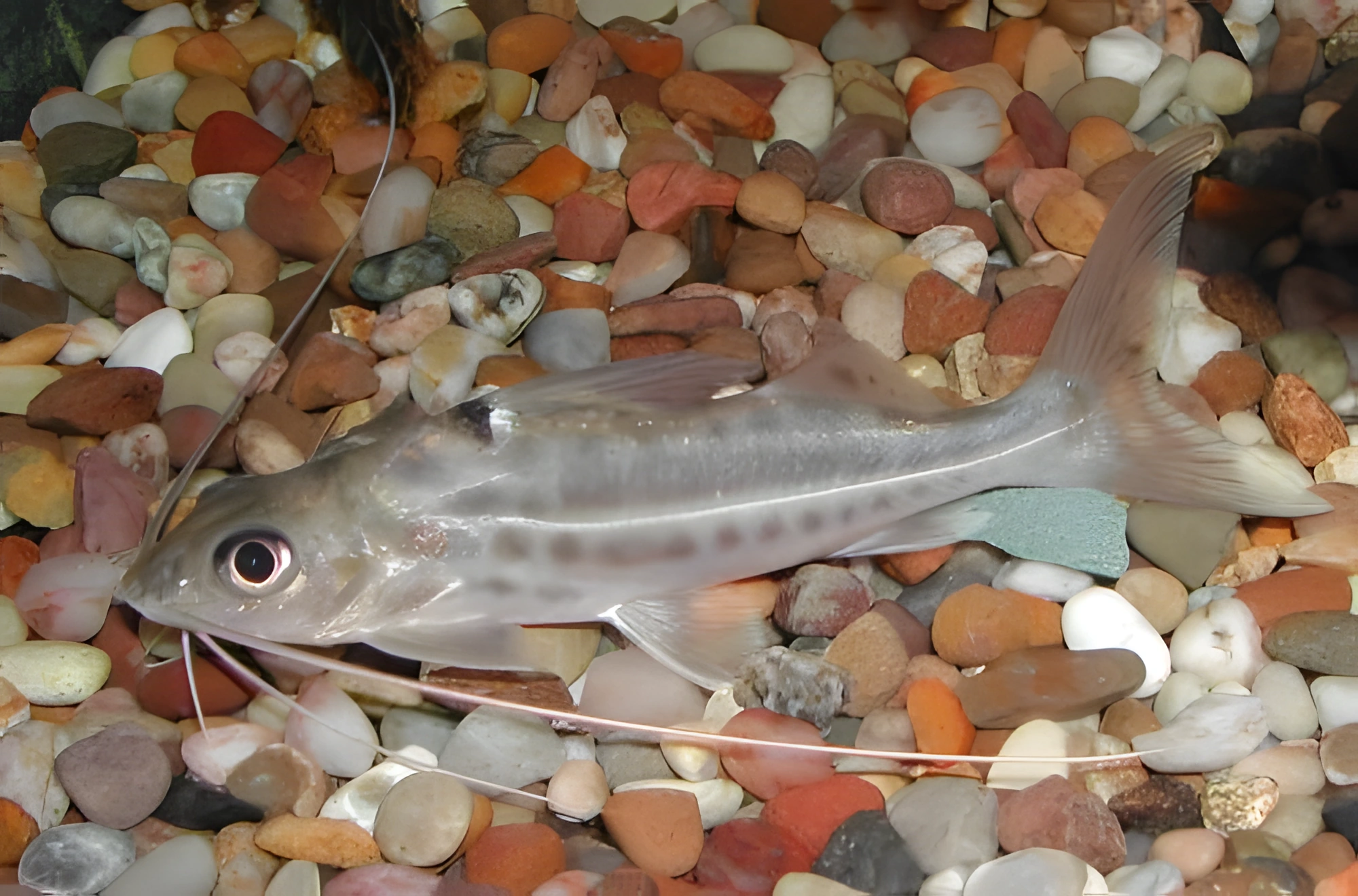
Pimelodus blochii, known as the four-banded pimelodus, belongs to the family Pimelodidae. This catfish species has many names in different countries; it has been given especially many names in Brazil, where it is most commonly found.
- Required aquarium volume
- 400 L
- Size in aquarium
- 35 cm
- Temperature
- 20 – 26 °C
- Temperament
- Peaceful (regular)
Parameters
Water pHSlightly acidic (6) – Neutral (7.5)
Water dHSoft (4) – Medium hardness (10)
Water salinitymarine/very high (over ~20 g/L)
Size in aquarium35 cm
Lifespan10 years
TemperamentPeaceful (regular)
Toward small fishnot a predator
Required aquarium volume400 L
Lightingdimmed or moderate
Substratesandy (regular, light)
Water flowmoderate or strong
FeedingAny (universal)
CareSmall group (5–6 individuals)
Description
In their natural habitat, they can reach 35 cm in length, but in aquarium conditions, their size rarely exceeds 20 cm. Their coloration is silvery-gray with four distinct dark gray bands. With age, these bands often become less pronounced. Like most catfish, their body is somewhat flattened from above, and the triangular pectoral fins are located parallel to the belly, gliding over the substrate surface like wings when moving. A distinctive feature is their long whisker-like barbels, which help the fish find food by exploring the surrounding environment. For a long time, it was believed that the dorsal fin ray was venomous, but subsequent studies disproved this assumption, confirming its safety for humans.
Habitat
These catfish are widely distributed in South and Central America, from Panama to Brazil. They can be found in the Amazon and Orinoco river systems, as well as in the Gulf of Paria and most of Guyana. The fish have adapted to living in both fresh and brackish waters, preferring areas with moderately fast currents. Living near the bottom, they feed on insects and small fish, but they also consume plant matter.
Behavior and Compatibility
This is a peaceful schooling fish; however, it is undesirable to keep them with very small species that could become food for them. Difficulties may also arise for slow-moving fish or those with large fins: in the dark, the catfish may constantly bump into them, feeling them with their barbels. The optimal option is to keep them in a group of 5–6 individuals.
Care and Maintenance
Keeping these catfish is relatively straightforward and does not require special effort. They prefer water with slight turbidity, similar to the bottom layers of the Amazon and its tributaries. Nevertheless, they adapt well to clear water, so there is no need to intentionally reduce visibility in the aquarium. It is recommended to change 10–15% of the water weekly, or 25% every two weeks. Given their size, catfish need a spacious aquarium of at least 400 L, providing ample room for swimming. It is important to provide hiding places made of driftwood or other decorative elements. Lighting should be moderate, with additional shading if floating plants are used. Smooth gravel or sand are the best substrates for these catfish, preventing damage to their barbels. Although water parameters can vary significantly, even substantial but gradual changes do not cause discomfort, which is related to the wide habitat range of wild catfish, including brackish waters. However, how prolonged exposure to hard water affects their health is not fully understood, so it is recommended to maintain optimal conditions.
Diet
The Four-banded Pimelodus is undemanding in its diet and readily consumes a variety of dry commercial foods. It is important that the food is sinking, as the fish are bottom-dwellers and will not seek food near the surface. Additionally, these catfish are typically fed at night.
Breeding and Reproduction
These fish do not breed in artificial aquarium environments. In the wild, spawning occurs once a year during the rainy season and lasts for a short period. Scientists believe that during reproduction, the catfish migrate upstream.
Diseases
No diseases have been observed under suitable keeping conditions. It is worth noting that these fish lack scales, which complicates the treatment of ichthyophthiriasis with conventional remedies. More detailed information on diseases can be found in the section "Diseases of Aquarium Fish".
How to choose
When selecting specimens, attention should be paid to the integrity of their long barbels, which are often damaged during transport or when kept in unsuitable conditions. A healthy fish should be active, have clean skin without plaque, spots, or visible damage, as the absence of scales makes the species vulnerable to infections. Avoid purchasing fish with signs of emaciation or sunken bellies, as well as those that appear apathetic and constantly lie on the bottom during daylight hours without attempting to move.
Frequently asked questions
The essentials: size, tank volume, water parameters and care
How big does Four-banded Pimelodus get?
An adult reaches 35 cm in length. Plan the tank around the maximum size: the fish quickly outgrows a cramped setup.
What size aquarium does Four-banded Pimelodus need?
The minimum recommended volume is 400 L. A smaller tank speeds up nitrate build-up and raises stress levels.
What water parameters does Four-banded Pimelodus need?
Temperature 20–26 °C, pH 6–7.5, hardness 4–10 dGH. Stability matters more than exact values: sudden swings are harder on the fish than a small deviation from the ideal.
How long does Four-banded Pimelodus live?
Around 10 years when kept properly. Lifespan depends directly on tank volume, water quality and a varied diet.
Is Four-banded Pimelodus aggressive?
Temperament: peaceful (regular). Keep this in mind when choosing tank mates.
How many Four-banded Pimelodus should be kept together?
Recommended setup: small group (5–6 individuals). Ignoring this is a common cause of stress and disease.
What does Four-banded Pimelodus eat?
Diet type: any (universal). Feed small portions that are finished within a couple of minutes — overfeeding does more harm than underfeeding.
What is the scientific name of Four-banded Pimelodus?
The scientific name of the species is Pimelodus blochii, family Pimelodidae (Long-whiskered Catfishes). It also appears in the literature as: Pimelodus clarias, Pseudorhamdia macronema, Pseudorhamdia piscatrix.