Temperature20 – 30 °C
Natural range
- Ivory Coast area
- Liberia area
- Ghana area
- West African coastal savannas area
KillifishConservation status: Least concern LC
Other scientific names: Aplocheilus dageti, Lycocyprinnus sexfasciatus, Lycocyprinus sexfasciatus, Poecilia sexfasciata
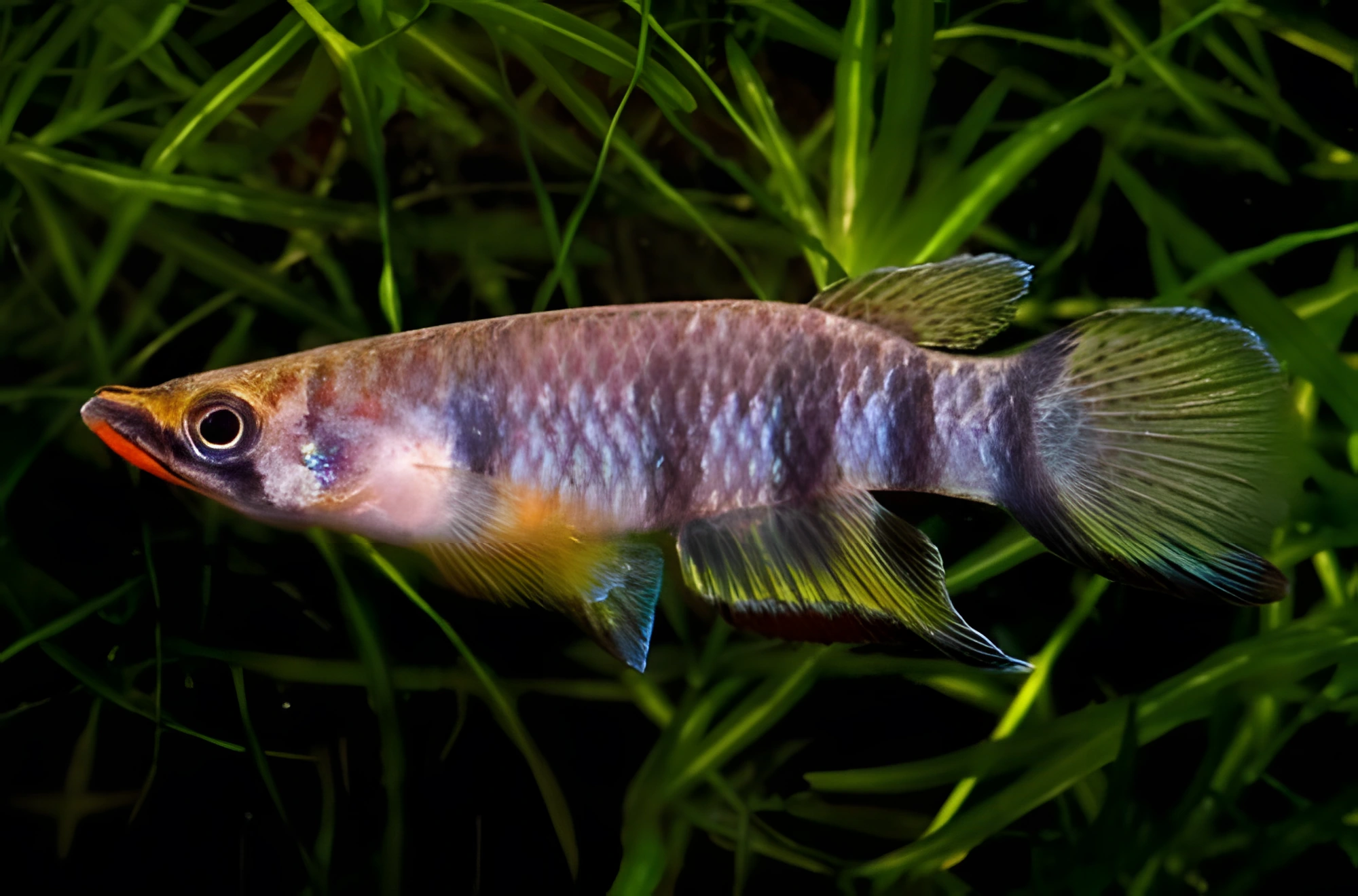
The Epiplatys dageti, also known as the Black-jaw Panchax, belongs to the family Nothobranchiidae. This peaceful and elegant fish is a perfect fit for a community aquarium. They are moderately hardy and undemanding, making them an excellent choice even for beginner aquarists. A distinctive feature of males is the characteristic red coloration of the lower part of the mouth, framed by a dark stripe.
- Required aquarium volume
- 60 L
- Size in aquarium
- 5 cm
- Temperature
- 20 – 30 °C
- Temperament
- Territorial (often aggressive)
Parameters
Water pHSlightly acidic (5) – Neutral (7)
Water dHVery soft (2) – Hard (12)
Water salinityvery low (up to ~3 g/L)
Size in aquarium5 cm
Lifespan4 years
TemperamentTerritorial (often aggressive)
Toward small fishnot a predator
Required aquarium volume60 L
Lightingdimmed
Substratesandy (regular, light)
Water flowweak or moderate
FeedingSinking (meat / protein)
CareMedium group (6–8 individuals)
Description
These small fish reach a length of only about 4.5 cm. Males are typically somewhat larger and have brighter coloration, with more opulent and expanded fins. A red mark with a dark border can be seen on their lower jaw. The fish's body is adorned with broad dark stripes against a primary pink background.
Habitat
This representative of the African continent originates from the famous region of the Ivory Coast. It is found in swampy areas of coastal savannas, as well as in brackish waters in modern-day Côte d'Ivoire, Liberia, and Ghana.
Behavior and Compatibility
This species is distinguished by its peaceful and calm disposition, making it an excellent addition to a community aquarium. The Black-jaw Panchax coexists well with some characins, cyprinids, killifish, and other species of comparable size and temperament. It is recommended to keep them in groups of 6 or more individuals, as they lack intraspecific competition, and males show friendliness towards each other even during spawning.
Care and Maintenance
To create optimal conditions in a home aquarium, it is recommended to recreate their natural biotope. This involves using roots, tree branches, and snags, as well as areas with rooted and floating plants. A sandy substrate, supplemented with dried leaves, will enrich the water with humic substances, which are formed during decomposition and are natural for the Black-jaw Panchax. Aquarium equipment should include a lighting system set to dim light, a heater, an aerator, and a filter. It is important to place the filter so that there is an obstacle in the path of the outgoing water flow, which will help weaken the internal current, as the fish prefer still waters and are sensitive to their movement. pH and dGH values should correspond to slightly acidic and soft values, respectively. When filling the aquarium and during subsequent partial water changes, these parameters must be artificially regulated, as tap water usually does not meet them. More detailed information on pH and dGH can be found in the "Water Hydrochemical Composition" section. Aquarium care includes weekly replacement of 10–15% of the water volume, periodic cleaning of the substrate from organic debris, and removal of algae from the glass as needed.
Diet
As a carnivorous species, in their natural habitat, Black-jaw Panchax feed on various terrestrial and aquatic invertebrates, as well as zooplankton. In a home aquarium, they readily accept dried, frozen, or live meaty foods of appropriate size, such as daphnia, bloodworms, or artemia. Mosquitoes and Drosophila flies can be included in their diet, but it is recommended to offer dry flakes with plant components beforehand to improve digestion and avoid constipation issues.
Breeding and Reproduction
The breeding period for these fish occurs regularly, and spawning can even happen in a community tank; however, the survival rate of the offspring in such conditions will be extremely low. Parents and other aquarium inhabitants pose a threat to the fry, and it is also difficult to provide sufficient food in a large volume. The best results are achieved in a separate spawning tank, the setup of which includes an abundance of plants such as Riccia and Java moss. Equipment for such an aquarium includes a simple sponge filter, a heater, and a low-wattage lamp. The water parameters in the spawning tank should be completely identical to the water in the main aquarium. When the female becomes noticeably rounded and the male begins to display brighter coloration and actively attract the attention of the opposite sex, this signals the onset of the breeding period. The female and one or two males are moved to the spawning tank, with the female preferably placed there a day earlier for adaptation. After some time, the female will lay eggs in the plant thickets, and the male (or males) will fertilize them. After this, the parents should be returned to the community tank. Egg development takes 11–14 days at a temperature of 21–23°C; within this temperature range, an even sex distribution is observed. If the temperature is higher, the number of males will increase compared to females. Fry should be fed microorganisms such as Artemia nauplii or Paramecium.
Diseases
The Black-mouthed Panchax has adapted perfectly to home aquarium conditions, demonstrating good resilience and unpretentiousness. An aquarium with balanced and suitable keeping conditions is a guarantee of your pets' health. Deterioration of water quality, unbalanced nutrition, or other negative factors significantly increase the risk of diseases. Therefore, before proceeding with treatment, it is important to ensure that the keeping conditions fully comply with the recommendations for this species. Detailed information on symptoms and treatment methods is presented in the section "Diseases of aquarium fish."
How to choose
When selecting individuals, attention should be paid to the fish's activity, the cleanliness of their skin, and the absence of fin damage. Healthy specimens should show interest in food and stay in the upper water layers. Avoid purchasing fish with signs of emaciation, sunken bellies, or visible growths. Since the species is prone to jumping, it is important to ensure the container lid is tightly secured during transport. It is advisable to acquire juveniles, as they adapt more easily to new conditions, considering that intraspecific aggression may manifest in fish as they age.
Frequently asked questions
The essentials: size, tank volume, water parameters and care
How big does Black-jaw Panchax get?
An adult reaches 5 cm in length. Plan the tank around the maximum size: the fish quickly outgrows a cramped setup.
What size aquarium does Black-jaw Panchax need?
The minimum recommended volume is 60 L. A smaller tank speeds up nitrate build-up and raises stress levels.
What water parameters does Black-jaw Panchax need?
Temperature 20–30 °C, pH 5–7, hardness 2–12 dGH. Stability matters more than exact values: sudden swings are harder on the fish than a small deviation from the ideal.
How long does Black-jaw Panchax live?
Around 4 years when kept properly. Lifespan depends directly on tank volume, water quality and a varied diet.
Is Black-jaw Panchax aggressive?
Temperament: territorial (often aggressive). Keep this in mind when choosing tank mates.
How many Black-jaw Panchax should be kept together?
Recommended setup: medium group (6–8 individuals). Ignoring this is a common cause of stress and disease.
What does Black-jaw Panchax eat?
Diet type: sinking (meat / protein). Feed small portions that are finished within a couple of minutes — overfeeding does more harm than underfeeding.
What is the scientific name of Black-jaw Panchax?
The scientific name of the species is Epiplatys dageti, family Nothobranchiidae. It also appears in the literature as: Aplocheilus dageti, Lycocyprinnus sexfasciatus, Lycocyprinus sexfasciatus.