Temperature22 – 28 °C
Natural range
- Thailand area
- Indonesia area
- Cambodia area
- Sumatra area
Labyrinth fish
Other scientific names: Helostomi temmincki
The scientific name Helostoma temminkii refers to the Helostomatidae family, to which the Kissing Gourami belongs. This is one of the most remarkable aquarium fish, attracting the close attention of aquarists for many decades due to its unusual behavior, which has no analogues among other species. Although this species was known to the scientific community since the 19th century, it gained real popularity in the 1950s, when its commercial breeding was successfully established in Florida.
- Required aquarium volume
- 280 L
- Size in aquarium
- 15 cm
- Temperature
- 22 – 28 °C
- Temperament
- Territorial (often aggressive)
Parameters
Water pHSlightly acidic (6) – Slightly alkaline (8)
Water dHSoft (5) – Very hard (19)
Water salinityno salt (freshwater)
Size in aquarium15 cm
Lifespan8 years
TemperamentTerritorial (often aggressive)
Toward small fishnot a predator
Required aquarium volume280 L
Lightingmoderate (regular)
Substrateany, but dark
Water flownone or stagnant (no flow)
FeedingMeat with plant additives (omnivores)
CareMixed (solitary / pair / group)
Description
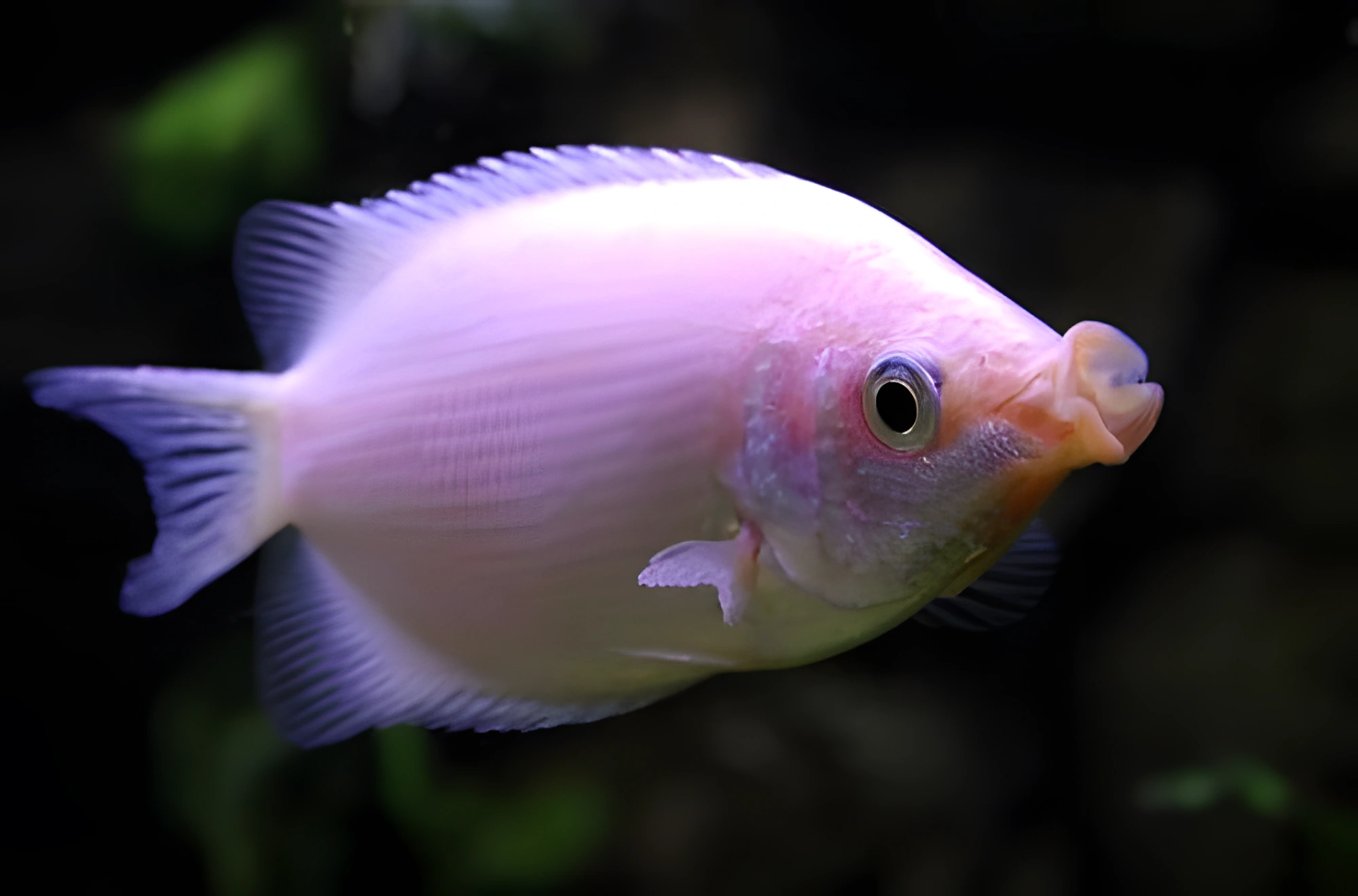
This is a medium-sized fish, reaching a length of 15 cm in aquarium conditions. Its body is flattened and compressed laterally. Large, rounded fins are located low relative to the body. The structure of the mouth is one of the most noticeable distinguishing features of the species: the lips are large, fleshy, equipped with small teeth on the inner surface, which allows the fish to scrape algae from various surfaces, such as stones and snags. Gouramis, like other labyrinth fish, possess a specialized respiratory organ that allows them to absorb atmospheric oxygen by gulping air. In nature, there are two main color variations: grayish-green and pink. The grayish-green form, originating from the waters of Thailand, has a gray body, which in some individuals may acquire a greenish tint. Distinctive features are clear dark brown stripes running from head to tail and continuing onto the fins. The pink form is more popular among aquarists; its body is colored in orange-pink tones, and the fins are translucent or transparent, pink. Based on this form, the Pink Kissing Gourami was artificially bred, which differs in somewhat smaller sizes compared to its ancestor.
Habitat
The first scientific description of this fish was made in 1829 by the French explorer Georges Cuvier in the context of studying the fauna of Southeast Asia. The Kissing Gourami is widespread in the territories of modern Thailand and Indonesia, and is also found in Sumatra, Borneo, Java, Cambodia, and other regions. In its natural habitat, it inhabits lakes, rivers, as well as artificial canals, ponds, and swamps. It prefers shallow, slow-moving or stagnant waters with abundant vegetation. The diet of these fish is omnivorous: they feed on algae, various plants, zooplankton, and aquatic insects, collected near the water surface.
Behavior and Compatibility
Adult Kissing Gouramis can show intolerance towards small fish, constantly attacking them, which may result in them being eaten. Therefore, it is recommended to keep them only with peaceful species of comparable size, or with other Gourami species. When setting up an aquarium, it is important to provide sufficient space: at least 80–100 liters of water should be allocated per adult fish. For example, three adult Kissing Gouramis can comfortably be housed in a 300-liter aquarium. Overcrowding or a lack of hiding places can provoke conflicts, where a stronger individual establishes its hierarchy, potentially leading to the death of weaker fish. It is also advisable to avoid cohabitation with fast and active fish that can provoke aggression in gouramis.
Care and Maintenance
It is a common misconception that labyrinth fish thrive in low-oxygen water. While they can survive in such conditions for a certain period, giving them a competitive advantage in the wild, in a closed aquarium system, oxygen deficiency often leads to problems with the decomposition of organic waste and an increase in the concentration of toxins, which are harmful to all inhabitants. It is important to equip the aquarium with an effective filtration and aeration system, however, the water flow from the equipment should not be too strong, as these fish prefer weak currents or stagnant water; otherwise, constant stress is inevitable. Other necessary equipment includes a heater and a lighting system. The presence of an aquarium lid is particularly important: a humid environment with an elevated temperature forms beneath it, minimizing the risk of damage to the fish's labyrinth organ when breathing atmospheric air due to temperature contrast. The fish's brightest colors are displayed against a dark substrate of fine gravel; to prevent excessive digging, small flat stones or plates with smooth edges can be placed on the substrate. It is also recommended to provide hiding places in the form of snags, roots, or artificial objects (e.g., ships, castles); their number should correspond to the number of fish. For example, for two Gouramis, two hiding places are desirable. A large number of plants is welcome; they can be planted along the aquarium walls and in groups around snags, and floating plants can also be used. The latter are a supplement to the fish's natural diet.
Diet
In home aquariums, these fish readily accept any food intended for aquarium inhabitants. This can include dry commercial foods (flakes, pellets), as well as live or freeze-dried meat products (e.g., bloodworms, daphnia, tubifex). When choosing food, preference should be given to specialized products developed for Gouramis, as they already contain all the necessary trace elements and vitamins. Feeding is recommended once or twice a day, offering a portion that will be eaten within 3–4 minutes.
Breeding and Reproduction
The breeding process for these Gouramis is somewhat more complex than for other species, and sexual dimorphism is weak, making it difficult to distinguish males and females when purchasing. Eggs are released directly into the water and float to the surface, as the fish do not build nests for their eggs. However, if floating plants with large leaves are present in the aquarium during spawning, the eggs may be laid beneath their surface. After spawning, the fish do not exhibit parental care and may eat their own offspring. Although successful breeding in home conditions is possible, it involves significant hassle, which is unacceptable for most aquarists.
Diseases
Aquarium Kissing Gouramis are direct descendants of wild populations, which accounts for their high resilience. In a balanced and healthy aquarium, disease outbreaks are extremely rare and are usually caused by external factors. However, problems will inevitably arise if living conditions deteriorate, so it is crucial to regularly change the water and maintain equipment promptly. More detailed information on symptoms and treatment methods can be found in the "Diseases of Aquarium Fish" section.
How to choose
When selecting a Kissing Gourami, preference should be given to individuals with active behavior and clean skin without signs of damage, ulcers, or film. It is important to avoid purchasing fish with deformed bodies, particularly the so-called balloon forms, as such artificial anatomical changes often lead to a reduced lifespan and health problems. It is recommended to carefully inspect the fish for sunken sides and signs of emaciation, which may indicate hidden parasitic diseases or improper keeping conditions in the store.
Since this species is prone to intraspecific aggression, it is advisable to acquire young individuals and introduce them to the aquarium simultaneously to reduce the risk of territorial conflicts. Do not buy only two fish, as the stronger individual will constantly harass the weaker one. The optimal option is to buy a group of young fish to establish a hierarchy in a spacious aquarium.
Frequently asked questions
The essentials: size, tank volume, water parameters and care
How big does Kissing Gourami get?
An adult reaches 15 cm in length. Plan the tank around the maximum size: the fish quickly outgrows a cramped setup.
What size aquarium does Kissing Gourami need?
The minimum recommended volume is 280 L. A smaller tank speeds up nitrate build-up and raises stress levels.
What water parameters does Kissing Gourami need?
Temperature 22–28 °C, pH 6–8, hardness 5–19 dGH. Stability matters more than exact values: sudden swings are harder on the fish than a small deviation from the ideal.
How long does Kissing Gourami live?
Around 8 years when kept properly. Lifespan depends directly on tank volume, water quality and a varied diet.
Is Kissing Gourami aggressive?
Temperament: territorial (often aggressive). Keep this in mind when choosing tank mates.
How many Kissing Gourami should be kept together?
Recommended setup: mixed (solitary / pair / group). Ignoring this is a common cause of stress and disease.
What does Kissing Gourami eat?
Diet type: meat with plant additives (omnivores). Feed small portions that are finished within a couple of minutes — overfeeding does more harm than underfeeding.
What is the scientific name of Kissing Gourami?
The scientific name of the species is Helostoma temminkii, family Kissing Gouramis (Helostomatidae). It also appears in the literature as: Helostomi temmincki.