Temperature22 – 28 °C
Natural range
- Lake Valencia area
- Venezuela area
CharacinsConservation status: Endangered EN
Other scientific names: Opisthanodus haerteli
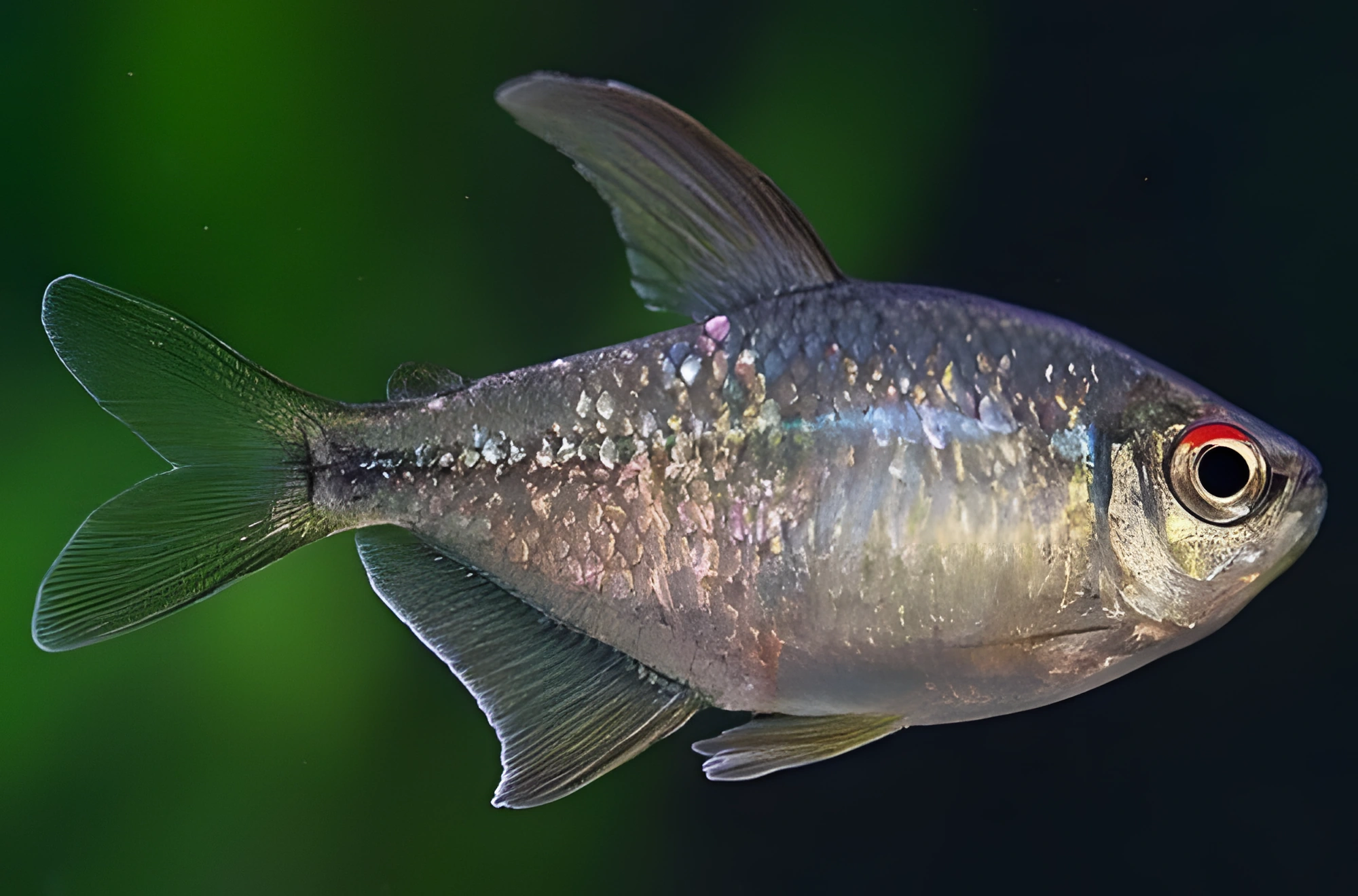
Among the representatives of the Characidae family, to which the Diamond Tetra (scientific name Moenkhausia pittieri) belongs, this species is perhaps the most luxurious. Its scales in adult individuals acquire unique properties to reflect and refract light, breaking it down into a spectrum, which gives it the appearance of a scattering of small diamonds.
- Required aquarium volume
- 60 L
- Size in aquarium
- 6 cm
- Temperature
- 22 – 28 °C
- Temperament
- Peaceful, active/mobile
Parameters
Water pHSlightly acidic (5.5) – Neutral (6.5)
Water dHSoft (5) – Hard (12)
Water salinityno salt (freshwater)
Size in aquarium6 cm
Lifespan6 years
TemperamentPeaceful, active/mobile
Toward small fishnot a predator
Required aquarium volume60 L
Lightingdimmed
Substratesandy (regular, light)
Water flowweak or moderate
FeedingPlant-based with meat additives
CareSmall group (5–6 individuals)
Description
This fish has a rather stocky body, flattened laterally, and reaches a size of no more than 6 cm. Its main distinguishing feature is its coloration, or rather, the unique properties of its scales to reflect and refract light, similar to cut crystals. It is important to note that this characteristic effect only appears in adult individuals; young fish look rather inconspicuous, having a common silvery coloration.
The main differences between male and female lie in the shape of the dorsal fin: in males, it is longer, pointed, and resembles a sickle.
Habitat
In 1920, this fish was first discovered in Lake Valencia, located in Venezuela. Later, it was found in other South American bodies of water. Lake Valencia, the second largest in Venezuela, lies between two mountain ranges. However, due to environmental pollution, wild populations of Diamond Tetra have significantly decreased. In their natural habitat, they live in schools, preferring shallow, densely vegetated areas of the lake and its tributaries. Their diet consists of small worms, crustaceans, and insects.
Behavior and Compatibility
These schooling and active fish are friendly and prefer to be in the company of their own kind, so they should be kept in groups of at least 5 individuals. They get along well with other peaceful fish of similar or slightly smaller size, including livebearers, other tetras, and bottom dwellers such as catfishes.
Care and Maintenance
These fish require rather specific water conditions, demanding a soft, slightly acidic, and very clean environment. Maintaining these parameters is possible with a powerful filter equipped with filter media that promotes water acidification. Other necessary equipment includes a heater, an aerator, and a lighting system that creates subdued light. The aquarium setup should include dense plant thickets; floating plants are also welcome as they create additional shading. A sandy substrate with a few snags or roots would be ideal; it is also advisable to add a few dry leaves (replacing them every two weeks) or pieces of wood to give the water a slight brown tint, which corresponds to the natural habitat of this species.
Diet
Being omnivorous, this fish readily consumes both dry commercial and live foods, as well as plant-based products. It is very important that their daily diet includes plant supplements in addition to dry food, for example, finely chopped lettuce or spinach leaves; alternatively, vegetable flakes can be used. This will help prevent damage to aquarium plants.
Breeding and Reproduction
Breeding these fish is quite straightforward, with the key condition being that the male and female are of the same age and size. Many breeding failures are often associated with neglecting this rule. For spawning, a separate tank of at least 40 liters will be needed, where water parameters should correspond as closely as possible to those in the main aquarium, with the exception of water hardness, which should be around 4 dGH. Standard equipment includes a filter, aerator, heater, and lighting system. The spawning tank setup provides for dense plant thickets and a sandy substrate. Before spawning begins, the fish should be fed abundantly, preferably offering both plant and meat products daily (freeze-dried will do). Then the pair is moved to a separate tank, which is covered with dark cloth, leaving the lighting off. The next day, the cloth is removed, but the light is still not turned on; after another day, the light can be turned on at minimum power. A gradual increase in light intensity stimulates the breeding instinct in Diamond Tetras. Once the eggs are laid, the parents are returned to the main aquarium.
Diseases
The fish are hardy, and provided they are kept in a favorable environment, health problems usually do not arise. More detailed information on symptoms and treatment methods can be found in the section "Diseases of Aquarium Fish".
How to choose
When purchasing, choose active, mobile individuals that stay in a school. Avoid fish with signs of fin damage, body film, ulcers, or an unnaturally bloated abdomen. A healthy Diamond Tetra should have clear, transparent eyes and a characteristic metallic sheen on its scales, which may be less pronounced in juveniles. In the store, fish often look dull due to stress, but they should not show signs of lethargy or apathy, or stay at the water surface, which may indicate problems with water quality in the aquarium or illness.
Frequently asked questions
The essentials: size, tank volume, water parameters and care
How big does Diamond Tetra get?
An adult reaches 6 cm in length. Plan the tank around the maximum size: the fish quickly outgrows a cramped setup.
What size aquarium does Diamond Tetra need?
The minimum recommended volume is 60 L. A smaller tank speeds up nitrate build-up and raises stress levels.
What water parameters does Diamond Tetra need?
Temperature 22–28 °C, pH 5.5–6.5, hardness 5–12 dGH. Stability matters more than exact values: sudden swings are harder on the fish than a small deviation from the ideal.
How long does Diamond Tetra live?
Around 6 years when kept properly. Lifespan depends directly on tank volume, water quality and a varied diet.
Is Diamond Tetra aggressive?
Temperament: peaceful, active/mobile. Keep this in mind when choosing tank mates.
How many Diamond Tetra should be kept together?
Recommended setup: small group (5–6 individuals). Ignoring this is a common cause of stress and disease.
What does Diamond Tetra eat?
Diet type: plant-based with meat additives. Feed small portions that are finished within a couple of minutes — overfeeding does more harm than underfeeding.
What is the scientific name of Diamond Tetra?
The scientific name of the species is Moenkhausia pittieri, family Characidae. It also appears in the literature as: Opisthanodus haerteli.