Temperature22 – 28 °C
Natural range
- Panama area
- Costa Rica area
- Central America area
LivebearersConservation status: Near threatened NT
Brachyrhaphis roseni, also known as Rosen's Brachyrhaphis, belongs to the family Poeciliidae. It is an active and colorful fish with a rather complex character. Its keeping does not present particular difficulties, but breeding can be problematic, which makes it less common compared to other live-bearing species.
- Required aquarium volume
- 50 L
- Size in aquarium
- 4 – 6 cm
- Temperature
- 22 – 28 °C
- Temperament
- Semi-peaceful (including aggression during spawning / intraspecific conflicts)
Parameters
Water pHNeutral (7) – Slightly alkaline (8)
Water dHSoft (5) – Hard (15)
Water salinityno salt (freshwater)
Size in aquarium4 – 6 cm
Lifespan3 years
TemperamentSemi-peaceful (including aggression during spawning / intraspecific conflicts)
Toward small fishnot a predator
Required aquarium volume50 L
Lightingmoderate (regular)
Substrateany (no restrictions)
Water flowmoderate
FeedingAny (universal)
CareSmall group (5–6 individuals)
Description
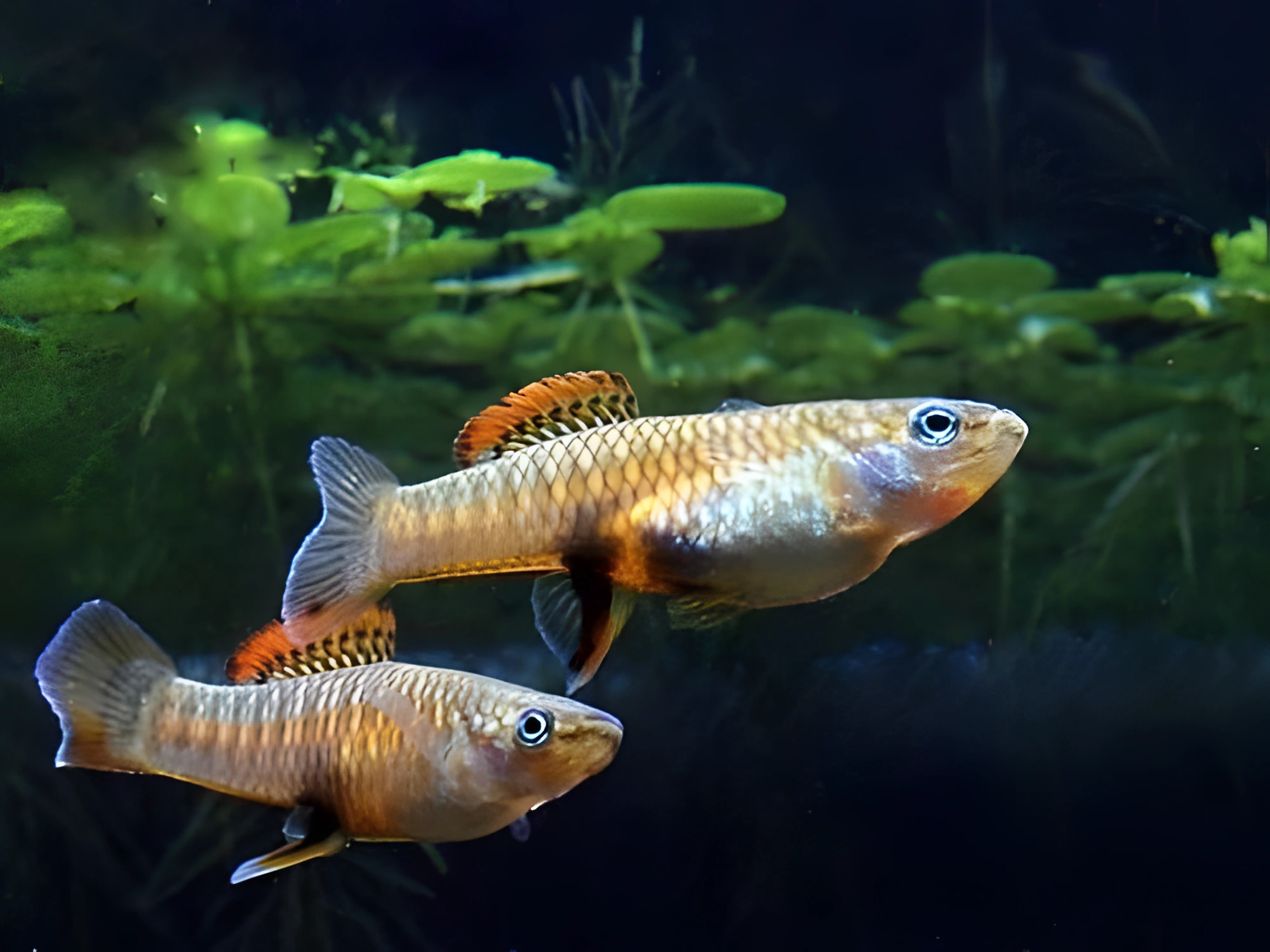
Females reach a length of up to 6 cm, while males are noticeably smaller — about 4 cm. An additional characteristic of males is the presence of a gonopodium, a reproductive organ, and one dark mark on the belly, whereas females have two. Otherwise, sexual dimorphism is weakly expressed. The fish's coloration is mottled, varying from gray-yellow to orange hues. Their scales have a slight bluish sheen. The dorsal fin and tail are distinguished by their red color with a black outline.
Habitat
The natural habitat of this species extends across Panama and Costa Rica in Central America. The mountain ranges and volcanic ridges of the region contribute to the formation of an extensive river network. Abundant year-round rainfall fills numerous rivers and streams, which, flowing down mountain slopes, cut deep gorges. In natural conditions, the fish inhabit fast-flowing waters with high carbonate hardness. The substrate is most often rocky or sandy, and aquatic vegetation is predominantly found along river banks.
Behavior and Compatibility
Rosen's Brachyrhaphis has a complex temperament. It's important to maintain a school of at least 5–6 individuals. Males of this species are not always friendly; they can show aggression towards smaller tankmates, their own kind, and even females during breeding. To reduce excessive male attention, it's recommended to have 3–4 females per male, and the aquarium should be equipped with a sufficient number of hiding places. These fish prefer to stay in the upper layers of the water. Most bottom-dwelling fish, such as catfish and some loaches, as well as fast tetras, small American cichlids, and other species that can comfortably exist in alkaline water, make good tankmates.
Care and Maintenance
For a school of 5–6 Rosen's Brachyrhaphis, an aquarium of 50–60 liters is recommended. When setting up the tank, provide open water areas for free swimming, as well as several hiding places, which can be created using driftwood, decorative elements, or dense plant thickets. The bottom, substrate layer of the aquarium does not play a significant role for these fish. For successful long-term keeping, it is important to maintain high pH and GH levels. This is achieved through regular aquarium maintenance: weekly water changes with fresh water of similar hydrochemical composition; timely removal of organic waste (such as food remnants and excrement), which can lower the pH level; prophylactic maintenance of equipment, and so on. Installing a powerful filtration system, such as internal filters, will solve two problems at once: in addition to water purification, it will create an artificial current, mimicking the natural flows of mountain rivers.
Diet
In a home aquarium, these fish readily accept a variety of dry, freeze-dried, frozen, and live foods. The daily diet can consist of flakes and granules, supplemented with Artemia, bloodworms, Daphnia, or mosquito larvae and other similar products. We would like to specifically mention Aqvium flake food for aquarium fish — our new product, which has become a bestseller on Ozon, receiving a rating of 4.9. It is suitable for most aquarium fish, and its raw materials are produced according to new European Union standards (EU 2018/848). It contains vitamins A, C, D3, E, and Omega 3-6. You can purchase it on Ozon.
Breeding and Reproduction
These fish are livebearers, meaning they do not have an egg stage, and fully formed fry are born. It is generally believed that breeding such fish is not difficult, but Rosen's Brachyrhaphis is an exception in this regard. This species exhibits extremely predatory behavior towards its own offspring. In the confined space of an aquarium, newly born fry can be eaten within minutes. Even dense plant thickets are not always able to provide reliable cover for the young. Some sources describe successful breeding cases using special breeding traps — these are transparent plastic containers with holes at the bottom and sides. When the belly of a "gravid" female noticeably increases, she is temporarily transferred to a separate tank with an identical water environment and placed in such a trap. During spawning, the fry swim out of the trap through the holes and find themselves in safety. After this, the female is returned to the main aquarium.
Diseases
Maintaining fish in a suitable habitat, providing balanced nutrition, and the absence of external threats, such as aggression from tank mates, are the best defense against disease. The appearance of signs of illness may indicate problems with husbandry. As a rule, normalizing environmental parameters promotes self-healing, but if the fish's condition has significantly worsened, medication will be required. Detailed information on symptoms and treatment methods can be found in the “Diseases of aquarium fish” section.
How to choose
When selecting individuals, pay attention to their activity and the absence of visible damage to fins or scales. A healthy fish should show curiosity and swim quickly in the water column, rather than hiding in the corners of the aquarium. Avoid purchasing fish with signs of emaciation, sunken bellies, or unnaturally bloated abdomens, which may indicate parasites or internal infections. Given the territorial nature of the species, it is important to assess the behavior of the fish in the store's community tank: aggressive skirmishes between individuals are acceptable, but the fish should not have torn fins or signs of injury from constant attacks. It is advisable to acquire a group of several individuals, as solitary fish can experience severe stress, which negatively affects their immunity and adaptation to new conditions.
Frequently asked questions
The essentials: size, tank volume, water parameters and care
How big does Rosen's Brachyrhaphis get?
An adult reaches 4–6 cm in length. Plan the tank around the maximum size: the fish quickly outgrows a cramped setup.
What size aquarium does Rosen's Brachyrhaphis need?
The minimum recommended volume is 50 L. A smaller tank speeds up nitrate build-up and raises stress levels.
What water parameters does Rosen's Brachyrhaphis need?
Temperature 22–28 °C, pH 7–8, hardness 5–15 dGH. Stability matters more than exact values: sudden swings are harder on the fish than a small deviation from the ideal.
How long does Rosen's Brachyrhaphis live?
Around 3 years when kept properly. Lifespan depends directly on tank volume, water quality and a varied diet.
Is Rosen's Brachyrhaphis aggressive?
Temperament: semi-peaceful (including aggression during spawning / intraspecific conflicts). Keep this in mind when choosing tank mates.
How many Rosen's Brachyrhaphis should be kept together?
Recommended setup: small group (5–6 individuals). Ignoring this is a common cause of stress and disease.
What does Rosen's Brachyrhaphis eat?
Diet type: any (universal). Feed small portions that are finished within a couple of minutes — overfeeding does more harm than underfeeding.
What is the scientific name of Rosen's Brachyrhaphis?
The scientific name of the species is Brachyrhaphis roseni, family Poeciliidae.