Temperature20 – 28 °C
Natural range
- Borneo area
- Sarawak, Malaysia area
UnusualConservation status: Data deficient DD
Other scientific names: Tetraodon borneensis, Tetrodon borneensis
The Bornean Pufferfish, known to specialists as Carinotetraodon borneensis, belongs to the family Tetraodontidae, or Pufferfish. It is less common in the aquarium fish market than, for example, its more widespread relative, the Red-eyed Pufferfish, but sometimes these species are supplied together. In general, its care is not difficult, and this pufferfish is unpretentious, with the exception of its specific dietary preferences.
- Required aquarium volume
- 60 L
- Size in aquarium
- 4 – 5 cm
- Temperature
- 20 – 28 °C
- Temperament
- Semi-peaceful (including aggression during spawning / intraspecific conflicts)
Parameters
Water pHSlightly acidic (6) – Neutral (7.5)
Water dHVery soft (1) – Hard (12)
Water salinityno salt (freshwater)
Size in aquarium4 – 5 cm
Lifespan8 years
TemperamentSemi-peaceful (including aggression during spawning / intraspecific conflicts)
Toward small fishnot a predator
Required aquarium volume60 L
Lightingdimmed
Substratesandy (regular, light)
Water flowmoderate
FeedingMeat / protein (live, frozen, fresh)
CareSolitary + other species (large / compatible)
Description
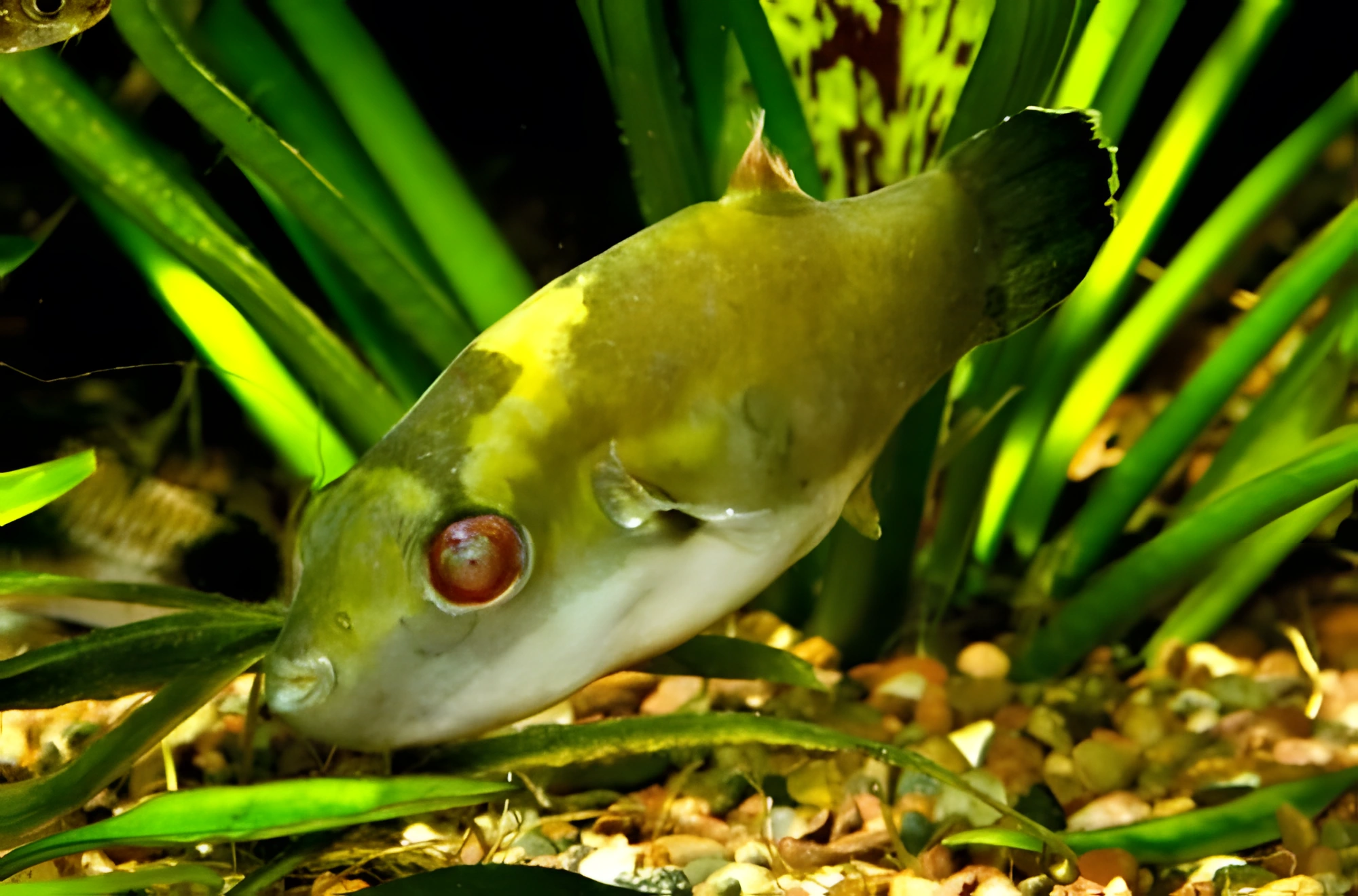
Adults of this fish typically reach a length of 4 to 5 cm. Sexual dimorphism is weakly expressed, making it difficult to visually distinguish males and females. The body of the Bornean Pufferfish is massive, oval-shaped, with small fins. The coloration is predominantly brown, with a noticeable white belly. Yellow streaks can be seen on the head, forming a figure resembling a triangle. The fish's eyes are red. Like all pufferfish, it has small spines covering its entire body. In a critical situation, the pufferfish can inflate, turning into a spherical shape with protruding spines, making it a less attractive target for potential predators.
Habitat
This species is endemic to the island of Borneo, or Kalimantan. Its range is limited to the northern part of the island, belonging to Malaysia, where it inhabits the Rajang and Sungai river basins. It prefers regions with slow-moving water. Its natural habitat is characterized by an abundance of submerged coastal and aquatic vegetation.
Behavior and Compatibility
Although this pufferfish is not as aggressive as some other pufferfish, it is still recommended to keep it separately from its conspecifics. It can be compatible with other peaceful aquarium species, but it is important that they are large enough not to become an unwitting food source for the pufferfish. Due to its unique defense, the Bornean Pufferfish can even be kept with large fish.
Care and Maintenance
For a single Bornean Pufferfish, an aquarium of at least 60 liters is recommended. When decorating, it is worth using plenty of aquatic vegetation and creating shelters with driftwood. Natural driftwood serves as an excellent basis for algae growth, which will be an additional food source for the pufferfish. To give the water a characteristic "tea" tint, Indian almond leaves or ordinary European oak leaves are placed at the bottom of the aquarium. These leaves should be dried in advance, and then soaked until they begin to sink. During decomposition, the leaves release tannins and other astringent substances that give the water the desired color. Maintaining high water quality is ensured by an effective filtration system and regular care, including cleaning the substrate and decorations, partial water changes with fresh water, and monitoring the concentrations of dangerous substances such as nitrites and nitrates.
Diet
In the process of evolution, the mouthparts of this fish have acquired a beak-like shape, consisting of a pair of bony plates that continue to grow throughout the individual's life. In its natural habitat, the diet of the Bornean Pufferfish includes snails, bivalve mollusks, crustaceans such as crabs and shrimp, as well as algae, which it scrapes from stone surfaces. When kept in a home aquarium, its diet must correspond to these natural needs. If the food lacks hard components, the fish's "beak" will not wear down naturally, which over time can cause problems with food intake.
Breeding and Reproduction
Reliable information on the captive breeding of the Bornean pufferfish is extremely limited. It is known that in closely related species, spawning occurs among dense vegetation, and the male cares for the clutch. Due to the lack of confirmed data on specific conditions for stimulating spawning and successful fry rearing in home aquariums, a reliable breeding method for this species is currently unavailable.
Diseases
In a mature aquarium ecosystem with correctly selected water parameters, health problems in these fish are extremely rare. Diseases most often manifest when keeping conditions deteriorate. Moreover, a diet lacking hard components can cause excessive growth of the "beak," which normally wears down against mollusk shells. More detailed information on possible symptoms and treatment methods can be found in the relevant section on aquarium fish diseases.
How to choose
When purchasing, choose active individuals with clean skin without visible damage, spots, or signs of emaciation. It is important to consider the following aspects:
- avoid fish that appear lethargic or constantly hide in the corners of the aquarium;
- check the integrity of the fins, as any damage may indicate aggression from tankmates or poor keeping conditions;
- make sure the fish shows interest in food, as adaptation to artificial foods can be difficult for this species;
- remember that this species is rarely available for sale and is often confused with other members of the genus, so carefully examine the coloration and body shape before purchasing.
Frequently asked questions
The essentials: size, tank volume, water parameters and care
How big does Bornean Pufferfish get?
An adult reaches 4–5 cm in length. Plan the tank around the maximum size: the fish quickly outgrows a cramped setup.
What size aquarium does Bornean Pufferfish need?
The minimum recommended volume is 60 L. A smaller tank speeds up nitrate build-up and raises stress levels.
What water parameters does Bornean Pufferfish need?
Temperature 20–28 °C, pH 6–7.5, hardness 1–12 dGH. Stability matters more than exact values: sudden swings are harder on the fish than a small deviation from the ideal.
How long does Bornean Pufferfish live?
Around 8 years when kept properly. Lifespan depends directly on tank volume, water quality and a varied diet.
Is Bornean Pufferfish aggressive?
Temperament: semi-peaceful (including aggression during spawning / intraspecific conflicts). Keep this in mind when choosing tank mates.
How many Bornean Pufferfish should be kept together?
Recommended setup: solitary + other species (large / compatible). Ignoring this is a common cause of stress and disease.
What does Bornean Pufferfish eat?
Diet type: meat / protein (live, frozen, fresh). Feed small portions that are finished within a couple of minutes — overfeeding does more harm than underfeeding.
What is the scientific name of Bornean Pufferfish?
The scientific name of the species is Carinotetraodon borneensis, family Pufferfish (Tetraodontidae). It also appears in the literature as: Tetraodon borneensis, Tetrodon borneensis.