Temperature23 – 28 °C
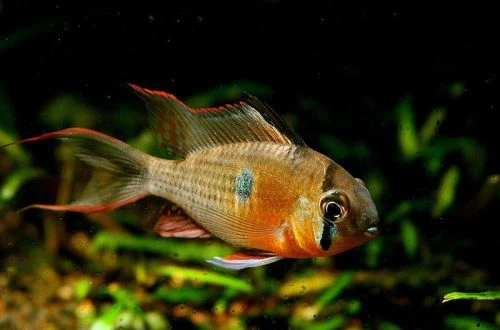
Other scientific names: Crenicara altispinosa, Microgeophagus altispinosus, Papiliochromis altispinosus
The Mikrogeophagus altispinosus, or Bolivian Ram (scientific name Mikrogeophagus altispinosus), is a member of the Cichlidae family. This attractive and colorful fish coexists well with other South American freshwater species of similar size. It is relatively easy to care for, making it a suitable choice even for beginner aquarists.
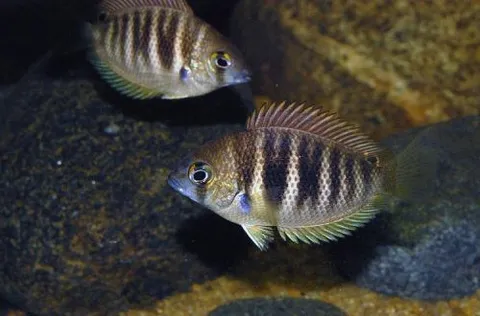
Adults grow to 7–8 cm in length. A distinguishing feature of males is their larger size, more intense coloration, and elongated fins and tail. The body coloration is a harmonious combination of red and yellow hues. A black spot is located in the middle of the body, and dark streaks are visible on the head, one of which passes directly through the eye.
The natural habitat of this species is in South America. The Bolivian Ram is endemic to the Madeira River basin, which flows through Bolivia and partially Brazil. It prefers to live in small tributaries with slow currents, as well as in floodplain lakes with sandy or silty bottoms.
This is a peaceful and calm species that prefers to live in groups of 6–8 individuals. They are highly compatible with small schooling characin fish, which are their constant companions in nature and also serve as an indicator of the absence of predators nearby. Large fish should be excluded as tank mates.
For a group of 6–8 individuals, an aquarium of 200 liters or more will be optimal. The setup must include a sandy substrate. Several snags and aquatic plants, arranged in separate groups, will help maintain open areas on the bottom. Lighting should be subdued. Given the fish's feeding habits and the dim light, preference should be given to unpretentious shade-loving plants or their artificial counterparts. A pair of large flat stones may eventually serve as a spawning site. This species is not as demanding regarding water quality as other Apistogramma and can tolerate some non-critical care mistakes or temporary forgetfulness on the part of the aquarist regarding maintenance. The Bolivian Ram thrives best in soft, slightly acidic water. Successful long-term keeping largely depends on the effective operation of the filtration system and regular cleaning procedures. These include weekly water changes of 10–15% of the volume with fresh water and the removal of organic waste, such as food remnants and excrement.
In natural conditions, these fish feed by sifting sand with their mouths in search of various microorganisms. In a home aquarium, the presence of sand also plays a key role in their feeding process. It is recommended to feed them sinking dry foods with vegetable additives, such as flakes or granules. If possible, the diet can be enriched with frozen artemia, daphnia, or small pieces of bloodworms. It should be remembered that food particles should not be large, as the fish do not bite but swallow them whole.
Breeding Mikrogeophagus altispinosus is quite possible if the fish are kept in a group and favorable conditions are created in the aquarium (special attention is paid to water quality). The best results are achieved in species-specific aquariums where there is no threat of predation from other fish. With the onset of the breeding season, a male and female form a pair. In a large group, two, three, or more pairs may form. Each pair occupies a certain area on the bottom, with a flat stone or snag as its central element. The female lays eggs in batches, arranging them in a row. This process is repeated several times. The incubation period lasts 2–3 days, after which the hatched fry remain motionless for about another week, and only then begin to swim freely. Throughout this time, the parents tirelessly protect their offspring.
The main cause of diseases often lies in the keeping conditions: if they go beyond acceptable limits, immunity decreases, making the fish vulnerable to various infections inevitably present in the environment. At the first suspicion of illness, it is important first of all to check the water parameters and ensure there are no dangerous concentrations of nitrogen cycle products. Often, restoring normal, suitable conditions promotes recovery. However, in some cases, medication may be required.
When choosing Bolivian Rams, preference should be given to active individuals with clean fins and no body damage. Healthy fish should have bright coloration, characteristic of the species, and show natural interest in food. Avoid specimens with signs of emaciation, sunken bellies, cloudy eyes, or whitish patches on their scales. It is important to pay attention to behavior: fish should not be overly timid or, conversely, show signs of depression, constantly hiding in the corners of the aquarium. When purchasing, it is recommended to clarify the keeping conditions in the store and inspect neighboring aquariums for the absence of sick fish, as dwarf cichlids can be sensitive to water quality.
The essentials: size, tank volume, water parameters and care
An adult reaches 7–8 cm in length. Plan the tank around the maximum size: the fish quickly outgrows a cramped setup.
The recommended volume is 200 L. A smaller tank speeds up nitrate build-up and raises stress levels.
Temperature 23–28 °C, pH 6–7.5, hardness 3–15 dGH. Stability matters more than exact values: sudden swings are harder on the fish than a small deviation from the ideal.
Around 5 years when kept properly. Lifespan depends directly on tank volume, water quality and a varied diet.
Temperament: peaceful (regular). Keep this in mind when choosing tank mates.
Recommended setup: medium group (6–8 individuals). Ignoring this is a common cause of stress and disease.
Diet type: high protein (predominantly meat). Feed small portions that are finished within a couple of minutes — overfeeding does more harm than underfeeding.
The scientific name of the species is Mikrogeophagus altispinosus, family Cichlids (Cichlidae). It also appears in the literature as: Crenicara altispinosa, Microgeophagus altispinosus, Papiliochromis altispinosus.
Matched by family, categories and overlapping keeping conditions
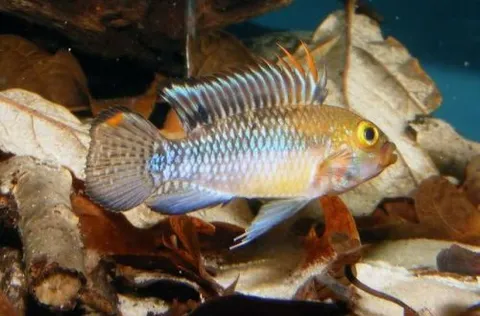
Apistogramma norberti
Norbert's Apistogramma (Apistogramma norberti), a representative of the Cichlidae family, is an attractive and rather undemanding aquarium fish. It coexists well with many freshwater species from South America. By…
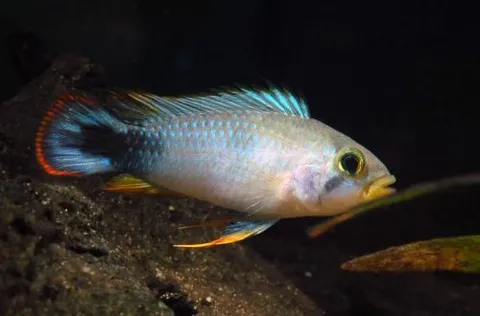
Apistogramma panduro
Apistogramma panduro, also known as the Azure or Blue Cichlid, belongs to the family Cichlidae. This South American cichlid is considered relatively undemanding in care and is well compatible with other freshwater…
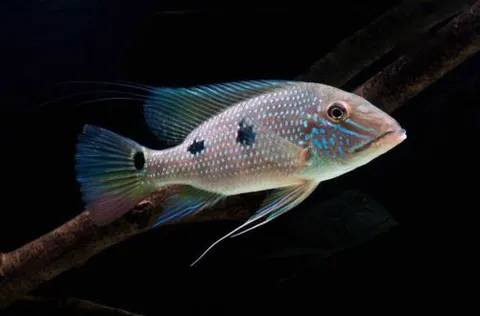
Satanoperca daemon
Although this fish bears a fearsome name, Geophagus daemon, or Satanoperca daemon (scientific name Satanoperca daemon), is actually a rather peaceful member of the Cichlidae family. Despite its unusual name, it poses no…
Etroplus canarensis
Etroplus Canara, scientifically known as Etroplus canarensis, belongs to the family Cichlidae. This fish was named after the region of its discovery – South Canara, located in the Indian state of Karnataka. This species…