Temperature22 – 28 °C
Other scientific names: Micracanthus marchei
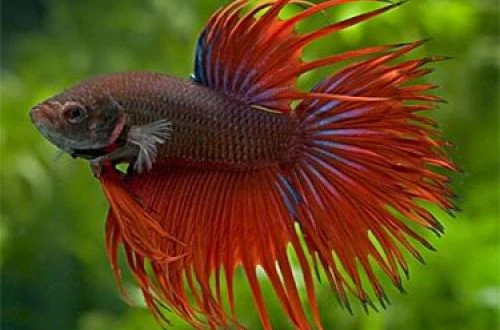
The fighting fish, also known as the Siamese Fighting Fish, with the scientific name Betta splendens, belongs to the family Osphronemidae. This fish attracts attention with its beauty and peculiar behavior. It is one of the oldest aquarium inhabitants among freshwater species; only the Goldfish has a longer history of being kept in home aquariums.
The fish is characterized by an elongated, robust body with rounded fins. Artificially bred varieties show an astonishing diversity of colors, patterns, and also fin sizes and shapes, which makes their classification quite difficult. Like other labyrinth fish, the Fighting Fish has a special organ located in its oral cavity, which allows it to breathe atmospheric air. This adaptation enables the fish to survive even in waters with low oxygen content. Males are distinguished by more intense coloration, although some selective breeding forms of females also have an expressive appearance. Nevertheless, as a rule, females' coloration is paler, and their fins are shorter. During spawning, horizontal stripes may appear on the females' bodies, which is a sign of their readiness to lay eggs.
The natural range of the Siamese Fighting Fish covers central Thailand — the Chao Phraya and Mae Khlong basins — and the eastern slope of the Cardamom Mountains in Cambodia. Records from the Mekong basin in Vietnam and Laos refer to other species of the genus or to introduced populations. However, selective breeding forms have gained the most popularity and are widely bred by both professional breeders and amateur aquarists. These fish prefer slow-moving waters with abundant vegetation, inhabiting the floodplains of large and medium rivers, canals, and flooded rice fields. Their natural diet consists of small crustaceans, insects, as well as plants and algae. Information on how to determine the age of Bettas (Siamese Fighting Fish).
The name "Fighting Fish" is due to the nature of interactions between males, who engage in fierce battles. However, these duels are not without a certain nobility: if one of the opponents needs to surface for a gulp of air, its rival ceases the attack, pausing the fight. If another male is nearby, he will patiently wait for the battle to end to fight the winner, without joining either side of the conflict. Females are less aggressive, but they also have an internal hierarchy, so weaker individuals need hiding places. Keeping two or more males in the same aquarium is unacceptable; there can be either one male or a male in the company of females. Such behavior significantly limits the choice of tank mates. Since a male attacks anyone who even remotely resembles a rival, other fish must differ from him in color, size, and fin shape. Brightly colored fish may be attacked by mistake. For this reason the fish is usually best kept alone: individual specimens may tolerate tankmates, but this is the exception rather than the rule. If tankmates are nevertheless planned, small cyprinids and loaches from similar habitats are suitable; brightly coloured or long-finned fish will be attacked as rivals.
This species is perfectly suited for both beginner aquarists and those who do not plan to set up large aquariums at home. A single fish needs an aquarium with a base of at least 45 × 30 cm, which is about 40 litres. Keeping this species in tiny containers or jars is unacceptable. The presence of the "labyrinth organ" allows it to adapt to fluctuations in oxygen concentration in the water, which is often encountered in compact aquariums. It is important that any aquarium is equipped with a lid to prevent accidental jumping out of the fish. The minimum set of equipment includes a filter, aerator, heater, and lighting system. In small tanks, it is advisable to use filters that combine the functions of an aerator. For aquascaping, it is recommended to use sturdy plants with a well-developed root system, arranging them in groups to maintain free swimming space. The presence of shelters (such as driftwood, grottoes) is a mandatory condition if more than one fish is kept in the aquarium. The substrate can be any dark color, and the particle size of the gravel is only important for successful plant rooting.
The diet of these fish should include a significant amount of protein components — these can be live or freeze-dried foods, preferably with the addition of vegetable supplements. In a home aquarium, bloodworms, insect larvae, daphnia, artemia, and similar products can be offered. Plants and algae, especially those actively growing on wooden elements of the aquarium, can serve as an additional source of vegetable food. In addition, there are specialized foods developed for Fighting Fish that contain all the necessary trace elements and vitamins. Feeding should be done once or twice a day.
Creating favorable conditions for spawning is not particularly difficult, however, breeding these fish at home is complicated by the fact that the fry of artificially bred morphological forms show high susceptibility to infections, which makes this process impractical. In addition, due to the external similarity of females and males, during spawning, females can be subjected to aggression by the partner, who mistakenly takes them for a rival, which can lead to undesirable consequences.
The closer the fish is to its natural wild type, the hardier and less demanding it is. Exotic varieties have a weaker immune system and, if keeping conditions deteriorate, are primarily susceptible to bacterial infections. Long fins are especially prone to fin rot and other diseases. There is also separate information about common diseases of fighting fish (Bettas).
When purchasing, choose an active fish with bright coloration and spread fins. Avoid individuals with signs of damage, white film, clamped fins, or apathetic behavior. Examine the fish for signs of diseases such as popeye or raised scales. In stores, bettas are often kept in individual containers, which allows for assessing the condition of each specimen separately.
The essentials: size, tank volume, water parameters and care
An adult reaches 7 cm in length. Plan the tank around the maximum size: the fish quickly outgrows a cramped setup.
The recommended volume is 40 L. A smaller tank speeds up nitrate build-up and raises stress levels.
Temperature 22–28 °C, pH 6–8, hardness 5–19 dGH. Stability matters more than exact values: sudden swings are harder on the fish than a small deviation from the ideal.
Around 4 years when kept properly. Lifespan depends directly on tank volume, water quality and a varied diet.
Temperament: territorial (often aggressive). Keep this in mind when choosing tank mates.
Recommended setup: solitary. Ignoring this is a common cause of stress and disease.
Diet type: high protein (predominantly meat). Feed small portions that are finished within a couple of minutes — overfeeding does more harm than underfeeding.
The scientific name of the species is Betta splendens, family Osphronemidae. It also appears in the literature as: Micracanthus marchei.
Matched by family, categories and overlapping keeping conditions
Parosphromenus quindecim
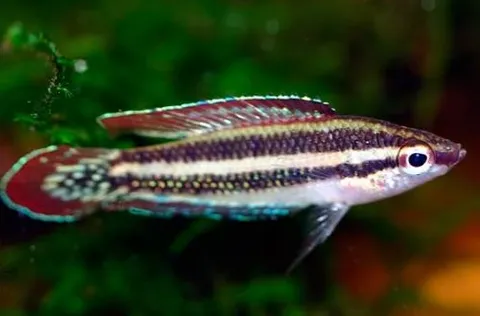
Parosphromenus quindecim, known as the Fifteen-rayed Licorice Gourami or Fifteen-rayed Betta, is a member of the Osphronemidae family. Its unusual name is due to the structure of its dorsal fin: unlike most relatives,…
Parosphromenus allani
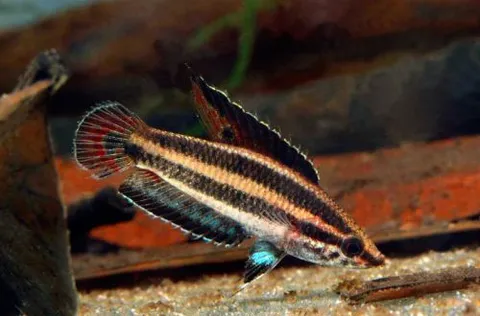
Parosphromenus allani, known as Allan's Licorice Gourami or Allan's Betta, belongs to the family Osphronemidae. It was named in honour of Allan Brown, who collected these fish in Sarawak, Borneo, in 1986; the species…
Parosphromenus alfredi
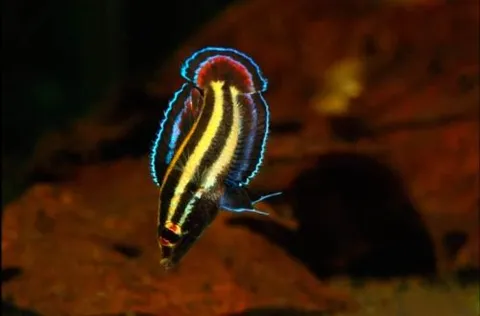
Parosphromenus alfredi, also known as Alfred's Licorice Gourami, belongs to the family Osphronemidae. This species was named in honor of Eric Alfred, former director of the National Museum of Singapore, whose…
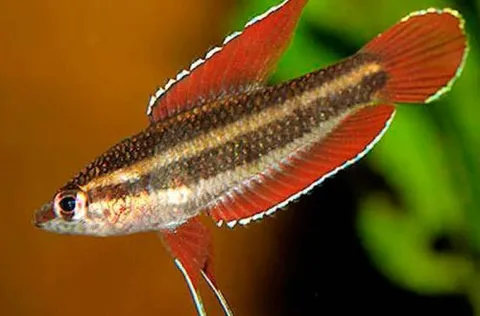
Parosphromenus anjunganensis
Inhabiting waters near the city of Anjungan, Parosphromenus anjunganensis, or Anjungan Licorice Gourami, belongs to the family Osphronemidae, receiving its scientific name from this locality. Keeping this fish is…