Temperature20 – 25 °C
Natural range
- Guangdong Province area
- Guangxi Province area
LoachesConservation status: Data deficient DD
Other scientific names: Botia gigantea, Botia pulchra
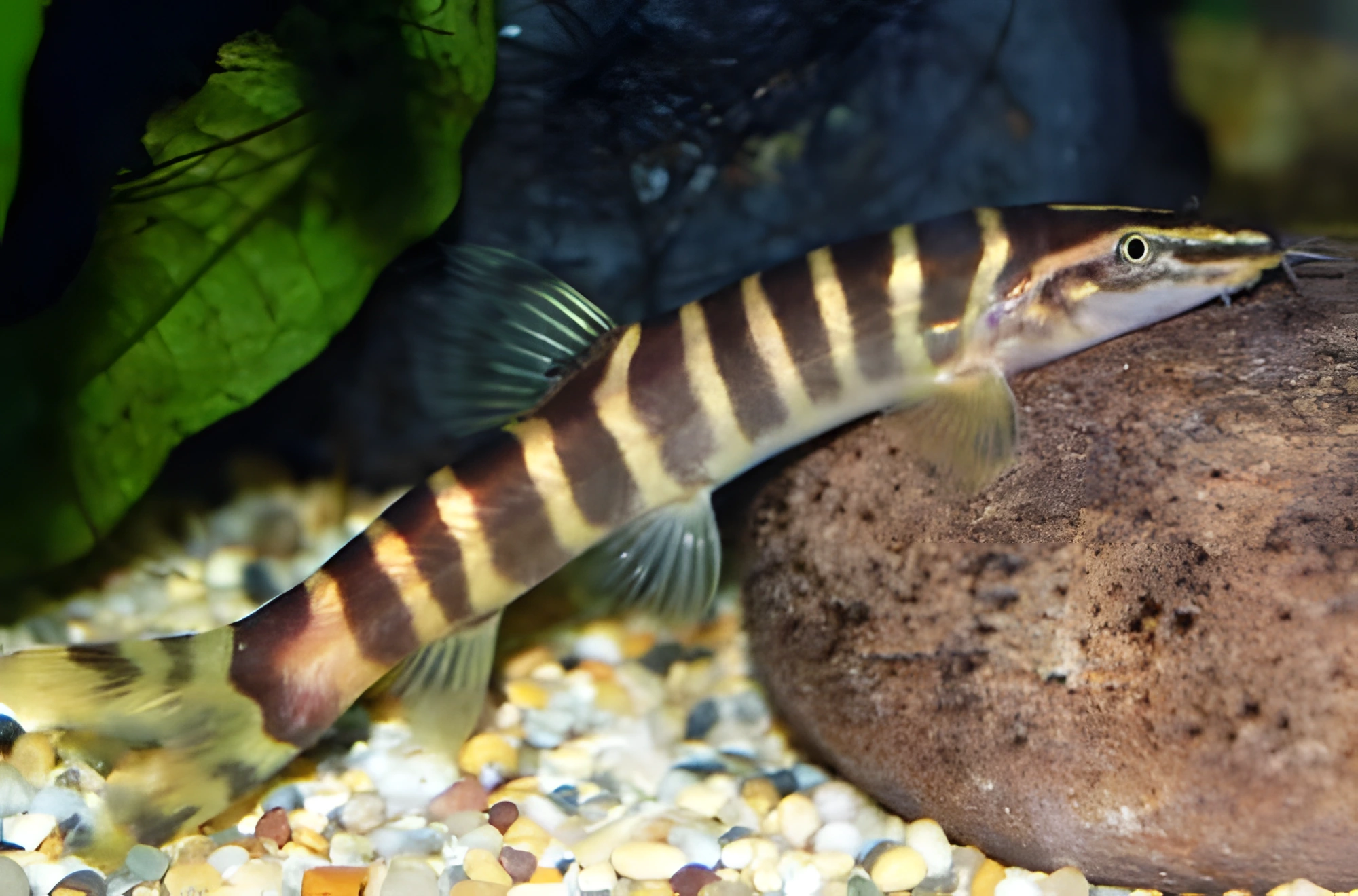
Botia pulchra, or Golden Zebra Loach (scientific name Sinibotia pulchra), belongs to the family Cobitidae (Loaches). This fish is characterized by its peaceful nature and undemanding care requirements, making it an excellent choice for a community aquarium. Its ease of care and good compatibility with many popular aquarium species allow it to be confidently recommended as an excellent inhabitant for both beginner and experienced aquarists.
- Required aquarium volume
- 100 L
- Size in aquarium
- 8 – 11 cm
- Temperature
- 20 – 25 °C
- Temperament
- Peaceful (regular)
Parameters
Water pHNeutral (6.5) – Slightly alkaline (8)
Water dHVery soft (2) – Hard (15)
Water salinityno salt (freshwater)
Size in aquarium8 – 11 cm
Lifespan7 years
TemperamentPeaceful (regular)
Toward small fishnot a predator
Required aquarium volume100 L
Lightingweak or moderate
Substraterocky (rock formations, boulders, etc.)
Water flowweak or moderate
FeedingSinking (any)
CareSmall group (3–4 individuals)
Description
Adults typically reach 8–11 cm in length. Sexual dimorphism is weakly expressed: females are generally slightly larger than males, but no other obvious differences between the sexes are observed. The fish has an elongated body and a pointed head. Sensitive barbels are located near the mouth, which help it find food on the aquarium bottom. The body coloration consists of alternating stripes of brown and yellow hues.
Habitat
The natural habitat of these fish covers the extensive Pearl River basin, located in southwestern China in Guangdong and Guangxi provinces. These provinces are the most densely populated and industrially developed in the country. The main population is found in the upper reaches of the river, as the lower sections and tributaries are significantly polluted. Botias prefer areas with clean water, moderate currents, and rocky bottoms.
Behavior and Compatibility
Botia pulchra generally leads a secretive lifestyle, preferring secluded corners of the aquarium, such as spaces between driftwood or under plant leaves. The highest activity is observed during feeding. This species coexists well with many non-aggressive fish. Keeping them in a group of at least 3–4 individuals is an important condition; with fewer numbers, the fish may show aggression towards tankmates.
Care and Maintenance
For a group of 3–4 individuals, the optimal aquarium volume starts from 100 liters. The aquarium setup can be arbitrary, depending on the aquarist's preferences. If you wish to create conditions as close as possible to their natural habitat, you can use a rocky substrate with several large boulders, driftwood, and small clusters of plants such as spiral Vallisneria, Anubias, mosses, and ferns. Maintaining high water quality with appropriate hydrochemical parameters is a key aspect when keeping Botia pulchra. This requires an effective filtration system, regular removal of organic waste, and weekly water changes of 30–50% of the volume with fresh water.
Diet
This species is not demanding regarding its diet, readily accepting various types of food, including dry, frozen, and live. However, despite their omnivorous nature, it is crucial to provide a varied diet combining several types of products. A monotonous diet should be avoided to maintain the fish's health.
Breeding and Reproduction
In their natural environment, the breeding period coincides with the rainy seasons, which stimulates fish migration to flooded areas for spawning. Thus, Botia pulchra spawning is triggered by a complex of external factors that are practically impossible to reproduce in aquarium conditions. Therefore, fry are usually obtained in large quantities at commercial fish farms using hormonal preparations.
Diseases
Non-ornamental fish species that have retained a close resemblance to their wild relatives usually exhibit high endurance, strong immunity, and resistance to various diseases. The occurrence of health problems most often indicates unsuitable keeping conditions. Therefore, before proceeding with treatment, it is strongly recommended to check the water quality and parameters. Only after all indicators have been brought back to normal should treatment begin, if it is still necessary. Detailed information on diseases, their symptoms, and therapy methods can be found in the “Aquarium Fish Diseases” section.
How to choose
When choosing Botia pulchra, attention should be paid to the activity and appearance of the individuals. A healthy fish should show curiosity, be active, and have clean skin without white spots, ulcers, or damage. Since this species has no scales, any signs of injury or film on the body indicate unsatisfactory conditions in the store, which can lead to the rapid death of the fish after purchase.
- Check the integrity of the barbels around the mouth: they should be symmetrical and show no signs of erosion.
- Prefer individuals with clear coloration and no signs of emaciation, such as a sunken belly.
- Given the schooling nature of the species, it is recommended to acquire a group of at least 3–5 individuals, as solitary keeping causes severe stress in fish and makes them more vulnerable to diseases.
Frequently asked questions
The essentials: size, tank volume, water parameters and care
How big does Botia pulchra get?
An adult reaches 8–11 cm in length. Plan the tank around the maximum size: the fish quickly outgrows a cramped setup.
What size aquarium does Botia pulchra need?
The minimum recommended volume is 100 L. A smaller tank speeds up nitrate build-up and raises stress levels.
What water parameters does Botia pulchra need?
Temperature 20–25 °C, pH 6.5–8, hardness 2–15 dGH. Stability matters more than exact values: sudden swings are harder on the fish than a small deviation from the ideal.
How long does Botia pulchra live?
Around 7 years when kept properly. Lifespan depends directly on tank volume, water quality and a varied diet.
Is Botia pulchra aggressive?
Temperament: peaceful (regular). Keep this in mind when choosing tank mates.
How many Botia pulchra should be kept together?
Recommended setup: small group (3–4 individuals). Ignoring this is a common cause of stress and disease.
What does Botia pulchra eat?
Diet type: sinking (any). Feed small portions that are finished within a couple of minutes — overfeeding does more harm than underfeeding.
What is the scientific name of Botia pulchra?
The scientific name of the species is Sinibotia pulchra, family Cobitidae (Loaches). It also appears in the literature as: Botia gigantea, Botia pulchra.