Temperature22 – 28 °C
Natural range
- Myanmar area
- Manipur area
LoachesConservation status: Least concern LC
The Burmese Border Loach, also known as Botia histrionica (scientific name Botia histrionica), belongs to the family Cobitidae, or True Loaches. It is a peaceful and friendly fish with a unique body pattern. It coexists well with many other aquarium species. Keeping Botia histrionica is not particularly difficult and does not require significant time or financial investment. For these reasons, it can be recommended even to beginner aquarists.
- Required aquarium volume
- 240 L
- Size in aquarium
- 11 – 13 cm
- Temperature
- 22 – 28 °C
- Temperament
- Peaceful (regular)
Parameters
Water pHSlightly acidic (6) – Neutral (7.5)
Water dHVery soft (2) – Medium hardness (10)
Water salinityno salt (freshwater)
Size in aquarium11 – 13 cm
Lifespan8 years
TemperamentPeaceful (regular)
Toward small fishnot a predator
Required aquarium volume240 L
Lightingweak or moderate
Substraterocky (rock formations, boulders, etc.)
Water flowweak or moderate
FeedingAny (universal)
CareSmall group (5–6 individuals)
Description
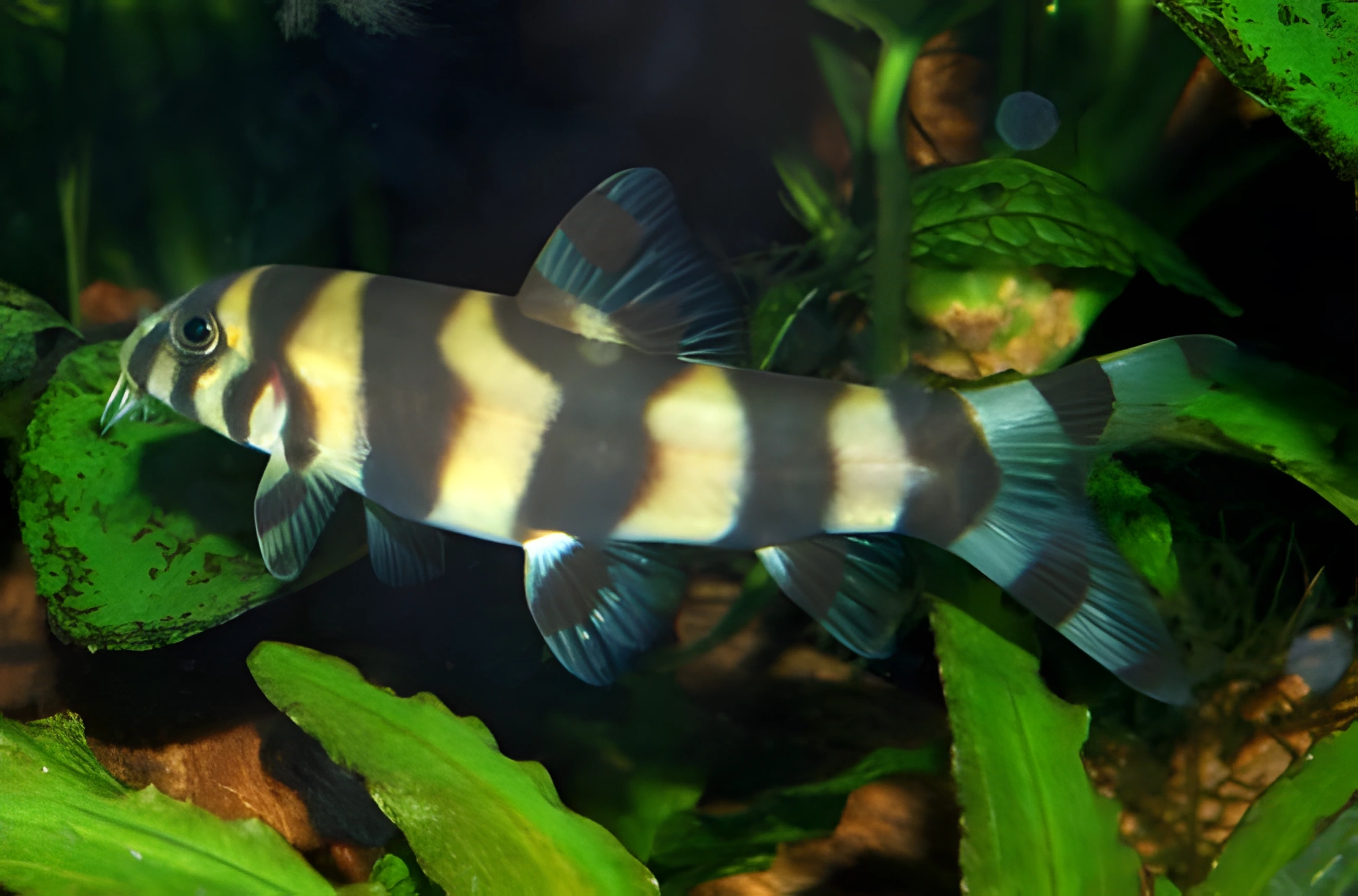
Adults of this fish reach a length of approximately 11–13 cm. Sexual dimorphism is weakly expressed; they differ only in size. Females are usually slightly larger than males. The body coloration consists of alternating broad bands of dark and light shades. Young fish are characterized by rich yellow and brown tones. However, with age, their coloration fades, and the dark bands gradually transform into irregularly shaped patterns.
Habitat
Its natural habitat is in Southeast Asia, specifically in the Irrawaddy River basin, which flows through modern-day Burma, the Indian state of Manipur, and the Chinese province of Yunnan. Botia histrionica prefers to live in sections of rivers with relatively slow currents amidst tropical forests. The typical habitat is characterized by a sand and gravel substrate, abundantly strewn with snags and fallen leaves, while the water remains clean and flowing.
Behavior and Compatibility
This peaceful and active fish can both actively dig through the bottom in search of food and remain in one place for a long time, hiding in some shelter. Such behavior is quite natural for this species. It coexists well with many non-aggressive fish of similar size. Nevertheless, it should be avoided to keep it together with species that have long, flowing fins. Such fins can be damaged by Botia histrionica, and moreover, fish with flowing fins will feel uncomfortable in conditions of moderate water current.
Care and Maintenance
For a group consisting of 5–6 fish, an aquarium of at least 240 L is recommended. The decor can be arbitrary, but it must provide a sufficient number of shelters. Typical decor elements include a sandy or rocky substrate with large boulders, snags imitating tree roots and branches, and several hardy plants. Since the lighting level should be subdued, shade-loving plant varieties, mosses, or ferns should be preferred. For successful keeping of these fish, it is necessary to strictly observe the following conditions: maintaining high water quality with appropriate hydrochemical parameters, as well as regular removal of organic waste (uneaten food residues, excrement, plant fragments, etc.). The presence of a moderate current in the aquarium is desirable, but not strictly mandatory.
Diet
This fish is undemanding in terms of diet. In a home aquarium, you can offer it a wide variety of foods: dry mixes, frozen, and live foods. It is also very important to include vegetable supplements in the diet. Spirulina flakes or chopped pieces of fresh vegetables and fruits such as melon, cucumber, spinach, apples, and others are suitable for this purpose. If there is a lack of plant components, the fish may begin to damage the leaves of aquarium plants.
Breeding and Reproduction
At the time of preparing this article, there are no documented cases of successful breeding of Botia histrionica in home aquariums. Breeding these fish is carried out on a commercial basis in large fish farms using hormonal methods.
Diseases
Non-ornamental fish species that have retained a close resemblance to their wild relatives usually exhibit high endurance, strong immunity, and resistance to various diseases. The occurrence of health problems most often indicates unsuitable keeping conditions. Therefore, before proceeding with treatment, it is strongly recommended to check the water quality and parameters. Only after all indicators have been brought back to normal should treatment begin, if it is still necessary. Detailed information on diseases, their symptoms, and therapy methods can be found in the “Aquarium Fish Diseases” section.
How to choose
When choosing Botia histrionica in a store, pay attention to the activity and appearance of the fish. Healthy individuals should be active, curious, and actively explore the bottom of the aquarium. Avoid specimens with signs of emaciation, sunken bellies, or skin damage, as these fish have no scales and are extremely sensitive to water quality and stress during transportation.
- refuse to buy if there are individuals with white spots on their bodies in the aquarium with the fish, which may indicate parasitic diseases;
- prefer individuals measuring 5 cm or more, as smaller specimens are often weakened and adapt worse to new conditions;
- make sure that the fish do not have visible fin damage or ulcers, which may indicate bacterial infections that developed due to poor keeping conditions in the store.
Frequently asked questions
The essentials: size, tank volume, water parameters and care
How big does Burmese Border Loach get?
An adult reaches 11–13 cm in length. Plan the tank around the maximum size: the fish quickly outgrows a cramped setup.
What size aquarium does Burmese Border Loach need?
The minimum recommended volume is 240 L. A smaller tank speeds up nitrate build-up and raises stress levels.
What water parameters does Burmese Border Loach need?
Temperature 22–28 °C, pH 6–7.5, hardness 2–10 dGH. Stability matters more than exact values: sudden swings are harder on the fish than a small deviation from the ideal.
How long does Burmese Border Loach live?
Around 8 years when kept properly. Lifespan depends directly on tank volume, water quality and a varied diet.
Is Burmese Border Loach aggressive?
Temperament: peaceful (regular). Keep this in mind when choosing tank mates.
How many Burmese Border Loach should be kept together?
Recommended setup: small group (5–6 individuals). Ignoring this is a common cause of stress and disease.
What does Burmese Border Loach eat?
Diet type: any (universal). Feed small portions that are finished within a couple of minutes — overfeeding does more harm than underfeeding.
What is the scientific name of Burmese Border Loach?
The scientific name of the species is Botia histrionica, family True Loaches (Cobitidae).