Temperature26 – 28 °C
Natural range
- Lake Malawi area
- Boadzulu Island area
CichlidsConservation status: Endangered EN
Other scientific names: Copadichromis boadzulu, Cyrtocara boadzulu, Haplochromis boadzulu
The fish, known scientifically as Nyassachromis boadzulu, is a member of the Cichlidae family, or Cichlids. Previously, the species was designated as Haplochromis boadzulu, hence the frequently used prefix "Haplochromis." This is a peaceful and colorful fish, although only males boast vibrant coloration. Females, on the other hand, have a more modest appearance. Keeping this species does not cause much trouble, provided a suitable habitat is created for it.
- Required aquarium volume
- 300 L
- Size in aquarium
- 13 – 17 cm
- Temperature
- 26 – 28 °C
- Temperament
- Semi-peaceful (including aggression during spawning / intraspecific conflicts)
Parameters
Water pHSlightly alkaline (7.6) – Slightly alkaline (8.5)
Water dHMedium hardness (10) – Very hard (25)
Water salinityno salt (freshwater)
Size in aquarium13 – 17 cm
Lifespan7 years
TemperamentSemi-peaceful (including aggression during spawning / intraspecific conflicts)
Toward small fishnot a predator
Required aquarium volume300 L
Lightingdimmed or moderate
Substratefine sand
Water flowweak or moderate
FeedingPlant-based (algae, vegetables)
CareHarem (1 male and several females)
Description
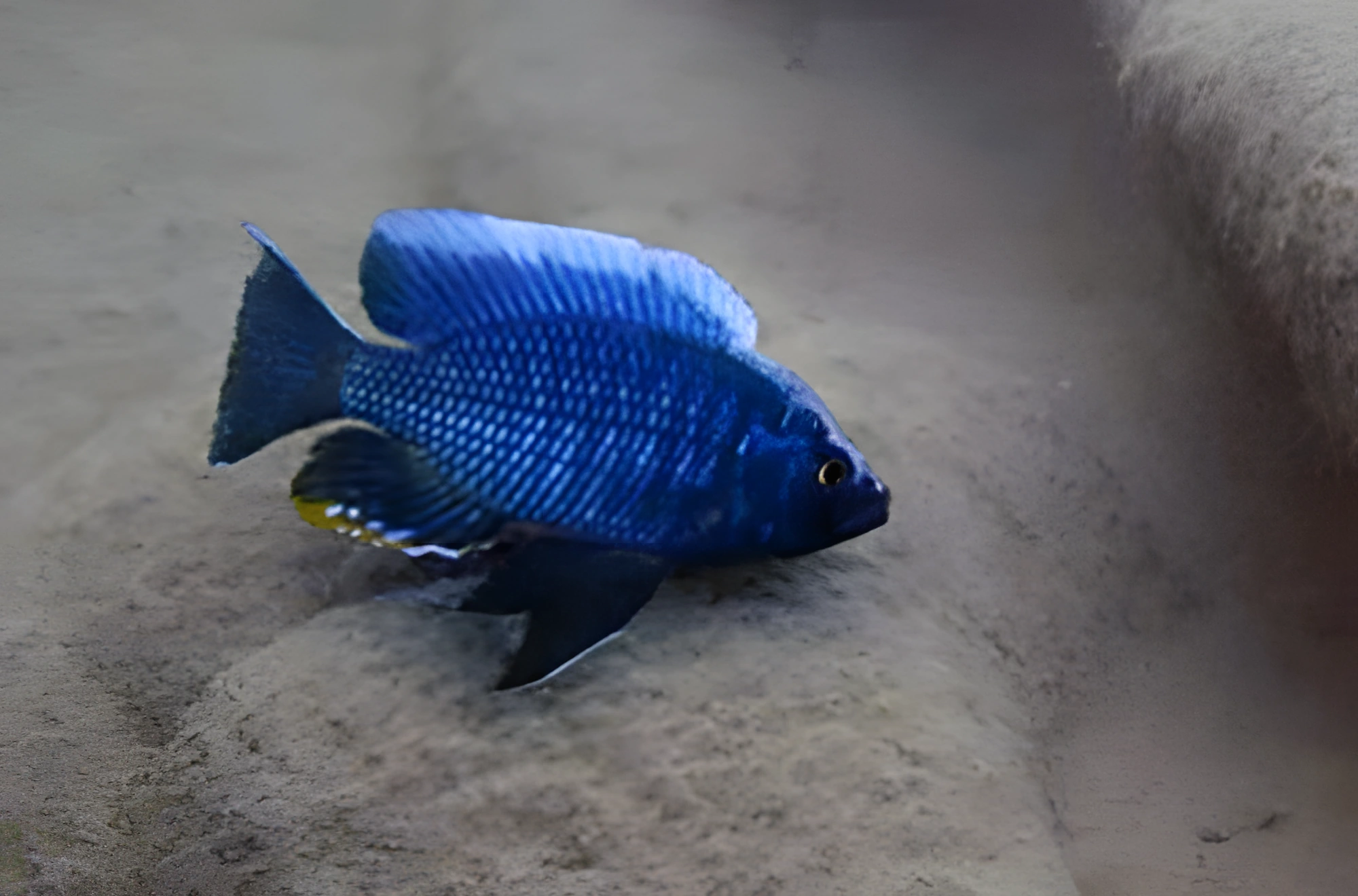
Males of this species reach up to 17 cm in length and display a rich blue coloration, complemented by a barely noticeable pattern of dark vertical stripes. A light stripe runs along the edge of the dorsal fin, extending over part of the back and head area. The anal fin, which has a dark blue hue, is adorned with blue speckles, and its lower edge is contrastingly colored yellow. Females are significantly smaller, growing up to 13 cm, and have a gray or silvery body coloration, with a dark stripe pattern similar to that of males.
Habitat
This species is endemic to Lake Nyasa, located in the East African Rift Valley on the border of Malawi, Tanzania, and Mozambique. Boadzulu prefers to inhabit the southern part of the lake, near Boadzulu and White Rock islands, in shallow open waters over sandy areas.
Behavior and Compatibility
Given the specific water composition of Lake Nyasa, ideal tankmates for Boadzulu in an aquarium would be other species inhabiting a similar biotope, such as Utaka cichlids or Aulonocara. When kept in very large volumes, 1000 liters or more, cohabitation with Mbuna group members is permissible. Boadzulu are peaceful and get along well with their conspecifics; in their natural environment, they often form large schools. However, in the confined space of an aquarium, their behavior may change, especially during the breeding season. Males may compete with each other, so to reduce aggression, it is advisable to form harem groups consisting of one male and several females.
Care and Maintenance
Boadzulu cichlids require a sufficiently spacious aquarium for active swimming; for a group of 3–5 individuals, a volume of 300–350 liters is recommended. The tank setup is quite minimalistic and usually includes a sandy substrate combined with piles of rocks and boulders. The presence of plants is not mandatory, but several species that can grow well in an alkaline environment can be chosen. For successful and long-term keeping, it is critically important to maintain stable hydrochemical water parameters with high pH and dGH values. Aquarium care is straightforward and involves weekly partial water changes with fresh water, as well as the removal of accumulated organic waste, such as food remnants and excrement. These procedures are usually conveniently combined.
Diet
In their natural habitat, the diet of these fish consists of zooplankton, which they filter from the water column. In a home aquarium, it is important to provide them with appropriate nutrition, including small invertebrates such as Artemia, bloodworms, and Daphnia. Specialized foods for Utaka cichlids, offered by many manufacturers, will also be an excellent choice.
Breeding and Reproduction
During the breeding season, the male begins to construct a sand crater at the bottom of the aquarium, which is a mound or hillock with a depression in the center, and this place will subsequently become the spawning area. He then begins to court the female, sometimes showing excessive persistence. When the female is ready to spawn, the pair lays several dozen eggs. After fertilization, the female takes the eggs into her mouth, where they will remain throughout the incubation period. This unique method of brooding eggs is the result of evolutionary adaptation to a highly competitive external environment. Fry appear after 3–4 weeks. In the first few days, they stay in close proximity to the female, forming a small cloud, and if danger arises, they can hide back in her mouth. This behavior continues until the fry reach a sufficiently large size.
Diseases
In a favorable and stable environment, diseases among Boadzulu cichlids are extremely rare. However, the most common ailment in this group of cichlids is Malawi Bloat, which most often occurs due to keeping fish in unsuitable conditions, particularly at low pH and dGH values. More detailed information on symptoms and treatment methods can be found in the "Diseases of Aquarium Fish" section.
How to choose
When selecting individuals, attention should be paid to their activity and the cleanliness of their skin. A healthy fish should show curiosity, have smooth scales without visible damage, ulcers, or white film. In the store, it is important to assess the conditions of keeping and the behavior of the fish: they should not be lethargic or hide in the corners of the aquarium, unless this is due to stress from relocation.
- avoid purchasing individuals with sunken bellies or signs of emaciation
- check for the absence of rapid breathing and unnatural spots on the fins
- prefer fish with bright, clear coloration characteristic of the species
- ensure that no aggressive species capable of injuring the fish are kept in the same aquarium with them
When purchasing, it is advisable to ask the seller about the diet and water parameters to which the fish are adapted. Quarantine after acquisition is mandatory to prevent the introduction of infections into the main aquarium.
Frequently asked questions
The essentials: size, tank volume, water parameters and care
How big does Boadzulu get?
An adult reaches 13–17 cm in length. Plan the tank around the maximum size: the fish quickly outgrows a cramped setup.
What size aquarium does Boadzulu need?
The minimum recommended volume is 300 L. A smaller tank speeds up nitrate build-up and raises stress levels.
What water parameters does Boadzulu need?
Temperature 26–28 °C, pH 7.6–8.5, hardness 10–25 dGH. Stability matters more than exact values: sudden swings are harder on the fish than a small deviation from the ideal.
How long does Boadzulu live?
Around 7 years when kept properly. Lifespan depends directly on tank volume, water quality and a varied diet.
Is Boadzulu aggressive?
Temperament: semi-peaceful (including aggression during spawning / intraspecific conflicts). Keep this in mind when choosing tank mates.
How many Boadzulu should be kept together?
Recommended setup: harem (1 male and several females). Ignoring this is a common cause of stress and disease.
What does Boadzulu eat?
Diet type: plant-based (algae, vegetables). Feed small portions that are finished within a couple of minutes — overfeeding does more harm than underfeeding.
What is the scientific name of Boadzulu?
The scientific name of the species is Nyassachromis boadzulu, family Cichlids (Cichlidae). It also appears in the literature as: Copadichromis boadzulu, Cyrtocara boadzulu, Haplochromis boadzulu.