Temperature20 – 24 °C
Natural range
- Northern Peru area
- Western Ecuador area
CichlidsConservation status: Least concern LC
Other scientific names: Acara aequinoctialis, Aequidens azurifer, Aequidens rivulatus, Chromis rivulata
Andinoacara rivulatus, more commonly known as the Turquoise Acara, belongs to the Cichlidae family. This large and strikingly beautiful fish, however, is characterized by pronounced aggression and requires keeping in a sizable aquarium equipped with a powerful filtration system.
- Required aquarium volume
- 300 L
- Size in aquarium
- 22 – 30 cm
- Temperature
- 20 – 24 °C
- Temperament
- Aggressive / incompatible / unfriendly
Parameters
Water pHNeutral (6.5) – Slightly alkaline (8)
Water dHSoft (5) – Very hard (25)
Water salinityno salt (freshwater)
Size in aquarium22 – 30 cm
Lifespan10 years
TemperamentAggressive / incompatible / unfriendly
Toward small fishnot a predator
Required aquarium volume300 L
Lightingdimmed
Substratesandy (regular, light)
Water flowweak or moderate
FeedingAny (universal)
CarePair (male/female)
Description
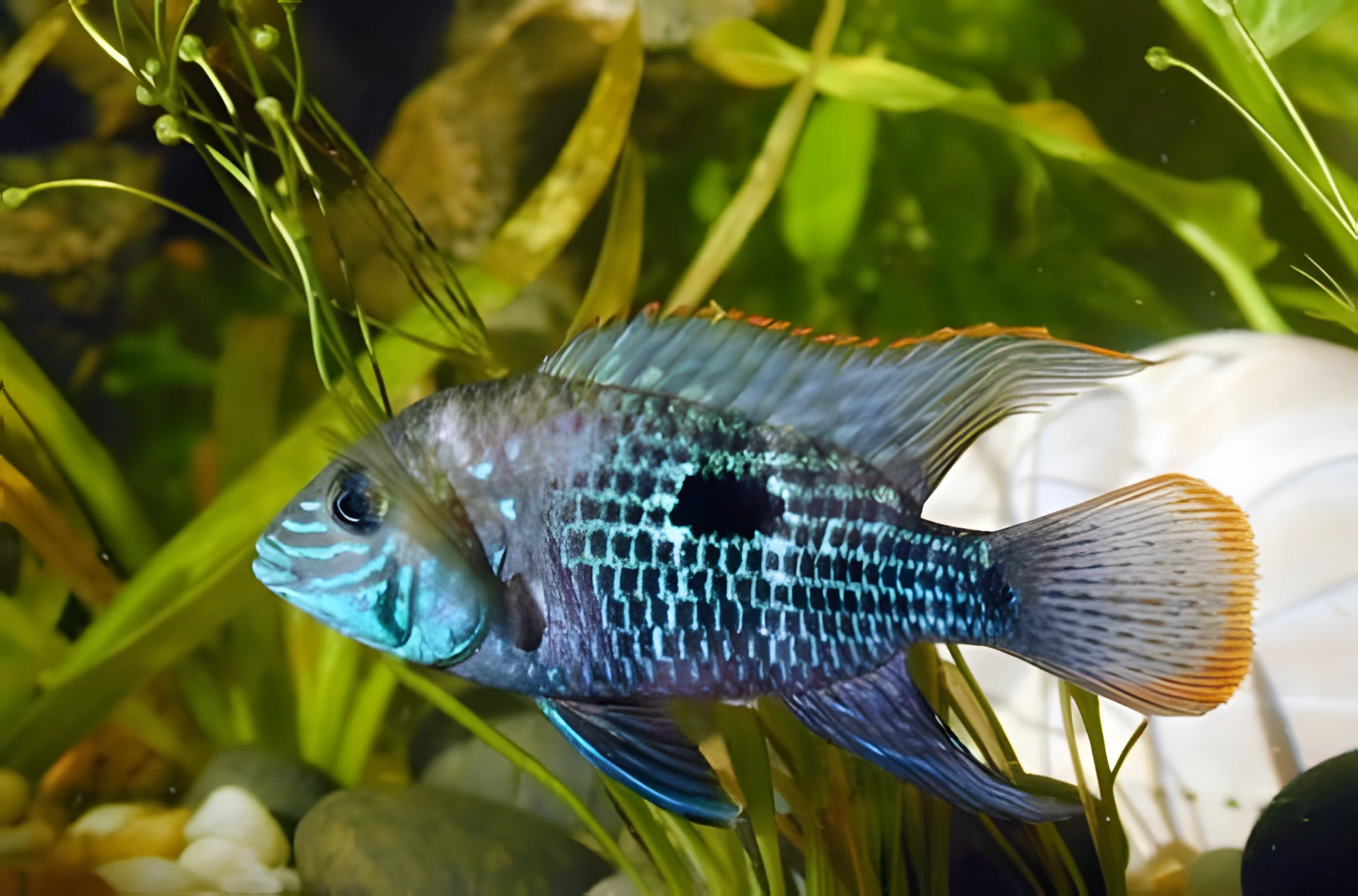
Adult males reach 30 cm in length, with their distinctive features being elongated dorsal and anal fins, as well as a noticeable nuchal hump. In their natural environment, this hump develops only during the breeding season, but in aquarium conditions, it persists permanently. Females are significantly smaller and do not have such pronounced features. The fish's coloration is a turquoise hue, falling between blue and green, with numerous black spots on each scale. This pattern extends to the fins. The dorsal and caudal fins are adorned with an orange fringe.
Habitat
The natural habitat of this fish extends across the northern regions of Peru and along the western coast of Ecuador. It is found in South America, inhabiting river deltas that flow into the ocean, as well as streams and small rivers winding down the gentle slopes of tropical forests. It can often be seen in coastal zones, and less frequently in open waters.
Behavior and Compatibility
The Turquoise Acara is an aggressive territorial species that can attack not only other fish but also its own kind. In smaller aquariums, it is possible to keep only one adult specimen or an already formed pair (male/female). In larger tanks (over 600 L), it can coexist with large catfish, cichlids, or characins, but in such a case, the Turquoise Acara should be a single specimen. Otherwise, when the breeding season arrives and it finds a partner, it can be dangerous for other inhabitants.
Care and Maintenance
For keeping a single Turquoise Acara, an aquarium volume of at least 300 L is necessary. For decor, a sandy substrate is preferred, supplemented with various snags and rock formations. Artificial, as well as floating, vegetation can also be used to give the aquarium an aesthetic look. Lighting should be subdued. It is important to note that the Turquoise Acara is not favorable to live plants: they are likely to be uprooted or severely damaged. All decor elements must be securely fixed so that such a large fish cannot overturn or destroy them. Although hydrochemical parameters (pH and dGH) can have a wide range of acceptable values, simplifying water preparation, maintaining high water quality can be a challenge due to the significant volume of organic waste (given the fish's size) and the absence of plants capable of partially purifying the water. Therefore, a powerful filtration system is an essential condition, supplemented by regular aquarium cleaning.
Diet
This species is omnivorous and does not have specific dietary requirements. It is recommended to use specialized foods developed for South American cichlids, as they contain all necessary trace elements. To enrich the diet, live or frozen foods such as earthworms, as well as finely chopped shrimp or mussel meat, can be included.
Breeding and Reproduction
This species forms stable pairs that can last throughout the fish's life. The exact mechanism of partner selection in Acara is still unknown, and not all fish can successfully pair up. For example, introducing a female to an adult male often results in her demise. However, if fish grow together in a group of 6–10 individuals from a young age, by the time they reach sexual maturity, there is a chance of at least one pair forming. Ideal conditions for spawning include soft, slightly acidic water with a temperature not exceeding 24°C. The stimulus for the start of the breeding period is a single replacement of a significant portion of the water (30–50%) with slightly cooler water. Before laying eggs, the female chooses a suitable spot — this could be a depression in the substrate, a flat stone, or any other decor element. A single clutch can contain up to 400 eggs. After fertilization, the female stays near the eggs, while the male patrols the territory, guarding its boundaries from intruders. It is important to note that during this period, he becomes unusually combative and capable of eliminating a potential intruder. The incubation period lasts approximately 3–4 days, and after another week, the fry begin to swim freely, preferring to stay near the female, who continues to protect them. Parental care lasts for several weeks.
Diseases
The main cause of most diseases in Leaf Fish is unsuitable keeping conditions and poor-quality nutrition. If initial symptoms are observed, it is first necessary to check water parameters and the concentration of dangerous substances such as ammonia, nitrites, and nitrates. If the indicators deviate from the norm, they should be brought back into order, and only then should treatment begin. More detailed information on symptoms and treatment methods can be found in the "Aquarium Fish Diseases" section.
How to choose
When purchasing, choose active specimens with clean scales and clear eyes. Avoid fish with signs of emaciation, sunken bellies, or fin damage, as these cichlids are prone to stress during transportation and poor keeping conditions. In the store, assess their behavior: a healthy fish shows curiosity and territoriality, whereas an apathetic state or constant attempts to hide may indicate hidden diseases. Given the high level of intraspecific aggression, it is recommended to acquire young specimens from the same group to make it easier to form a compatible pair later on.
Frequently asked questions
The essentials: size, tank volume, water parameters and care
How big does Turquoise Acara get?
An adult reaches 22–30 cm in length. Plan the tank around the maximum size: the fish quickly outgrows a cramped setup.
What size aquarium does Turquoise Acara need?
The minimum recommended volume is 300 L. A smaller tank speeds up nitrate build-up and raises stress levels.
What water parameters does Turquoise Acara need?
Temperature 20–24 °C, pH 6.5–8, hardness 5–25 dGH. Stability matters more than exact values: sudden swings are harder on the fish than a small deviation from the ideal.
How long does Turquoise Acara live?
Around 10 years when kept properly. Lifespan depends directly on tank volume, water quality and a varied diet.
Is Turquoise Acara aggressive?
Temperament: aggressive / incompatible / unfriendly. Keep this in mind when choosing tank mates.
How many Turquoise Acara should be kept together?
Recommended setup: pair (male/female). Ignoring this is a common cause of stress and disease.
What does Turquoise Acara eat?
Diet type: any (universal). Feed small portions that are finished within a couple of minutes — overfeeding does more harm than underfeeding.
What is the scientific name of Turquoise Acara?
The scientific name of the species is Andinoacara rivulatus, family Cichlids (Cichlidae). It also appears in the literature as: Acara aequinoctialis, Aequidens azurifer, Aequidens rivulatus.