Temperature21 – 24 °C
Natural range
- West Kalimantan area
- Borneo area
Labyrinth fishConservation status: Data deficient DD
Betta enisae, or as it is often called, the Energetic Betta, belongs to the family Osphronemidae, receiving its Russian name through adaptive translation from Latin. Despite this, one should not expect high mobility from this fish; it usually moves calmly around the aquarium. However, placing two males together can disrupt the peaceful flow of life. This species is not recommended for beginner aquarists who plan to maintain the aquarium themselves, due to specific requirements for water hydrochemical composition.
- Required aquarium volume
- 40 L
- Size in aquarium
- 5 – 6 cm
- Temperature
- 21 – 24 °C
- Temperament
- Peaceful (regular)
Parameters
Water pHSlightly acidic (5.5) – Neutral (7)
Water dHVery soft (1) – Soft (5)
Water salinityno salt (freshwater)
Size in aquarium5 – 6 cm
Lifespan3 years
TemperamentPeaceful (regular)
Toward small fishnot a predator
Required aquarium volume40 L
Lightingdimmed
Substrateany (no restrictions)
Water flownone or stagnant (no flow)
FeedingAny (universal)
CareMixed (solitary / pair / group)
Description
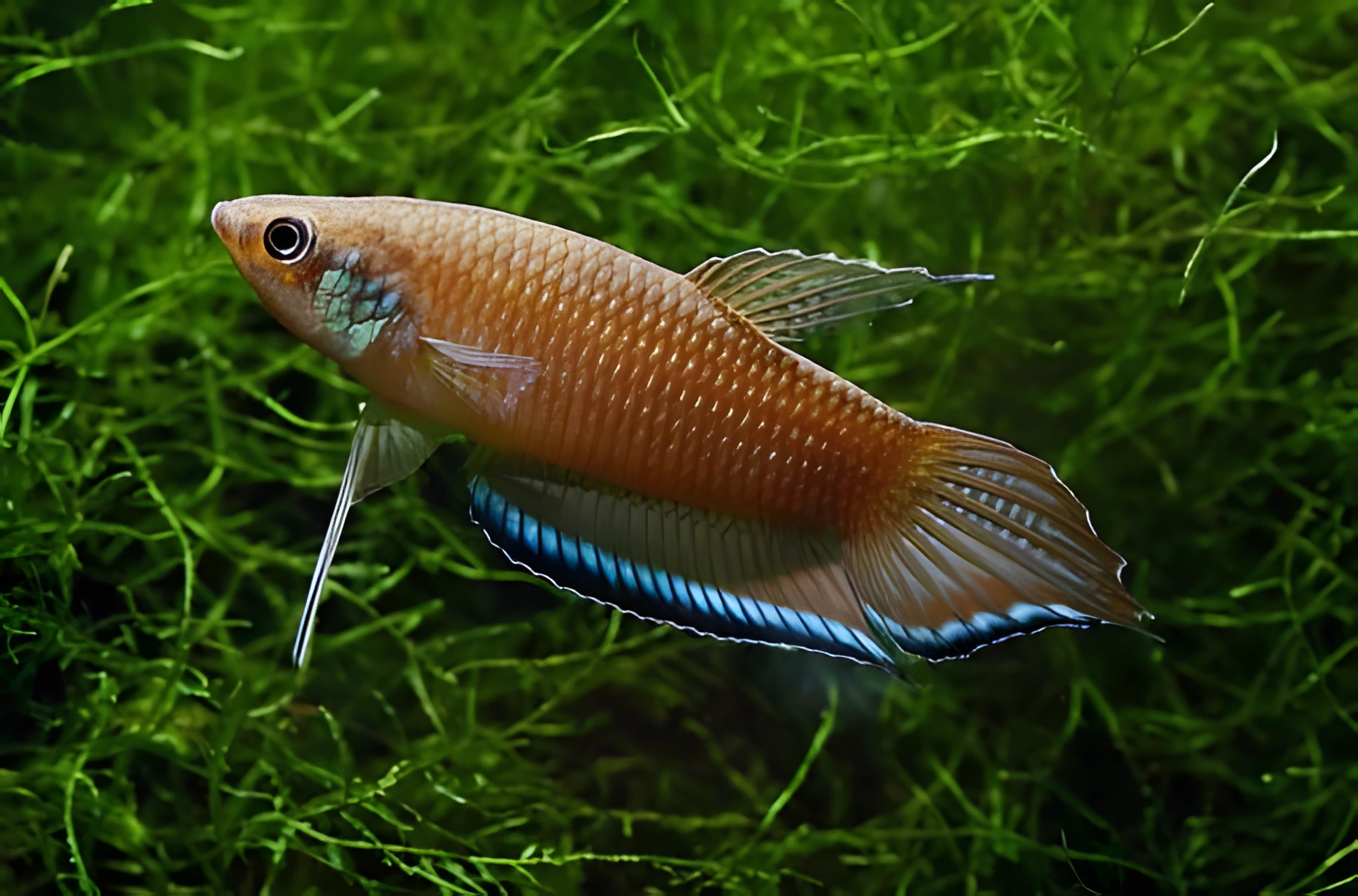
Adults reach a length of 5 to 6 cm. These fish are characterized by a large body and expressive fins with elongated tips. Males typically have a reddish coloration, and their anal fin and tail are bordered by a black-turquoise stripe. Females, as a rule, are light gray, with rows of horizontal dark stripes.
Habitat
Its natural habitat is in Southeast Asia, on the Indonesian part of Borneo island, in the West Kalimantan region. These fish inhabit the Kapuas River basin, preferring swamps and associated streams located deep within humid tropical forests. The bodies of water are shallow and poorly lit by the sun due to the dense tree canopy. The bottom is often covered with a layer of fallen vegetation, such as leaves and twigs. The decomposition of these materials leads to the release of humic acids and other substances that give the water a rich brown tint.
Behavior and Compatibility
Although these fish belong to the Betta group, their temperament is not as aggressive as one might assume. Intraspecific relationships between males are based on competition for dominance, but fierce fights usually do not occur. As a rule, after a display of strength, the weaker individual prefers to retreat. Towards other species, they behave quite peacefully and get along well with fish of comparable size.
Care and Maintenance
The optimal aquarium volume for keeping a single pair is a minimum of 40 liters. It is not uncommon to find fish in pet stores and from breeders in minimalist tanks without any decor, which sometimes gives beginners the mistaken impression of bettas' unpretentiousness. However, such an environment is only temporary and far from ideal. For long-term and successful keeping in a home aquarium, it is important to recreate conditions as close as possible to the natural biotope. This implies subdued lighting, the use of dark substrate, the creation of numerous shelters from driftwood or decorative elements, and areas with dense thickets of shade-loving plants. A leaf litter will be an excellent addition, as the leaves of some trees not only serve as a natural decorative element but also, as they decompose, release tannins, enriching the water with a composition close to the fish's natural habitat. Another key aspect of keeping Betta enisae is maintaining biological balance. It is important that the main hydrochemical parameters are within an acceptable range, and that the maximum concentrations of nitrogen cycle products (ammonia, nitrites, nitrates) are not exceeded. Usually, an adequate filtration system and regular aquarium maintenance procedures, such as partial water changes and waste removal, are sufficient to maintain high water quality.
Diet
In their natural environment, these fish feed on small aquatic insects and zooplankton. In aquarium conditions, they successfully adapt to various alternative foods. For example, dry foods can be included in the daily diet, supplemented with live or frozen bloodworms, brine shrimp, and daphnia.
Breeding and Reproduction
During spawning, the fish do not lay eggs on the substrate or among plants, nor do they form clutches. The mechanism of offspring protection, which ensures the survival of most eggs, evolved under unstable environmental conditions with fluctuating water levels. Betta enisae incubates fertilized eggs in its mouth, with the male taking on this role. The incubation period lasts 9–12 days, after which fully formed fry emerge. Parents do not pose a threat to their offspring, but other fish may prey on the young, so to preserve them, it is recommended to transfer the fry to a separate tank with identical water conditions.
Diseases
Most health problems in fish often arise from unsuitable keeping conditions. Maintaining a stable and comfortable habitat is a key factor for successful keeping. If symptoms of illness appear, the first step is to check the water quality. If deviations are found, it is important to take immediate measures to eliminate them. If the symptoms do not disappear or worsen, medicinal treatment may be required. More detailed information on symptoms and treatment methods can be found in the "Diseases of Aquarium Fish" section.
How to choose
When choosing Betta enisae, it should be noted that the species is extremely rare in general sale, and other species, such as Betta breviobesa, are often sold under this name. When inspecting fish in a store, it is important to ensure that there are no white spots, ulcers, or fin damage on the fish's body, which may indicate bacterial infections or parasites. Healthy individuals should be active, show interest in their surroundings, and have clear, transparent eyes without cloudiness. Avoid buying fish that appear emaciated, stay near the water surface with labored breathing, or constantly hide in the corners of the aquarium, as this may indicate stress or poor health.
Frequently asked questions
The essentials: size, tank volume, water parameters and care
How big does Betta enisae get?
An adult reaches 5–6 cm in length. Plan the tank around the maximum size: the fish quickly outgrows a cramped setup.
What size aquarium does Betta enisae need?
The minimum recommended volume is 40 L. A smaller tank speeds up nitrate build-up and raises stress levels.
What water parameters does Betta enisae need?
Temperature 21–24 °C, pH 5.5–7, hardness 1–5 dGH. Stability matters more than exact values: sudden swings are harder on the fish than a small deviation from the ideal.
How long does Betta enisae live?
Around 3 years when kept properly. Lifespan depends directly on tank volume, water quality and a varied diet.
Is Betta enisae aggressive?
Temperament: peaceful (regular). Keep this in mind when choosing tank mates.
How many Betta enisae should be kept together?
Recommended setup: mixed (solitary / pair / group). Ignoring this is a common cause of stress and disease.
What does Betta enisae eat?
Diet type: any (universal). Feed small portions that are finished within a couple of minutes — overfeeding does more harm than underfeeding.
What is the scientific name of Betta enisae?
The scientific name of the species is Betta enisae, family Osphronemidae.