Temperature22 – 27 °C
Natural range
- Aceh area
- Sumatra area
Labyrinth fishConservation status: Vulnerable VU
Betta dennisyongi, also known as Dennis Yong's Betta, belongs to the family Osphronemidae. This fish received its scientific name in honor of the Indonesian naturalist and explorer, Dennis Yong Ghong Chong, who discovered and described many fish species inhabiting the Greater Sunda Islands. This species is not considered easy to keep, and its behavioral characteristics often complicate the selection of suitable tank mates. For this reason, Dennis Yong's Betta is not recommended for beginner aquarists.
- Required aquarium volume
- 40 L
- Size in aquarium
- 3 cm
- Temperature
- 22 – 27 °C
- Temperament
- Peaceful (regular)
Parameters
Water pHSlightly acidic (5) – Neutral (7)
Water dHVery soft (1) – Soft (5)
Water salinityno salt (freshwater)
Size in aquarium3 cm
Lifespan3 years
TemperamentPeaceful (regular)
Toward small fishnot a predator
Required aquarium volume40 L
Lightingdimmed
Substrateany, but dark
Water flownone or stagnant (no flow)
FeedingAny (universal)
CareMixed (solitary / pair / group)
Description
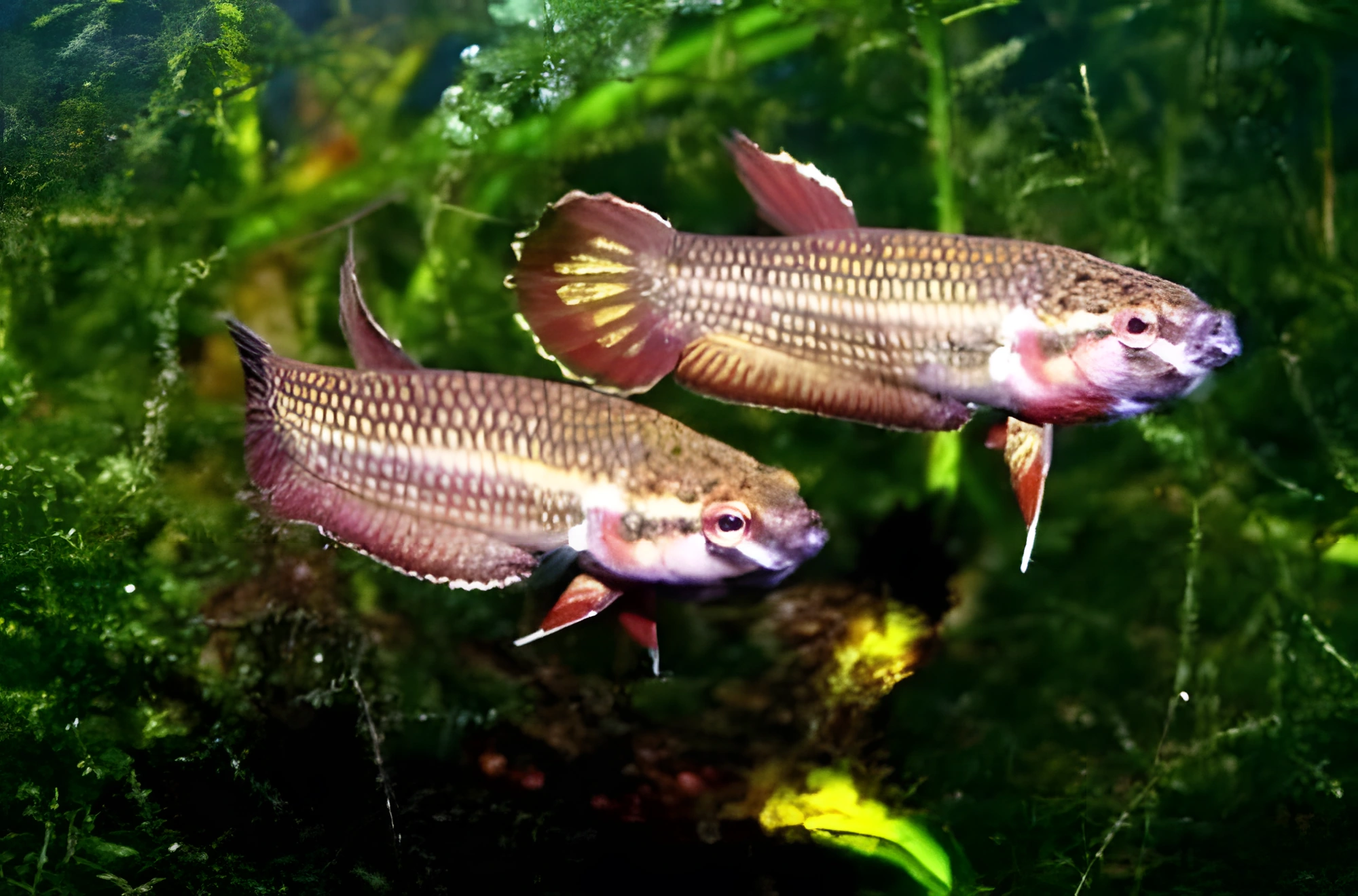
The appearance of these fish causes some confusion. Until 2013, they were identified as a subspecies of the Red Betta. However, this species was later recognized as distinct. Since both fish were previously supplied in common batches and kept together, this led to the appearance of hybrid offspring that inherited traits from both species. It is these hybrids and their descendants that are predominantly available for sale today. True Betta dennisyongi reach approximately 3 cm in length. Males are generally slightly larger than females, with a gray coloration and a distinct light horizontal stripe from head to tail. Red hues may appear on the body and fins. Hybrid individuals usually have noticeable red vertical streaks on their sides. Females have a more modest coloration, mainly in gray tones.
Habitat
The natural habitats of this species are found in Southeast Asia, specifically in the northern part of Sumatra Island in the Indonesian province of Aceh. The fish inhabit small rivers and streams that flow down from hills, as well as swampy areas located between elevations. A typical biotope is characterized by either stagnant or slow-moving water, a bottom of sand, clay, and a thick layer of silt covered with fallen leaves, branches, and other vegetation. The water in such bodies often acquires a brownish tint due to the high concentration of humic acids and other tannins formed by the decomposition of organic plant matter.
Behavior and Compatibility
This species belongs to the group of fighting fish. Males often show aggression towards each other, and skirmishes between them are not uncommon. Competition intensifies if there is insufficient space in the aquarium. Although serious injuries are rare, a weaker individual will be forced to constantly hide and remain on the periphery of the aquarium. In small tanks, it is advisable to maintain groups consisting of one male and several females. It should be noted that other fish species with similar coloration may also be subject to attacks by males. However, given the modest size of Betta dennisyongi, there is no need to worry about larger fish.
Care and Maintenance
For keeping a single pair of these fish, an aquarium of at least 40 L will be optimal. It can be minimally decorated or fully furnished, although many aquarists choose not to use substrate to simplify maintenance. Nevertheless, the presence of decorative elements is highly desirable, as Bettas look more harmonious in an environment resembling their natural habitat. Dim lighting is recommended, and diffused light can be created using floating plants. Various shelters can be formed from natural snags and clusters of aquatic mosses or ferns, creating shaded areas. To give the aquarium a more natural look, dried leaves of certain trees can be added to a dark substrate. If decorative arrangement is not a priority, any artificial elements, such as ceramic pots lying on their side or fragments of PVC pipes, can serve as shelters. Successful long-term keeping is only possible with the maintenance of a stable aquatic environment with low pH and dGH values. When preparing water for the aquarium or during its weekly maintenance (partial water changes), especially in regions with hard water, it may be necessary to acquire additional devices, such as a reverse osmosis system. You can also refer to our articles for recommendations on reducing hydrochemical parameters. Filters that do not create strong water movement should be used, as Bettas, originating from stagnant waters, are not adapted to strong currents. The filtration system in small aquariums is critically important. For a pair of fish in a small tank, a simple air-driven sponge filter will suffice.
Diet
Bettas raised in aquarium conditions have successfully adapted to consuming dry foods, such as flakes and pellets. However, the most preferred diet is considered to be a combination of dry products with frozen and live foods, such as Artemia, Daphnia, bloodworms, and others.
Breeding and Reproduction
Bettas inhabiting the Greater Sunda Islands (Sumatra, Borneo, Java, Sulawesi) are characterized by a special breeding method in which the male incubates fertilized eggs in his mouth. This strategy ensures a high survival rate of fry, despite the relatively small number of eggs. When the breeding season arrives, the dominant male (if there are several) actively courts the female, forming a temporary pair with her. During spawning, accompanied by close embraces where the fish entwine around each other, the female releases several eggs. After fertilization, the male immediately collects them. Upon completion of spawning, the male retreats, seeking the most secluded spot, where all the created shelters will come in handy. Fry emerge after approximately 10–17 days. They are fully formed and begin actively swimming in search of food from the very first days of life. Specialized foods for aquarium fry, as well as live products, such as Artemia nauplii, will be a good choice for feeding the fry. To ensure the preservation of the offspring, it is best to transfer them to a separate tank. And although the parents do not pose a threat to their fry, other fish may view them as a food item.
Diseases
Most health problems in fish often arise from unsuitable keeping conditions. Maintaining a stable and comfortable habitat is a key factor for successful keeping. If symptoms of illness appear, the first step is to check the water quality. If deviations are found, it is important to take immediate measures to eliminate them. If the symptoms do not disappear or worsen, medicinal treatment may be required. More detailed information on symptoms and treatment methods can be found in the "Diseases of Aquarium Fish" section.
How to choose
When purchasing, caution should be exercised, as this species is often confused with the closely related Betta rubra, with which they were often kept together in the same supply batches. Because of this, hybrid individuals with mixed traits of both species are often found for sale. It is recommended to carefully examine the fish's appearance: purebred Betta dennisyongi individuals have a characteristic triangular black mark under the eye, 4–5 scale rows wide, and a continuous black stripe behind the eye extending to the edge of the operculum.
Healthy fish should be active, have clean fins without signs of erosion or white patches, and show no signs of emaciation. Avoid purchasing individuals that appear lethargic, constantly hide, or have a sunken belly. Given the vulnerable status of the species in the wild, it is preferable to acquire captive-bred specimens, as they are better adapted to aquarium conditions and accepting dry foods.
Frequently asked questions
The essentials: size, tank volume, water parameters and care
How big does Dennis Yong's Betta get?
An adult reaches 3 cm in length. Plan the tank around the maximum size: the fish quickly outgrows a cramped setup.
What size aquarium does Dennis Yong's Betta need?
The minimum recommended volume is 40 L. A smaller tank speeds up nitrate build-up and raises stress levels.
What water parameters does Dennis Yong's Betta need?
Temperature 22–27 °C, pH 5–7, hardness 1–5 dGH. Stability matters more than exact values: sudden swings are harder on the fish than a small deviation from the ideal.
How long does Dennis Yong's Betta live?
Around 3 years when kept properly. Lifespan depends directly on tank volume, water quality and a varied diet.
Is Dennis Yong's Betta aggressive?
Temperament: peaceful (regular). Keep this in mind when choosing tank mates.
How many Dennis Yong's Betta should be kept together?
Recommended setup: mixed (solitary / pair / group). Ignoring this is a common cause of stress and disease.
What does Dennis Yong's Betta eat?
Diet type: any (universal). Feed small portions that are finished within a couple of minutes — overfeeding does more harm than underfeeding.
What is the scientific name of Dennis Yong's Betta?
The scientific name of the species is Betta dennisyongi, family Osphronemidae.