Temperature16 – 28 °C
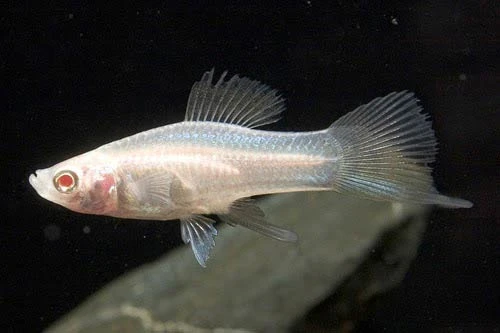
strain White
Other scientific names: Mollienisia helleri, Poecilia helleri, Xiphophorus brevis, Xiphophorus guentheri, Xiphophorus guntheri, Xiphophorus helleri
The White Swordtail, known as Xiphophorus hellerii (White variety), belongs to the family Poeciliidae. This breed, a result of selective breeding from the Koi Swordtail, was specifically developed to exclude red and black hues from its coloration. As a result, the fish acquires a uniform milky-white color, which can be translucent in places.
The White Swordtail is a selectively bred form obtained by suppressing red and black pigments in other breeds. These fish have a milky-white, sometimes translucent body coloration. Like other members of the species, they have an elongated, laterally compressed body. Males are distinguished by the presence of a gonopodium and a characteristic elongated lower ray of the caudal fin, called a sword. Females are usually larger than males and do not have a sword, but with age, they may develop male secondary sexual characteristics.
In nature, Xiphophorus hellerii inhabits freshwater bodies of Central America, including territories of Mexico, Guatemala, and Honduras. These fish are found in a variety of biotopes: from fast-flowing mountain rivers to stagnant lakes, swamps, and lagoons with dense vegetation and sandy or rocky bottoms. Due to their high adaptability, swordtails have been successfully introduced in many regions of the world, including Africa and the southern states of the USA.
These are active and peaceful fish, suitable for keeping in community tanks with similarly sized tankmates. Intraspecific aggression can occur between males, so it is recommended to keep them in a ratio of one male to two or three females to distribute attention and reduce conflicts. The species is highly prone to jumping, so the aquarium must be covered with a lid.
This species is easy to keep, owing to its excellent ability to adapt to a wide variety of environmental conditions. This primarily concerns the hydrochemical parameters of the water. Swordtails successfully adapt to a wide range of pH and GH values, including the ability to exist in brackish water. These fish also show resistance to relatively low temperatures, down to 16°C, which allows them to do without a specialized heater in a species tank. Their care includes standard procedures: weekly partial water changes, usually combined with cleaning organic deposits such as food remnants and excrement, as well as regular checking and maintenance of equipment. Most of their time is spent in the upper and middle layers of the water. They are highly active and prone to jumping out of the aquarium. Given this characteristic, it is recommended to either use an aquarium with a tightly fitting lid or place floating plants on the water surface, which can serve as a natural barrier to fish jumping. As for feeding, the choice of products for Swordtails is quite wide. They readily accept most dry foods, such as flakes and granules. Their diet can also include frozen and live foods — Artemia, bloodworms, Daphnia, mosquito larvae, and others. Swordtails are characterized by peaceful behavior and can successfully coexist with many other fish species of similar size and temperament. Nevertheless, it is necessary to be cautious when choosing tankmates, especially if they are closely related forms or other swordtail breeds.
Swordtails are omnivores and undemanding in their diet. In the aquarium, they readily eat quality dry foods in the form of flakes or granules, as well as frozen and live foods such as Daphnia, Artemia, or bloodworms. To maintain health and vibrant coloration, it is recommended to include plant-based components in their diet, such as spirulina or blanched vegetables. Feeding should be done 1–2 times a day in small portions.
The species is livebearing: eggs develop inside the female's body, and fully formed fry are born. Spawning occurs in the community tank, but to ensure the survival of the offspring, it is recommended to use dense plant thickets or a breeding trap. Pregnancy lasts 4–6 weeks, after which the female gives birth to 20 to 100 fry. Sexual maturity is reached at 5–7 months of age.
The health of fish directly depends on water quality and a balanced diet. If keeping conditions are violated, diseases caused by protozoan or bacterial infections are possible. Common problems include swim bladder disorders and monogenean infestations. Prevention includes regular water changes, maintaining stable parameters, and quarantining new individuals.
When purchasing, choose active fish with clean skin without spots, ulcers, or film. Fins should be spread, and breathing should be even, without signs of labored breathing. It is important to avoid individuals with signs of emaciation or unnaturally clamped fins. Since the white form is rarer, it is worth ensuring the absence of hybrid traits if line purity is important.
The essentials: size, tank volume, water parameters and care
An adult reaches 14–16 cm in length. Plan the tank around the maximum size: the fish quickly outgrows a cramped setup.
The recommended volume is 100 L. A smaller tank speeds up nitrate build-up and raises stress levels.
Temperature 16–28 °C, pH 7–8, hardness 10–30 dGH. Stability matters more than exact values: sudden swings are harder on the fish than a small deviation from the ideal.
Around 4 years when kept properly. Lifespan depends directly on tank volume, water quality and a varied diet.
Temperament: peaceful (regular). Keep this in mind when choosing tank mates.
Recommended setup: mixed (solitary / pair / group). Ignoring this is a common cause of stress and disease.
Diet type: any (universal). Feed small portions that are finished within a couple of minutes — overfeeding does more harm than underfeeding.
The scientific name of the species is Xiphophorus hellerii, family Poeciliidae. It also appears in the literature as: Mollienisia helleri, Poecilia helleri, Xiphophorus brevis.
Matched by family, categories and overlapping keeping conditions
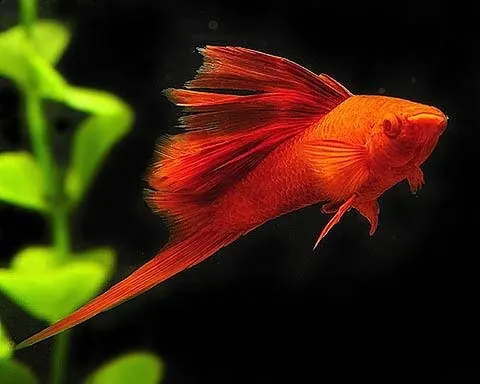
Xiphophorus hellerii
Xiphophorus hellerii, known as the Hi-Fin Swordtail, is a member of the Poeciliidae family. Outside of Russia, in Europe and America, this variety is known as Swordtails Hi Fin. A distinctive feature of both male and…
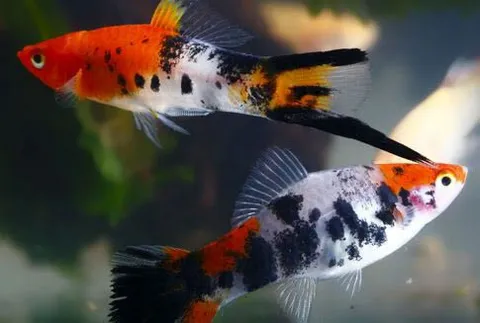
Xiphophorus hellerii
Koi Swordtails, a variety of Xiphophorus hellerii, belong to the Poeciliidae family. This common name refers to fish whose unique body coloration resembles ornamental Koi carp. Among the most sought-after strains are…
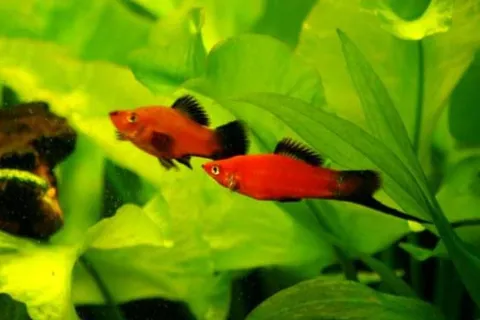
Xiphophorus hellerii
The Berlin Swordtail, known in the English-speaking world as the Red Wagtail Swordtail, is an artificially bred variety. This hybrid, resulting from the crossbreeding of the common Green Swordtail (Xiphophorus hellerii)…
Xiphophorus hellerii
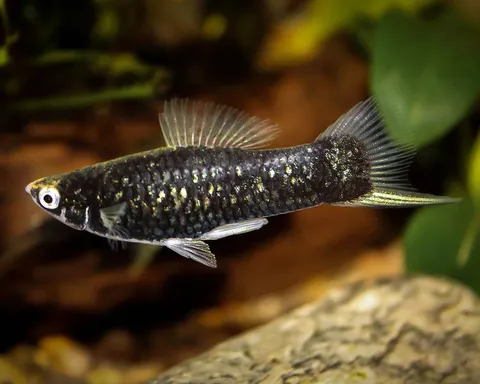
The Black Swordtail, scientifically known as Xiphophorus hellerii (Black variety), belongs to the Poeciliidae family. This fish is distinguished by its uniform dark body coloration, which gives it its name. Under…