Temperature22 – 26 °C
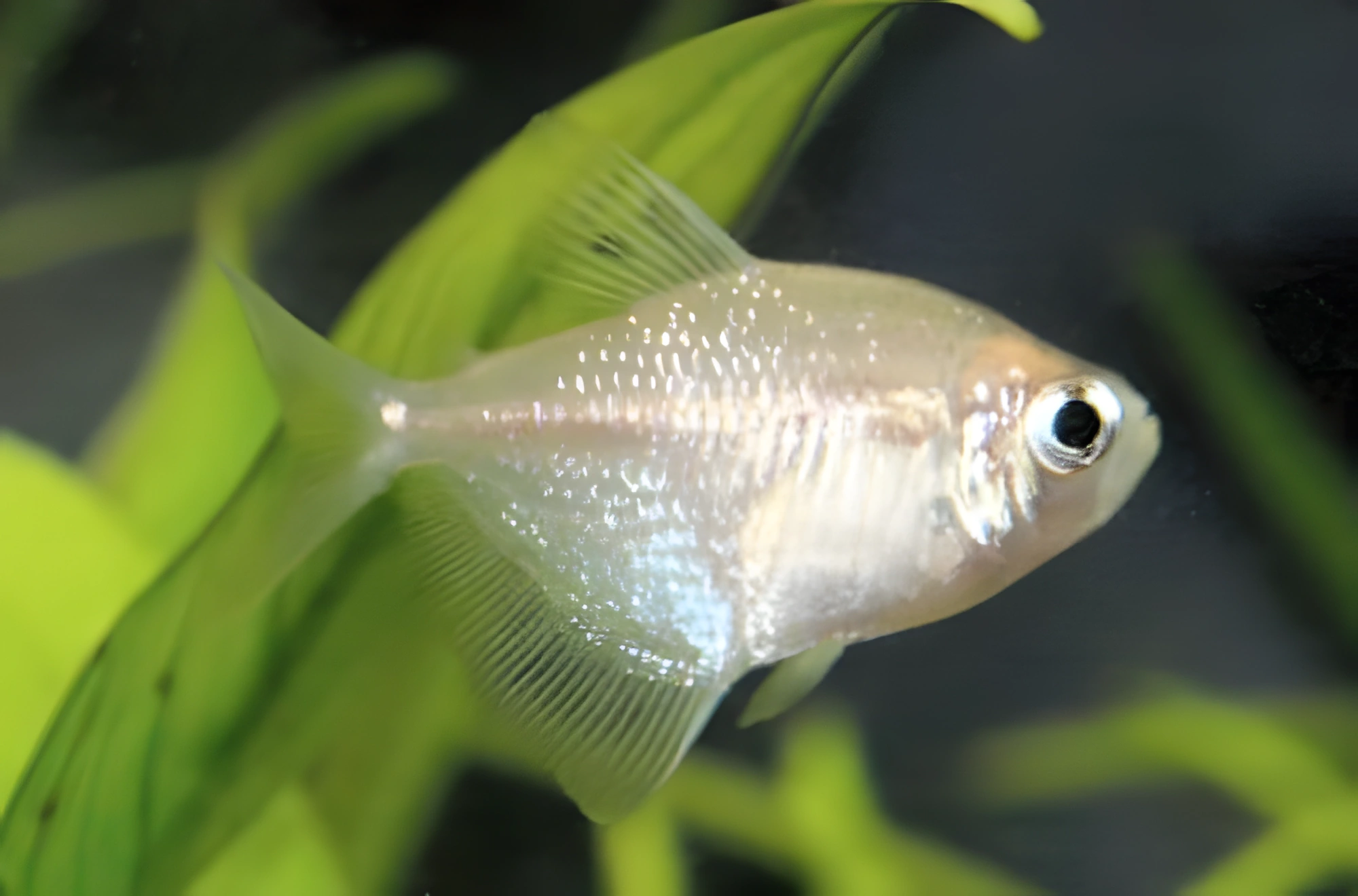
CharacinsConservation status: Least concern LC
Other scientific names: Gymnocothymbus ternetzii, Tetragonopterus ternetzi
The White Tetra, scientifically known as Gymnocorymbus ternetzi, is part of the Characidae family. This widely available and very popular fish is a selective breeding form, artificially bred from the Black Tetra. Its unpretentiousness, hardiness, and ease of breeding make it an excellent choice for those just starting their journey in aquaristics.
- Required aquarium volume
- 60 L
- Size in aquarium
- 5 cm
- Temperature
- 22 – 26 °C
- Temperament
- Peaceful, but may bite fins
Parameters
Water pHSlightly acidic (6) – Slightly alkaline (8)
Water dHSoft (5) – Very hard (19)
Water salinityno salt (freshwater)
Size in aquarium5 cm
Lifespan7 years
TemperamentPeaceful, but may bite fins
Toward small fishnot a predator
Required aquarium volume60 L
Lightingdimmed
Substraterocky (rock formations, boulders, etc.)
Water flowweak
FeedingAny (universal)
CareGroup (8–10 individuals)
Description
This small fish, characterized by a rather high body, grows only up to 5 cm in length. Its fins are significantly larger than those of previous forms, and the bred veil-tail varieties can even compete with goldfish in their beauty. Its coloration is predominantly light, sometimes appearing transparent. Occasionally, vertical stripes can be seen on the front part of the body.
The differences between male and female White Tetras are noticeable in the shape and size of their fins. In males, the dorsal fin is pointed, and the anal fin has an uneven height: it is elongated near the belly and becomes lower closer to the tail. In females, the anal fin (the “skirt”) is symmetrical, and their belly is also larger.
Habitat
This species was bred by humans and does not occur in natural conditions. White Tetra breeding is actively conducted in both commercial hatcheries and home aquariums.
Behavior and Compatibility
Relatively peaceful, this fish coexists quite calmly with neighbors of similar or even larger size. However, it should be noted that small species may be subject to constant attacks. It is important to keep them in a school consisting of at least 6 individuals.
Care and Maintenance
The only, but important, requirement for keeping these fish is maintaining water purity. An effective filter and regular replacement of 25–50% of the water volume every two weeks successfully solve this problem. Technical equipment for the aquarium will require a heater, an aerator, and a filtration system. Since the fish prefer subdued lighting, additional light is not needed if the aquarium is in a living room — the light coming from the room is quite sufficient. For decoration, it is advisable to use low, shade-loving plants that can thrive in low light, planted in groups. Dark fine gravel or coarse sand will work as substrate, and pieces of wood, intertwined roots, or snags can be used for decorative elements.
Diet
A wide range of specialized foods is available for Tetras, containing all necessary nutrients, including freeze-dried meat components. The diet can be enriched by adding bloodworms or large daphnia.
Breeding and Reproduction
Spawning of these fish should be carried out in a specially designated tank, as parents are prone to eating their offspring. A 20 L aquarium will be quite sufficient for spawning. The water composition in it should be as close as possible to the parameters of the water in the main aquarium. Equipment will include a filter, heater, aerator, and, in this case, lighting fixtures. The decor uses groups of low plants and a sandy substrate. Spawning can begin at any time. When the female's belly noticeably increases, it is a signal that the pair should be moved to a separate tank. After some time, the female releases eggs into the water, and the male fertilizes them; the entire process occurs over plant thickets, where the eggs then settle. If the plants are arranged in several groups, the pair can spawn in several areas at once. After spawning, the parents are returned to the community tank. The incubation period lasts about two days. Fry are recommended to be fed powdered foods or Artemia nauplii.
Diseases
At low water temperatures, fish become more susceptible to skin diseases. Under optimal conditions, health problems usually do not arise, although artificially bred species show less resilience compared to their natural ancestors. More detailed information on symptoms and treatment methods can be found in the “Aquarium Fish Diseases” section.
How to choose
When choosing individuals in a store, attention should be paid to their activity and fin integrity. A healthy fish should show curiosity, stay in a school, and have no visible damage, sores, or white plaque on its scales. Avoid buying fish that appear sluggish, keep to themselves, or have an unnaturally bloated belly. Pay special attention to the coloration: it should be uniform, without spots that do not match the species standard. Given the species' tendency to nip the fins of tankmates, acquire a group of at least 6 individuals to reduce stress and aggression in the aquarium.
Frequently asked questions
The essentials: size, tank volume, water parameters and care
How big does White Tetra get?
An adult reaches 5 cm in length. Plan the tank around the maximum size: the fish quickly outgrows a cramped setup.
What size aquarium does White Tetra need?
The minimum recommended volume is 60 L. A smaller tank speeds up nitrate build-up and raises stress levels.
What water parameters does White Tetra need?
Temperature 22–26 °C, pH 6–8, hardness 5–19 dGH. Stability matters more than exact values: sudden swings are harder on the fish than a small deviation from the ideal.
How long does White Tetra live?
Around 7 years when kept properly. Lifespan depends directly on tank volume, water quality and a varied diet.
Is White Tetra aggressive?
Temperament: peaceful, but may bite fins. Keep this in mind when choosing tank mates.
How many White Tetra should be kept together?
Recommended setup: group (8–10 individuals). Ignoring this is a common cause of stress and disease.
What does White Tetra eat?
Diet type: any (universal). Feed small portions that are finished within a couple of minutes — overfeeding does more harm than underfeeding.
What is the scientific name of White Tetra?
The scientific name of the species is Gymnocorymbus ternetzi, family Characidae. It also appears in the literature as: Gymnocothymbus ternetzii, Tetragonopterus ternetzi.