Temperature20 – 28 °C
Other scientific names: Platypoecilus aurata, Platypoecilus cyanellus, Platypoecilus maculatus, Platypoecilus nigra, Platypoecilus pulchra, Platypoecilus rubra
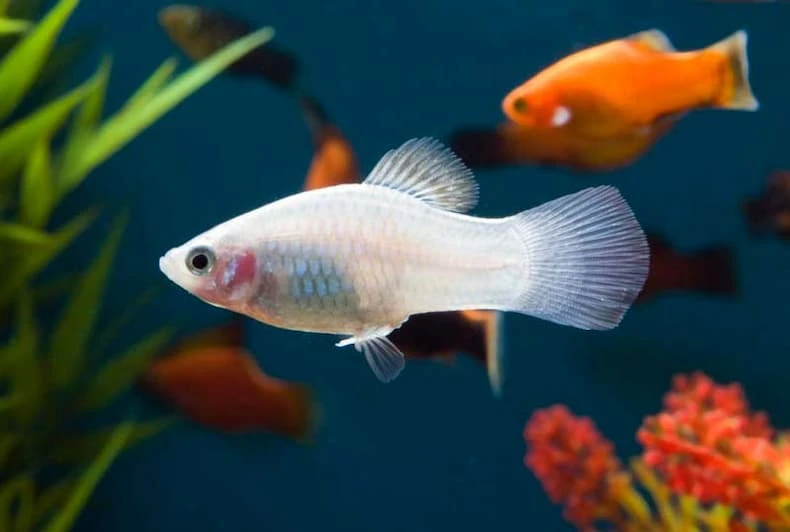
White Platy — this is the English trade name for the “White Platy.” This decorative variety of the common Platy emerged as a result of selective breeding, which suppressed the genes responsible for pigmentation. The outcome was a complete absence of any hues on the body other than white. Often, through the unpigmented outer layers, internal organs, crimson gills, and even the fish's skeleton are easily discernible.
The White Platy is a selectively bred color variation of the species Xiphophorus maculatus. These fish have a dense, laterally compressed body and rounded fins. Adults reach 5–7 cm in length, with females being noticeably larger than males. The main body coloration ranges from pearly white to silvery. Sexual dimorphism is clearly expressed: in males, the anal fin is transformed into a gonopodium — an organ for fertilization, while in females, it has a broad, fan-like shape.
In nature, the species Xiphophorus maculatus inhabits water bodies in Central America, including territories from Mexico to Nicaragua. The fish prefer shallow areas of rivers, swamps, ditches, and flooded pastures with abundant vegetation. Natural water parameters in their habitat are characterized by a wide range of hardness and a neutral or slightly alkaline reaction, which contributes to the species' high adaptability to aquarium conditions.
Platies are peaceful and active fish, suitable for a community tank. They prefer to stay in the middle water layers. Intraspecific aggression is virtually absent; however, to reduce stress, it is recommended to keep them in a group with a predominance of females. They coexist well with other calm species of similar size, such as guppies, swordtails, or mollies. Compatibility with large predators is not recommended, as platies may become prey.
The hardiness and general unpretentiousness of the White Platy make it an excellent choice for beginner aquarists. This fish can forgive certain shortcomings and oversights in care, such as delays in cleaning the aquarium, leading to the accumulation of organic deposits like uneaten food and excrement. For a small community of 3–4 individuals, an aquarium of at least 50–60 liters is necessary. Within it, it is desirable to create plant thickets or use other decorative elements that will serve as shelters. It is important to provide quality nutrition with plant components and select peaceful neighbors of comparable size. Although basic water parameters such as pH and GH are not critical, observations show that the fish feel better in hard water with a slightly alkaline reaction. Regarding behavior and compatibility, the White Platy coexists perfectly with other livebearing species such as Guppies, Swordtails, and Mollies, as well as with any fish that prefer a slightly alkaline aquatic environment. Under suitable conditions, the White Platy regularly produces offspring, usually every 1–2 months. Fry are ready to eat from the first hours of life; finely crushed dry flakes or special foods designed for young aquarium fish are suitable for their feeding. It is important to consider that adult individuals may exhibit predatory behavior towards fry, so it is recommended to transfer the young to a separate tank.
The species is omnivorous. In the aquarium, platies readily eat high-quality dry foods in the form of flakes or granules, as well as frozen and live foods such as Artemia, bloodworms, or Daphnia. An important part of their diet is plant components, which contribute to proper digestion. It is recommended to feed the fish 1–2 times a day with portions that are completely consumed within a few minutes.
Platies are livebearing fish, so reproduction does not require special conditions. Fertilization occurs inside the female's body. Pregnancy lasts about a month, after which fully formed fry are born, capable of feeding immediately. To preserve offspring in a community tank, it is recommended to use dense plant thickets or move the pregnant female to a separate container, as adult individuals may eat the young.
Platies have strong immunity, but are sensitive to water quality and substrate cleanliness. If maintenance conditions are violated, bacterial infections or fungal lesions are possible. Characteristic of some selective forms is melanosis — the appearance of dark spots on the body due to excess pigment. Prevention involves weekly water changes of 20–30%, maintaining a stable temperature, and using quality food.
When purchasing, choose active fish with clean fins and scales, without visible damage, ulcers, or film. It is important to avoid individuals that stay near the water surface, appear apathetic, or have an unnaturally swollen abdomen. It is recommended to acquire fish from aquariums where there are no signs of other inhabitants dying, and to observe quarantine before introducing them into the main aquarium.
The essentials: size, tank volume, water parameters and care
An adult reaches 5–7 cm in length. Plan the tank around the maximum size: the fish quickly outgrows a cramped setup.
The recommended volume is 60 L. A smaller tank speeds up nitrate build-up and raises stress levels.
Temperature 20–28 °C, pH 7–8.2, hardness 10–30 dGH. Stability matters more than exact values: sudden swings are harder on the fish than a small deviation from the ideal.
Around 4 years when kept properly. Lifespan depends directly on tank volume, water quality and a varied diet.
Temperament: peaceful (regular). Keep this in mind when choosing tank mates.
Recommended setup: mixed (solitary / pair / group). Ignoring this is a common cause of stress and disease.
Diet type: any (universal). Feed small portions that are finished within a couple of minutes — overfeeding does more harm than underfeeding.
The scientific name of the species is Xiphophorus maculatus, family Poeciliidae. It also appears in the literature as: Platypoecilus aurata, Platypoecilus cyanellus, Platypoecilus maculatus.
Matched by family, categories and overlapping keeping conditions
Xiphophorus maculatus
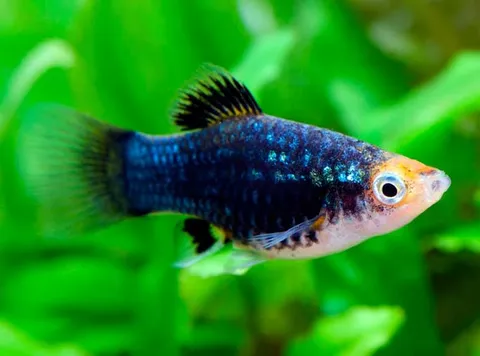
Platy Black is the trade name for this variety of Black Platy in the English-speaking market. This fish is not found in nature, as it is an artificially bred color variation derived from the common Platy (Xiphophorus…
Xiphophorus maculatus
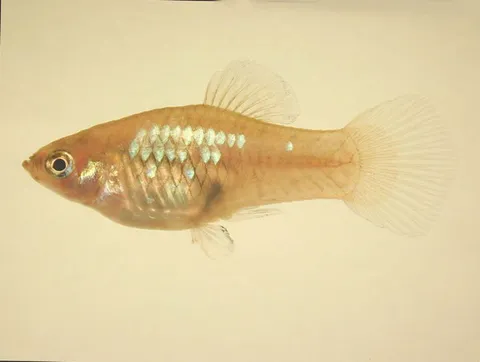
The Platy, or Spotted Platy (scientific name Xiphophorus maculatus), belongs to the family Poeciliidae. Its hardiness and vibrant coloration make it one of the most sought-after aquarium fish. However, it should be…
Xiphophorus maculatus
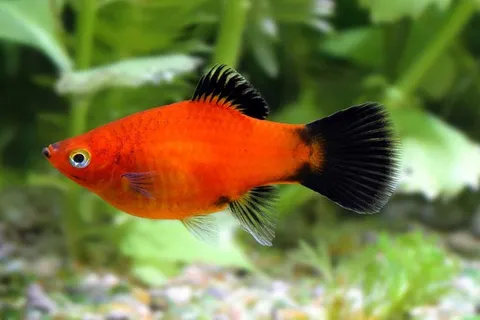
The Wagtail Platy, often considered a benchmark or even a classic example among platies, is the fish usually associated with this entire group of attractive fish. Its body can be red, orange, or golden, which contrasts…
Xiphophorus maculatus
The Flag Platy, also known as the Sailfin Platy in English-speaking environments, stands out with its characteristic high dorsal fin. The first rays of this fin are noticeably thickened and taller than the subsequent…