Temperature21 – 26 °C
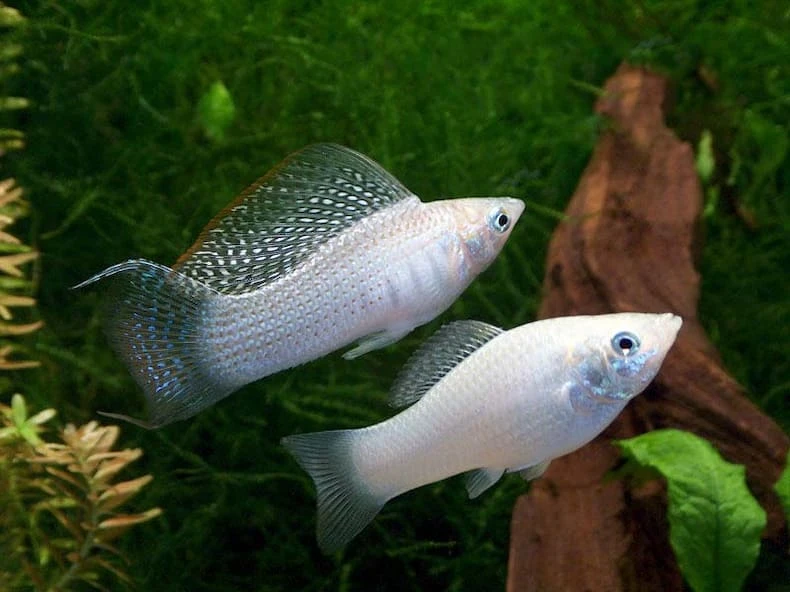
Other scientific names: Gambusia modesta, Gambusia plumbea, Lembesseia parvianalis, Mollienesia altissima, Mollienesia macrura, Mollienesia pallida
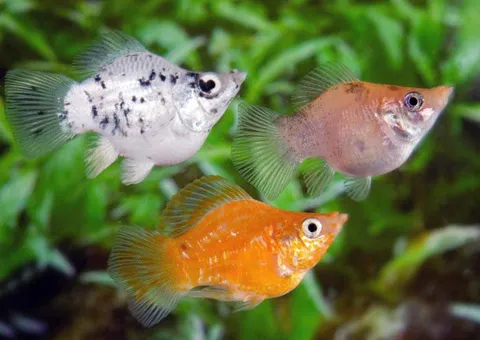
The White Molly, also known as the “Snowflake” Molly, is a collective name. It is used to refer to selective color variations of Poecilia velifera or Poecilia latipinna, as well as their hybrids. This species is entirely artificial in origin and does not occur in its natural habitat. The main distinguishing feature of these fish is their uniform silvery coloration. Their fins are translucent, adorned with tiny white speckles.
The White Molly, known as the Snowflake, is a selectively bred form obtained through artificial selection. It is a livebearing fish with an elongated body and pronounced sexual dimorphism: females are larger than males, and males possess a more developed dorsal fin and a gonopodium. The body coloration is solid, silvery-white, and the fins are often translucent with small speckles. In the aquarium females grow to about 10–12 cm, while males stay smaller at around 6–8 cm.
This species is not found in the wild, as it is a product of aquarium breeding. The original forms of Poecilia sphenops inhabit fresh and brackish waters of Central and South America, from Mexico to Colombia and Venezuela. In nature, they prefer areas with dense vegetation and are often found in coastal zones where fresh and saltwater mix, which accounts for the fish's high adaptability to various water hardness levels.
These fish coexist perfectly with other peaceful species of comparable size that thrive in slightly alkaline conditions and high general water hardness. Within the species, males compete for the attention of females; sometimes their activity can be excessive. Therefore, it is recommended to form groups with a predominance of females.
For keeping 3–4 individuals, an aquarium of at least 150 liters is recommended; there is no upper limit, as a larger volume is always beneficial. An important role in aquarium design is given to thickets of live plants. They not only provide shelter but also serve as an additional food source for the fish. In this regard, it is advisable to choose unpretentious and fast-growing species such as Najas, Vallisneria, Hornwort, Elodea, Egeria densa, as well as various types of aquatic mosses and ferns. The “Snowflake” Molly thrives in warm water with medium to high general hardness and a pH close to neutral or slightly above it. Keeping them in soft or acidic water can weaken the fish and increase their susceptibility to various fungal and bacterial infections. Aquarium maintenance involves two key procedures: weekly partial water changes with fresh water and regular removal of organic waste, including uneaten food and metabolic byproducts.
The diet of these fish should primarily consist of foods with a high content of plant components, the deficiency of which negatively affects their health, in particular, disrupting the development of the dorsal fin. For beginner aquarists, specialized foods from well-known manufacturers, developed to meet the needs of mollies and offered in flakes, pellets, and other forms, will be an optimal choice.
White Mollies, like most livebearing species, give birth to fully formed fry, without an egg stage. Under favorable conditions, a new brood can appear every two months. It is important to note that these fish lack parental instincts, and the fry often become prey for adult individuals. To ensure the survival of the fry, it is recommended to move them to a separate aquarium, maintaining identical water parameters. The possibility of cross-breeding with other varieties of mollies should be considered, as this can lead to mixed offspring.
Selective breeding forms, especially when kept in unsuitable conditions, are prone to reduced immunity. The main risk factors are low water temperature, sharp fluctuations in pH and hardness, and an unbalanced diet. A lack of plant components in the diet often leads to fin deformities and weakening of the body, making fish vulnerable to bacterial and fungal infections. Prevention involves maintaining stable water parameters and regular aquarium hygiene.
When choosing healthy specimens, pay attention to the cleanliness of the skin and fins: there should be no white plaque, ulcers, or signs of fin erosion. The fish should be active, have a firm body without signs of emaciation or unnatural bloating. It is recommended to observe their behavior in the store: healthy mollies stay in a group, swim actively, and show interest in food. Avoid purchasing individuals that stay at the surface, breathe heavily, or appear lethargic.
The essentials: size, tank volume, water parameters and care
An adult reaches 8–12 cm in length. Plan the tank around the maximum size: the fish quickly outgrows a cramped setup.
The recommended volume is 150 L. A smaller tank speeds up nitrate build-up and raises stress levels.
Temperature 21–26 °C, pH 7–8.5, hardness 15–30 dGH. Stability matters more than exact values: sudden swings are harder on the fish than a small deviation from the ideal.
Around 4 years when kept properly. Lifespan depends directly on tank volume, water quality and a varied diet.
Temperament: peaceful (regular). Keep this in mind when choosing tank mates.
Recommended setup: mixed (solitary / pair / group). Ignoring this is a common cause of stress and disease.
Diet type: mixed diet (meat + plant-based). Feed small portions that are finished within a couple of minutes — overfeeding does more harm than underfeeding.
The scientific name of the species is Poecilia sphenops, family Poeciliidae. It also appears in the literature as: Gambusia modesta, Gambusia plumbea, Lembesseia parvianalis.
Matched by family, categories and overlapping keeping conditions
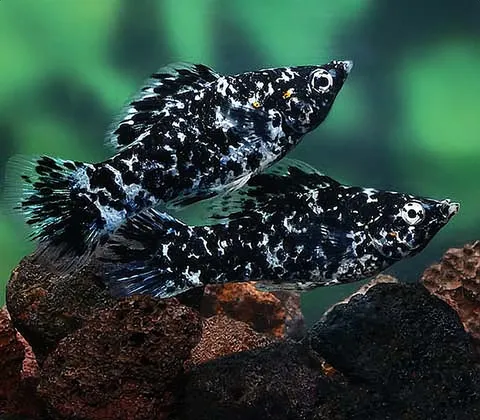
Poecilia sphenops
The collective term “black and white molly” usually refers to several selective breeding forms, distinguished by their characteristic body coloration, where white and black tones predominate. Examples of such forms…
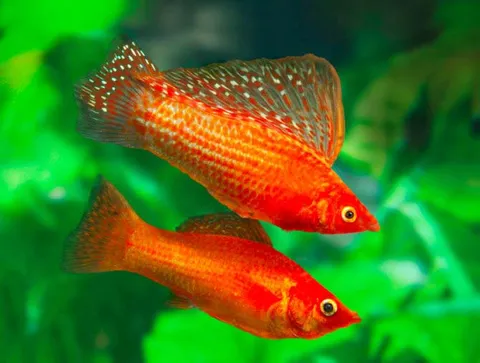
Poecilia sphenops
The Blood Red Molly, often called Blood Red Molly in English-speaking countries, is a vibrant color variation developed through selective breeding of certain Molly species. Its distinguishing feature is its intense red…
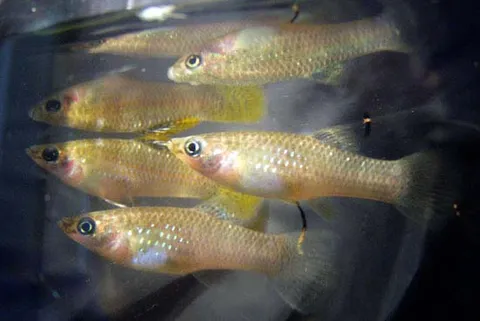
Poecilia sphenops
The Molly sphenops (Poecilia sphenops), or simply Molly, belongs to the Poeciliidae family. This fish is known for its unpretentiousness in keeping and relative ease of breeding. Additionally, it attracts attention with…
Poecilia sphenops
The Balloon Molly, also known as the Balloon Molly, is called the Balloon Molly in English-speaking trade. This common name is given to selective breeding forms obtained by breeding based on Poecilia sphenops, Poecilia…