Temperature20 – 26 °C
Natural range
- Sumatra area
- Borneo area
CyprinidsConservation status: Least concern LC
Other scientific names: Barbus tetrazona, Capoeta tetrazona, Puntius tetrazona, Systomus sumatranus, Systomus sumatrensis, Systomus tetrazona
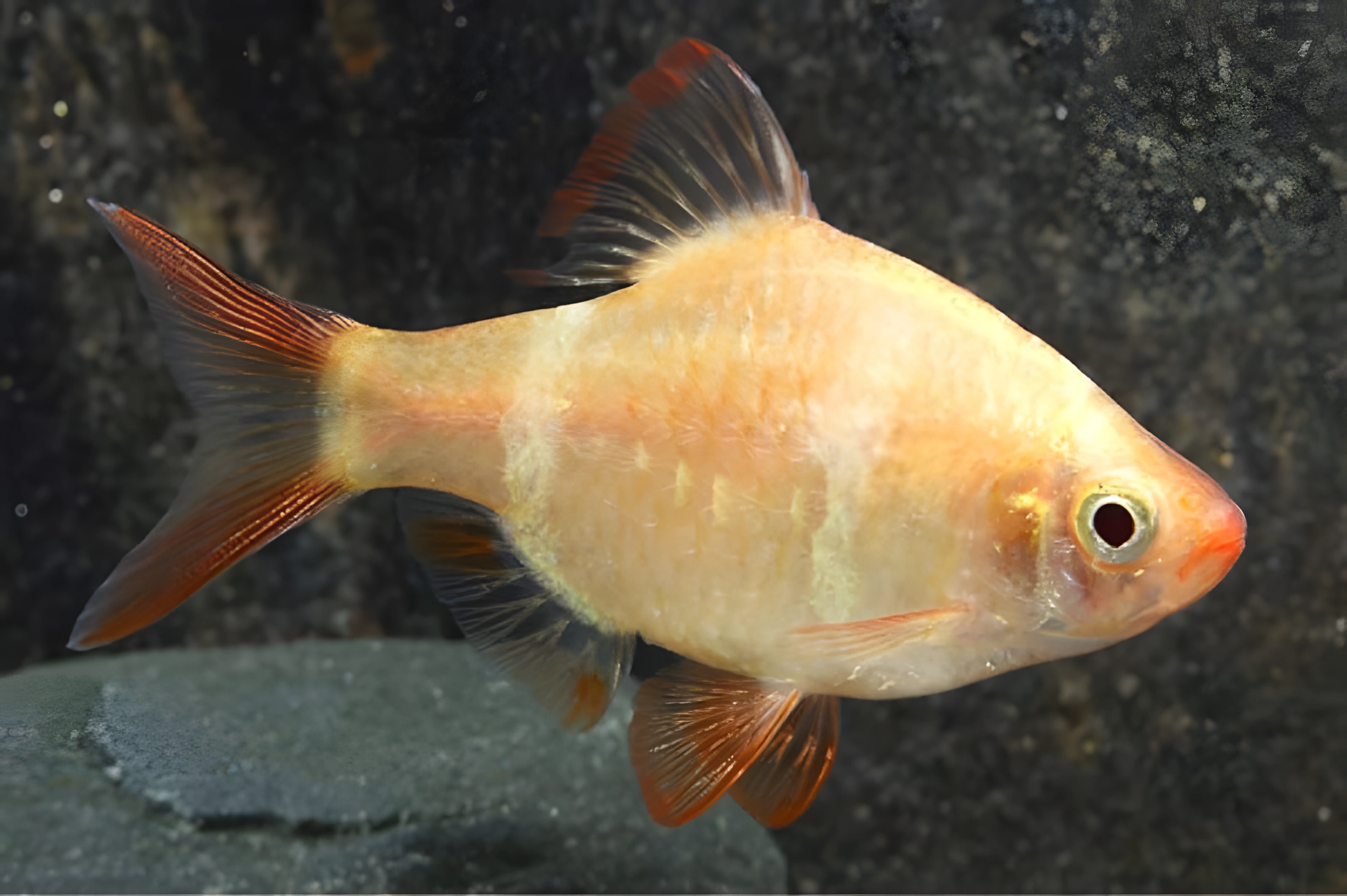
The scientific name Systomus tetrazona belongs to the Sumatra Barb (albino), a representative of the Cyprinidae family. This subspecies emerged as a result of selective breeding of the Sumatra Barb, acquiring a new body coloration ranging from yellow to cream with characteristic colorless stripes. Another distinction from its predecessor, besides the color scheme, is the possible absence of gill covers in albinos. Other common names for this fish include Golden Tiger Barb and Platinum Barb.
- Required aquarium volume
- 60 L
- Size in aquarium
- 7 cm
- Temperature
- 20 – 26 °C
- Temperament
- Peaceful, but may bite fins
Parameters
Water pHSlightly acidic (6) – Slightly alkaline (8)
Water dHSoft (5) – Very hard (19)
Water salinityno salt (freshwater)
Size in aquarium7 cm
Lifespan7 years
TemperamentPeaceful, but may bite fins
Toward small fishnot a predator
Required aquarium volume60 L
Lightingmoderate (regular)
Substratesandy (regular, light)
Water flowmoderate
FeedingAny (universal)
CareSchooling (usually from 5–6 individuals and more)
Description
The albino barb has a flattened, rounded body adorned with a high dorsal fin and a pointed head. Sometimes these fish lack gill covers or have underdeveloped ones, which is a side effect of selective breeding. Their size is modest, reaching approximately 7 cm. With proper care, their lifespan can be 6 to 7 years. The coloration of these fish varies from yellow to cream hues, with some individuals exhibiting a silvery sheen. White stripes are visible on their bodies, inherited from the Sumatra barb, where they are black. The tips of the fins are reddish, and during spawning, the fish's head also acquires a red tint.
Outwardly, the female appears more robust, especially noticeable during the spawning period. Males are distinguished by brighter coloration and smaller size; their heads turn red during spawning.
Habitat
The Sumatra barb was first described by Pieter Bleeker in 1855. The natural habitats of these fish span Southeast Asia, including the islands of Sumatra and Borneo. During the 20th century, wild populations of this species were successfully introduced into Singapore, Australia, the USA, and Colombia. Barbs prefer clean, oxygen-rich forest streams. The bottom of such bodies of water is often composed of sand and stones, supplemented by abundant aquatic vegetation. In their natural environment, these fish feed on insects, various algae, including diatoms and multicellular algae, as well as small invertebrates. It should be noted that the albino barb is a result of selective breeding and is not found in the wild.
Behavior and Compatibility
As a small, active, and schooling fish, the barb coexists well with most aquarium species. It is important to keep these fish in a group of at least 6 individuals. If kept in a smaller school, problems may arise for slow-moving fish or species with long fins: barbs will chase them and sometimes nip their fins. In a large school, their activity is directed towards each other, which does not inconvenience other aquarium inhabitants. When kept alone, the fish may exhibit aggression.
Care and Maintenance
These fish do not have high demands for keeping conditions, but maintaining water purity is a key factor. To achieve this, a productive filter must be installed, and 20–25% of the water volume should be replaced with fresh water every two weeks. The filter performs two important functions: it cleans the water of suspended particles and harmful chemicals, and it also creates water movement, which helps maintain the fish's tone and enhances their coloration. Barbs prefer to swim in open spaces, so it is recommended to leave a free zone in the center of the aquarium, and densely plant vegetation in a sandy substrate along the edges to provide hiding places. Pieces of driftwood or roots will be an excellent addition to the decor and serve as a base for algae growth. It is desirable that the length of the aquarium exceeds 30 cm, as a small enclosed space can cause discomfort for such an active fish. A lid on the aquarium will prevent accidental jumping out.
Diet
The barb is an omnivorous species, readily consuming both dry commercial foods and frozen or live foods, as well as algae. An ideal diet includes a variety of flakes with periodic additions of live foods, such as bloodworms or brine shrimp. These fish do not know moderation when it comes to food and will eat as much as they are offered, so it is important to observe reasonable portions. It is recommended to feed them 2–3 times a day, with each portion being consumed within 3 minutes to prevent overeating.
Breeding and Reproduction
Albino barbs reach sexual maturity at a body length of over 3 cm. A change in the hydrochemical composition of the water signals the beginning of mating games and spawning: the water should be soft (dH up to 10) and slightly acidic (pH around 6.5) at a temperature of 24 – 26 °C. It is recommended to create similar conditions in a separate spawning tank, where a male and female are then placed. After the courtship ritual, the female lays about 300 eggs, which are fertilized by the male. After this, the pair should be moved back to the main aquarium, as barbs are prone to eating their eggs. Feeding fry requires a special type of food — micro-food, but caution should be exercised, as uneaten remnants quickly contaminate the water.
Diseases
Under favorable keeping conditions, health problems usually do not arise. However, if the water quality is unsatisfactory, the barb becomes vulnerable to external infections, primarily ichthyophthiriasis. More detailed information about diseases can be found in the "Aquarium Fish Diseases" section.
How to choose
When choosing fish, pay attention to their activity and appearance. Healthy individuals should be active, without visible damage to scales, ulcers, or white coating. Avoid specimens with an unnaturally bloated abdomen or, conversely, excessively emaciated ones, as well as fish that stay separate from the school or show signs of apathy. Given their selective breeding origin, carefully inspect the gill covers, as some individuals may have underdeveloped ones. In the store, barbs should exhibit typical schooling behavior; if other species are present in the aquarium with them, check for damaged fins on their neighbors, which may indicate an aggressive nature of a particular group.
Frequently asked questions
The essentials: size, tank volume, water parameters and care
How big does Platinum Barb get?
An adult reaches 7 cm in length. Plan the tank around the maximum size: the fish quickly outgrows a cramped setup.
What size aquarium does Platinum Barb need?
The minimum recommended volume is 60 L. A smaller tank speeds up nitrate build-up and raises stress levels.
What water parameters does Platinum Barb need?
Temperature 20–26 °C, pH 6–8, hardness 5–19 dGH. Stability matters more than exact values: sudden swings are harder on the fish than a small deviation from the ideal.
How long does Platinum Barb live?
Around 7 years when kept properly. Lifespan depends directly on tank volume, water quality and a varied diet.
Is Platinum Barb aggressive?
Temperament: peaceful, but may bite fins. Keep this in mind when choosing tank mates.
How many Platinum Barb should be kept together?
Recommended setup: schooling (usually from 5–6 individuals and more). Ignoring this is a common cause of stress and disease.
What does Platinum Barb eat?
Diet type: any (universal). Feed small portions that are finished within a couple of minutes — overfeeding does more harm than underfeeding.
What is the scientific name of Platinum Barb?
The scientific name of the species is Puntigrus tetrazona, family Cyprinids (Cyprinidae). It also appears in the literature as: Barbus tetrazona, Capoeta tetrazona, Puntius tetrazona.