Temperature18 – 26 °C
Natural range
- Thailand area
- Laos area
- Myanmar area
- Eastern India area
CyprinidsConservation status: Least concern LC
Other scientific names: Barbus stoliczkanus, Barbus ticto, Puntius stoliczkae, Puntius stoliczkanus, Puntius ticto
Pethia stoliczkana, known as Stoliczka's Barb, belongs to the carp family (Cyprinidae). The species is named after the zoologist Ferdinand Stoliczka (1838–1874) from Moravia (now the Czech Republic), who dedicated many years to studying the fauna of Indochina and discovering new species. This species is easy to keep and breed, coexisting perfectly with many other common aquarium fish. Therefore, it can be highly recommended for those just starting their journey in aquaristics.
- Required aquarium volume
- 60 L
- Size in aquarium
- 5 cm
- Temperature
- 18 – 26 °C
- Temperament
- Peaceful (regular)
Parameters
Water pHSlightly acidic (6) – Neutral (7.5)
Water dHVery soft (1) – Hard (15)
Water salinityno salt (freshwater)
Size in aquarium5 cm
Lifespan4 years
TemperamentPeaceful (regular)
Toward small fishnot a predator
Required aquarium volume60 L
Lightingdimmed or moderate
Substrateany (no restrictions)
Water flowweak or moderate
FeedingSmall / appropriate size / pieces
CareGroup (8–10 individuals)
Description
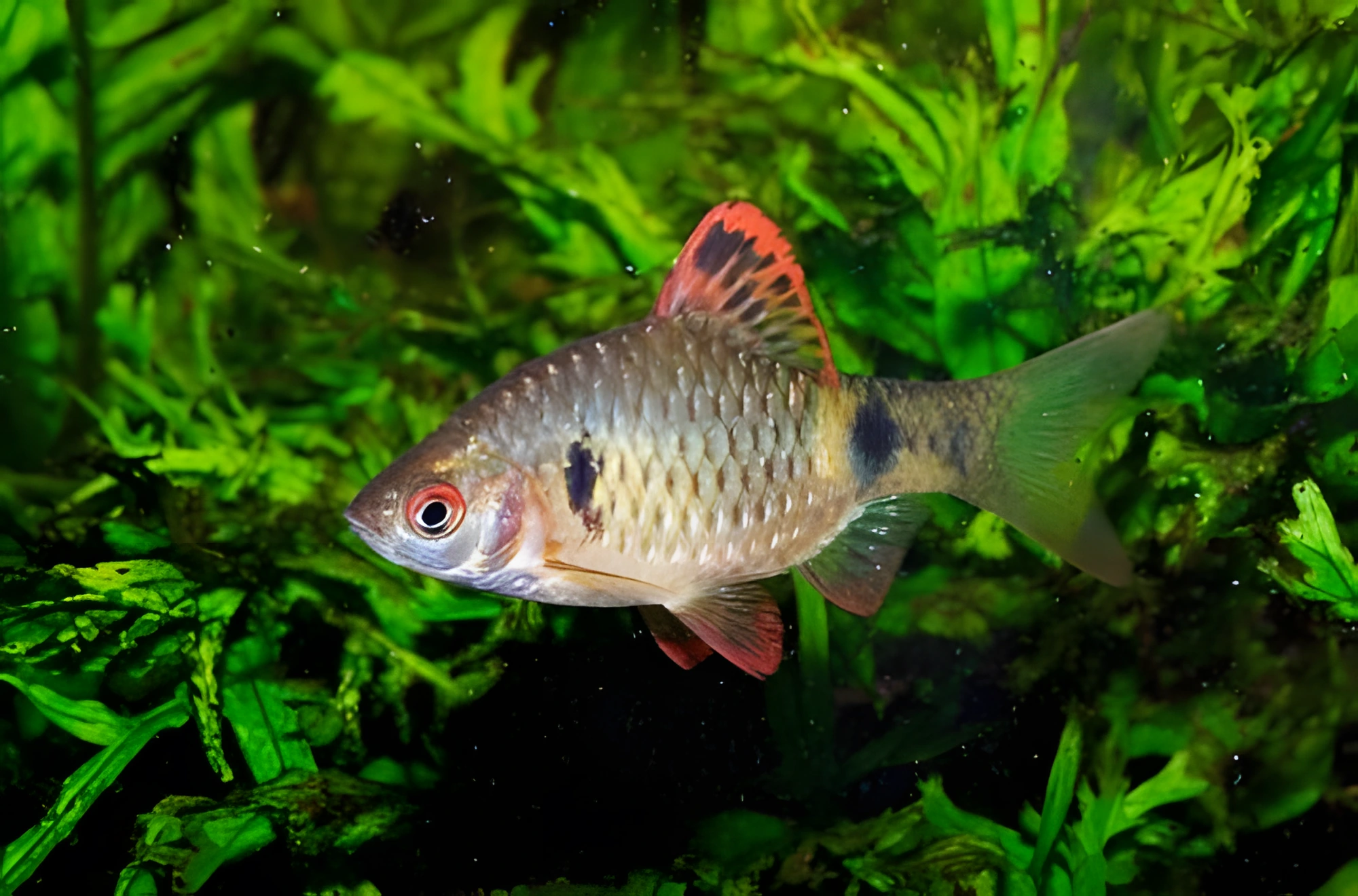
Adults grow up to 5 cm in length. Outwardly, Stoliczka's Barb resembles its relative, the Ticto Barb, which often leads to confusion between them. The fish's coloration can be light or dark silver. A large dark spot is usually noticeable at the base of the tail, and another can sometimes be seen behind the gill cover. Males are distinguished by red dorsal and ventral fins with dark speckles, while in females, these fins are most often transparent and lack distinct color. In general, females are usually less brightly colored.
Habitat
Its natural range covers areas of Southeast Asia, including modern-day Thailand, Laos, Myanmar, and the eastern states of India. Stoliczka's Barb is found everywhere, inhabiting mainly small streams, tributaries, and headwaters of rivers that flow in the shade of tropical forests. Its natural environment is characterized by sandy substrates interspersed with rocks, a bottom covered with fallen leaves, and an abundance of snags, as well as submerged roots of riparian trees. Among the plants in such bodies of water, Cryptocorynes, well-known in aquaristics, are often found.
Behavior and Compatibility
This is a peaceful, active, and schooling fish that coexists well with many other non-aggressive species of comparable size. It is recommended to keep them in a group of at least 8–10 individuals.
Care and Maintenance
The optimal tank volume for a small group of these fish starts from 60 liters. The choice of decor is not critically important, but creating an environment that resembles their natural habitat will be beneficial. Therefore, various snags, fallen tree leaves, as well as floating and rooted plants will be very appropriate. Successful keeping largely depends on maintaining stable water parameters and suitable hydrochemical indicators. Aquarium maintenance includes standard procedures: weekly partial water changes, regular removal of organic waste, equipment prophylaxis, and monitoring parameters such as pH, dGH, and oxidizability.
Diet
Stoliczka's Barb is an unpretentious and omnivorous aquarium inhabitant. In home keeping conditions, these fish readily accept most common foods of suitable size, whether dry, frozen, or live. The presence of plant supplements in their diet is important. They can be part of ready-made products, such as dry flakes or granules, or added separately.
Breeding and Reproduction
Under favorable conditions, spawning occurs regularly. Females scatter eggs in the water column, and males fertilize them at this time. The incubation period lasts from 24 to 48 hours, after which the hatched fry begin to swim freely the very next day. Parental instincts are absent in these fish, so they do not care for their offspring. Moreover, adults can eat their own eggs and fry at the first opportunity. To preserve the young, a separate spawning tank with similar water conditions is used, where the eggs are moved immediately after spawning. It is equipped with a simple air-driven sponge filter and a heater. A separate light source is not required. Unpretentious shade-loving plants or their artificial counterparts can be used for decoration.
Diseases
In a balanced aquarium ecosystem, closely matching the requirements of this species, diseases are extremely rare. Illnesses often arise due to deteriorating habitat quality, contact with already sick fish, or physical injuries. If these factors could not be avoided, the “Aquarium Fish Diseases” section will provide detailed information on symptoms and treatment methods.
How to choose
When selecting individuals, attention should be paid to their activity and the integrity of their integument. Healthy fish should show curiosity, actively swim as part of a group, and have no damaged fins, ulcers, or white spots on their bodies. Avoid purchasing fish that appear emaciated, keep to themselves, constantly hide, or have an unnaturally bloated abdomen.
- purchase a group of 8–10 individuals, as fish kept alone or in small groups become timid and stressed
- check for signs of infectious diseases in all inhabitants of the community tank in the store
- prefer individuals with bright coloration appropriate for their sex, which indicates good health and proper keeping conditions
Frequently asked questions
The essentials: size, tank volume, water parameters and care
How big does Stoliczka's Barb get?
An adult reaches 5 cm in length. Plan the tank around the maximum size: the fish quickly outgrows a cramped setup.
What size aquarium does Stoliczka's Barb need?
The minimum recommended volume is 60 L. A smaller tank speeds up nitrate build-up and raises stress levels.
What water parameters does Stoliczka's Barb need?
Temperature 18–26 °C, pH 6–7.5, hardness 1–15 dGH. Stability matters more than exact values: sudden swings are harder on the fish than a small deviation from the ideal.
How long does Stoliczka's Barb live?
Around 4 years when kept properly. Lifespan depends directly on tank volume, water quality and a varied diet.
Is Stoliczka's Barb aggressive?
Temperament: peaceful (regular). Keep this in mind when choosing tank mates.
How many Stoliczka's Barb should be kept together?
Recommended setup: group (8–10 individuals). Ignoring this is a common cause of stress and disease.
What does Stoliczka's Barb eat?
Diet type: small / appropriate size / pieces. Feed small portions that are finished within a couple of minutes — overfeeding does more harm than underfeeding.
What is the scientific name of Stoliczka's Barb?
The scientific name of the species is Pethia stoliczkana, family Cyprinids (Cyprinidae). It also appears in the literature as: Barbus stoliczkanus, Barbus ticto, Puntius stoliczkae.