Temperature17 – 24 °C
Other scientific names: Barbus candens
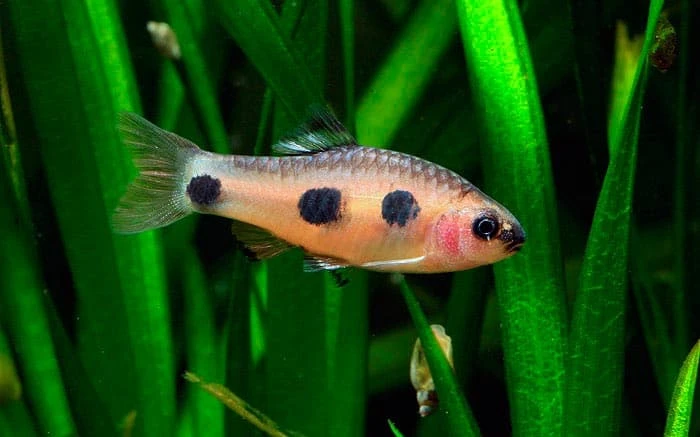
The Rosy Barb, also known by its scientific name Enteromius candens, belongs to the family Cyprinidae. These fish are deservedly valued for their peaceful nature and distinctive body pattern, as well as for their ease of care and breeding.
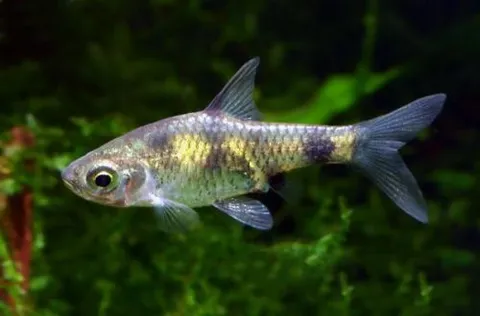
Adults of this species reach a length of approximately 3 cm. The appearance of the Rosy Barb is very similar to its close relative, the Butterfly Barb. Sexual dimorphism is weakly expressed; males and females are almost identical, with only minor external differences. The body coloration varies from rosy-yellow on the underside to dark on the back. The semi-transparent fins have noticeable dark edges. One of the most striking features of their body pattern is the presence of three large black spots.
This species originates from the African continent, specifically the territory of the Democratic Republic of Congo. Its natural habitats include the middle basin of the Congo River, located between Lisala and Kisangani. Here, it inhabits small unnamed streams and little-studied rivers winding through tropical forests, as well as associated swampy areas with dense aquatic vegetation. The local waters often have a brownish tint due to the presence of tannins released from the natural decomposition of plant debris — fallen leaves, fruits, branches, and tree roots.
The Rosy Barb is a peaceful and active fish that coexists well with other miniature species. However, the selection of larger tank mates should be approached with particular caution. Even non-predatory but sufficiently large fish, such as some catfish, may eat a small Rosy Barb if the opportunity arises. This species is conditionally schooling, as relationships within the group are primarily based on the alpha male's dominance over his brethren, and subdominant individuals prefer to keep their distance to avoid potential skirmishes. Nevertheless, for keeping in a home aquarium, it is recommended to acquire a group of at least 8–10 individuals.
For a small group of these fish, the optimal aquarium size starts from 40 liters. For decor, it is recommended to use a soft dark substrate, various snags, and dense plant thickets. Lighting should be subdued. Adding dried fallen leaves will not only give the decor a natural look but also positively affect the water's chemical composition, creating a characteristic "tea" tint. To maintain these conditions, several standard aquarium care procedures are required: weekly partial water changes, regular cleaning of organic waste (excrement, food remnants), preventive equipment maintenance, and monitoring of pH, GH, and oxidizability values.
These unpretentious fish are omnivorous and readily accept most common foods of appropriate size, including dry, freeze-dried, live, and frozen. To maintain the health and vibrant coloration of the fish, it is recommended to use feeds from well-known or trusted manufacturers, as product quality directly affects their well-being.
Under favorable conditions, spawning can occur regularly in these fish. Females usually scatter eggs in the water column, and males immediately fertilize them. Rosy Barbs lack parental instincts, so there is no care for the offspring. Moreover, adult fish are capable of eating their own eggs and fry. In aquariums with abundant vegetation, there is a small chance that some fry may survive to adulthood. However, if the goal is to maximize the survival rate of the young, a separate tank with identical water conditions will be needed, where the eggs will be moved immediately after spawning for their safety. This separate fry tank, or breeding tank, should have a volume of about 10 liters and be equipped with a simple air-driven sponge filter and a heater. No additional light source is required for it. The incubation period lasts up to 10 days, and after another 2–3 days, the fry begin to swim freely, actively searching for food. At this initial stage, they need microscopic food, such as infusoria; as they grow, they can transition to Artemia nauplii or special powdered foods.
In a balanced aquarium ecosystem, with parameters suitable for this species, diseases in Rosy Barbs are rare. The causes of illness are most often due to environmental deterioration, contact with already sick fish, or physical injuries.
When choosing rosy barbs, pay attention to the overall activity of the individuals: healthy fish should be active and stay in a school. Avoid specimens with visible fin damage, strange spots on the body, or signs of emaciation. It is important to observe their behavior: unnatural movements, heavy breathing, or attempts to rub against the substrate and decorations are signs of illness. — Refuse to purchase if there are dead individuals in the tank with the fish or signs of mass diseases are observed; — Ask the seller to feed the fish to ensure they have a good appetite and are not timid during feeding; — Do not purchase individuals that have recently gone on sale, as the adaptation period to new conditions is the most critical for their health.
The essentials: size, tank volume, water parameters and care
An adult reaches 2.4–3 cm in length. Plan the tank around the maximum size: the fish quickly outgrows a cramped setup.
The recommended volume is 50 L. A smaller tank speeds up nitrate build-up and raises stress levels.
Temperature 17–24 °C, pH 5–7, hardness 1–5 dGH. Stability matters more than exact values: sudden swings are harder on the fish than a small deviation from the ideal.
Around 2 years when kept properly. Lifespan depends directly on tank volume, water quality and a varied diet.
Temperament: peaceful (regular). Keep this in mind when choosing tank mates.
Recommended setup: schooling (usually from 5–6 individuals and more). Ignoring this is a common cause of stress and disease.
Diet type: mixed diet (meat + plant-based). Feed small portions that are finished within a couple of minutes — overfeeding does more harm than underfeeding.
The scientific name of the species is Enteromius candens, family Cyprinids (Cyprinidae). It also appears in the literature as: Barbus candens.
Matched by family, categories and overlapping keeping conditions
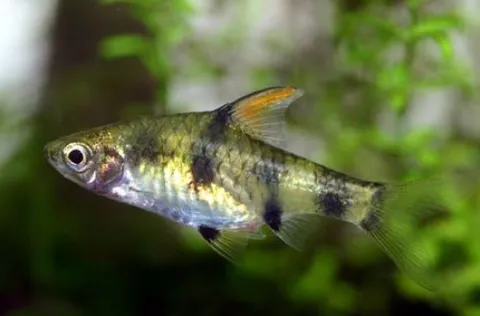
Pethia canius
Pethia canius, scientifically known as Pethia canius, belongs to the family Cyprinidae. The genus name Pethia is the Sinhalese collective name for small cyprinids, while the specific name “canius” appears to follow a…
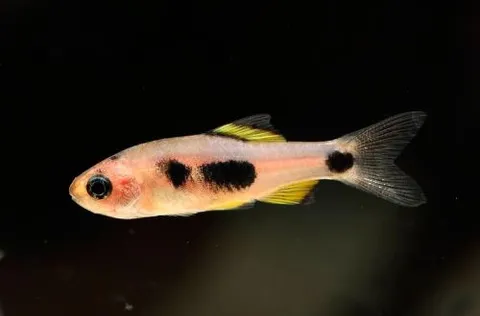
Enteromius hulstaerti
Enteromius hulstaerti, known as the Butterfly Barb or Moth Barb, belongs to the family Cyprinidae. This fish attracts attention with its beauty and does not cause much trouble in maintenance, but it is not often found…
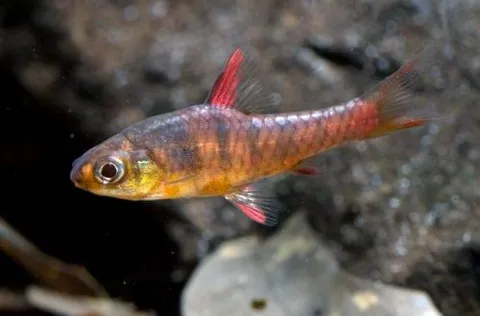
Enteromius jae
The Jae Barb, also known by its scientific name Enteromius jae, belongs to the family Cyprinidae. This miniature and picturesque fish can become a true gem in a nano aquarium. Its care and breeding are straightforward,…
Pethia aurea
The small Golden Barb, scientifically known as Pethia aurea, belongs to the family Cyprinidae. This peaceful, undemanding, small-sized fish can be a wonderful addition to any small aquarium. Its care and breeding do not…