Temperature20 – 28 °C
Natural range
- Borneo area
- Kalimantan area
CyprinidsConservation status: Least concern LC
Other scientific names: Barbus kahajani, Barbus rhomboocellatus, Barbus tetrazona, Puntius rhomboocellatus, Systomus rhomboocellatus
The Rhombus Barb, scientifically known as Desmopuntius rhomboocellatus, belongs to the family Cyprinidae. This small fish, with its distinctive body coloration and specific water chemistry requirements, thrives in biotope aquariums that recreate the peat swamp environments of Southeast Asia. Overall, this species is considered undemanding, and if the necessary conditions are met, aquarium care will not be particularly troublesome.
- Required aquarium volume
- 80 L
- Size in aquarium
- 5 – 5.5 cm
- Temperature
- 20 – 28 °C
- Temperament
- Peaceful (regular)
Parameters
Water pHAcidic (4) – Neutral (7)
Water dHVery soft (1) – Soft (5)
Water salinityno salt (freshwater)
Size in aquarium5 – 5.5 cm
Lifespan5 years
TemperamentPeaceful (regular)
Toward small fishnot a predator
Required aquarium volume80 L
Lightingdimmed
Substratesoft silted
Water flownone or stagnant (no flow)
FeedingAny (universal)
CareSchooling (usually from 5–6 individuals and more)
Description
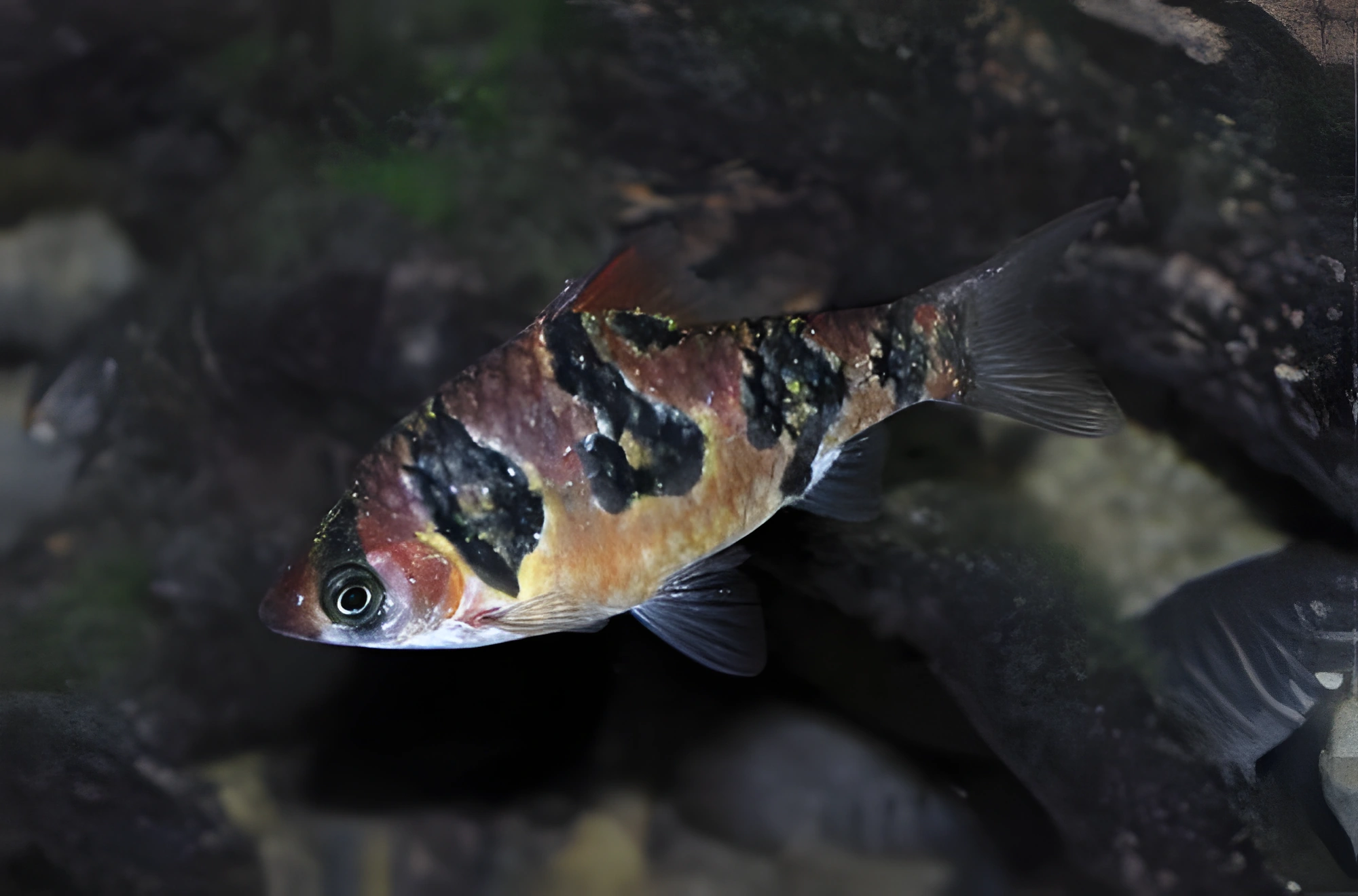
Adults of this species reach approximately 5 cm in length. Males are noticeably smaller than females, have a more slender body, and their coloration, which significantly depends on light intensity, is more vibrant. Under natural, subdued lighting, their colors acquire golden-pink hues. However, under bright lighting, the coloration becomes less expressive, taking on a silvery tone. On the fish's body, 3–4 large black markings, resembling rhombuses in shape, can be seen.
Habitat
This species is endemic to the island of Kalimantan, also known as Borneo. Its natural habitat includes peat swamps, as well as rivers and streams flowing from them. These fish prefer areas with abundant dense aquatic and riparian vegetation. The water in such bodies of water usually has a rich brown tint, due to the high concentration of dissolved humic acids and other chemical compounds formed during the decomposition of organic materials (e.g., fallen leaves and branches), while being characterized by low mineralization. The pH in these areas typically ranges from 3.0–4.0.
Behavior and Compatibility
Being a peaceful, active, and schooling species, these barbs coexist well with other cyprinids from Southeast Asia, such as Hengel's Rasbora, Espei's Rasbora, and Harlequin Rasbora. It is advisable to avoid introducing overly boisterous or large tank mates, as they may intimidate the Rhombus Barb. Keeping them in a group of 8 or more individuals positively affects the fish's behavior and coloration, especially in males, as competition for female attention stimulates them to intensify their own coloration.
Care and Maintenance
Maintaining a school of Rhombus Barbs requires very specific conditions, making them best suited for biotope aquariums. Optimal conditions are created in a tank of 80 liters or more, decorated with a soft peat substrate and dense groups of plants along the side walls. Additional hiding places, such as snags, branches, and tree roots, are welcome, and the addition of pre-dried leaves will give the aquarium a more natural look. Water parameters should be slightly acidic (low pH) and very soft. A neutral pH is acceptable when first filling the aquarium, which will naturally approach the desired value as the bio-system matures. The filtration system plays an important role here; it is recommended to use filters containing peat components as filter media. Other necessary equipment includes low-power lighting fixtures, a heater, and an aerator. Aquarium maintenance includes weekly water changes of 15–20% of the volume with fresh water and regular substrate cleaning with a siphon to remove organic waste.
Diet
In natural conditions, barbs feed on small insects, worms, crustaceans, and other zooplankton. In a home aquarium, the fish will readily accept dry and freeze-dried foods of appropriate size. Their diet should also be enriched with various frozen and live foods, such as daphnia, artemia, and bloodworms. It is important to avoid monotonous feeding; the diet should be balanced and include all listed types of food. It is recommended to feed the fish 2–3 times a day, offering portions that will be consumed within 5 minutes. Any uneaten food remnants must be promptly removed to prevent water contamination.
Breeding and Reproduction
Like most small cyprinids, barbs are capable of spawning in a community tank without specially created conditions. However, they do not exhibit parental care and may eat their own offspring. Although some fry may survive and reach maturity without aquarist intervention, their number can be significantly increased by organizing spawning in a separate tank. A spawning tank is a small reservoir of 30–40 liters, filled with water from the main aquarium. Equipment requirements are limited to a simple sponge filter and a heater. Lighting is not mandatory; natural room light is usually sufficient. Shade-loving plants, aquatic ferns, and mosses can be used for decoration. Special attention should be paid to the substrate: it should consist of balls about 1 cm in diameter or regular gravel covered with a fine mesh. When the eggs roll into the space between the balls or fall under the mesh, they become inaccessible to the parents, reliably protecting them from being eaten. Domestic spawning is not tied to a specific season. It is important to observe the fish carefully; if you notice that some individuals have noticeably rounded, it is a sign of impending offspring. The female and the chosen male—usually the largest and most vibrant—are placed in the spawning tank, where spawning should soon occur. If the process is prolonged, remember to feed the fish and promptly remove their waste products and uneaten food. Fry hatch from eggs within 24–36 hours but only begin free-swimming on day 3–4. From this point, feeding with specialized micro-food, available in most pet stores, should begin.
Diseases
The Diamond Barb is sensitive to water quality, and any deviations from the parameters of its natural habitat, especially an increase in hardness or the accumulation of organic pollutants, can provoke diseases. The most common diseases are ichthyophthiriasis (white spots on the body) and oodinium disease (velvet disease). The species is also susceptible to hexamitiasis, which manifests as loss of appetite, emaciation, and damage to the digestive organs.
Prevention involves maintaining stable conditions, regular water changes, and providing a soft, slightly acidic environment using tannins. It is important to avoid stress, as solitary keeping or overpopulation significantly reduces the fish's immunity, making them vulnerable to bacterial infections and parasites.
How to choose
When choosing Diamond Barbs, preference should be given to individuals that are active, stay in a school, and have clean, undamaged fins without signs of plaque or spots. It is important to carefully inspect the fish for the absence of sunken bellies, ulcers, or unnatural bloating, which may indicate emaciation or internal parasitic infections.
Since this species is often sold as wild-caught, it is recommended to ask the seller about the fish's adaptation period in the store. When purchasing, avoid individuals that appear lethargic, hide in corners, or show signs of rapid breathing, as adapting such specimens to aquarium conditions can be extremely difficult.
Frequently asked questions
The essentials: size, tank volume, water parameters and care
How big does Rhombus Barb get?
An adult reaches 5–5.5 cm in length. Plan the tank around the maximum size: the fish quickly outgrows a cramped setup.
What size aquarium does Rhombus Barb need?
The minimum recommended volume is 80 L. A smaller tank speeds up nitrate build-up and raises stress levels.
What water parameters does Rhombus Barb need?
Temperature 20–28 °C, pH 4–7, hardness 1–5 dGH. Stability matters more than exact values: sudden swings are harder on the fish than a small deviation from the ideal.
How long does Rhombus Barb live?
Around 5 years when kept properly. Lifespan depends directly on tank volume, water quality and a varied diet.
Is Rhombus Barb aggressive?
Temperament: peaceful (regular). Keep this in mind when choosing tank mates.
How many Rhombus Barb should be kept together?
Recommended setup: schooling (usually from 5–6 individuals and more). Ignoring this is a common cause of stress and disease.
What does Rhombus Barb eat?
Diet type: any (universal). Feed small portions that are finished within a couple of minutes — overfeeding does more harm than underfeeding.
What is the scientific name of Rhombus Barb?
The scientific name of the species is Desmopuntius rhomboocellatus, family Cyprinids (Cyprinidae). It also appears in the literature as: Barbus kahajani, Barbus rhomboocellatus, Barbus tetrazona.