Temperature19 – 25 °C
Natural range
- Western Ghats area
- Tamil Nadu area
CyprinidsConservation status: Vulnerable VU
Other scientific names: Puntius rohani
The fish known as Rohan's Barb (Dawkinsia rohani by its scientific name) belongs to the family Cyprinidae. Its name is a tribute to two prominent biologist-ichthyologists, Richard Dawkins and Rohan Pethiyagoda. This species is characterized by its unpretentiousness in keeping and breeding, making it an excellent choice for beginner aquarists, and it also coexists well with many other freshwater inhabitants.
- Required aquarium volume
- 200 L
- Size in aquarium
- 8 – 9 cm
- Temperature
- 19 – 25 °C
- Temperament
- Peaceful (regular)
Parameters
Water pHSlightly acidic (6) – Neutral (7.5)
Water dHVery soft (2) – Medium hardness (10)
Water salinityno salt (freshwater)
Size in aquarium8 – 9 cm
Lifespan4 years
TemperamentPeaceful (regular)
Toward small fishnot a predator
Required aquarium volume200 L
Lightingany
Substrateany (no restrictions)
Water flowweak or moderate
FeedingAny (universal)
CareGroup (8–10 individuals)
Description
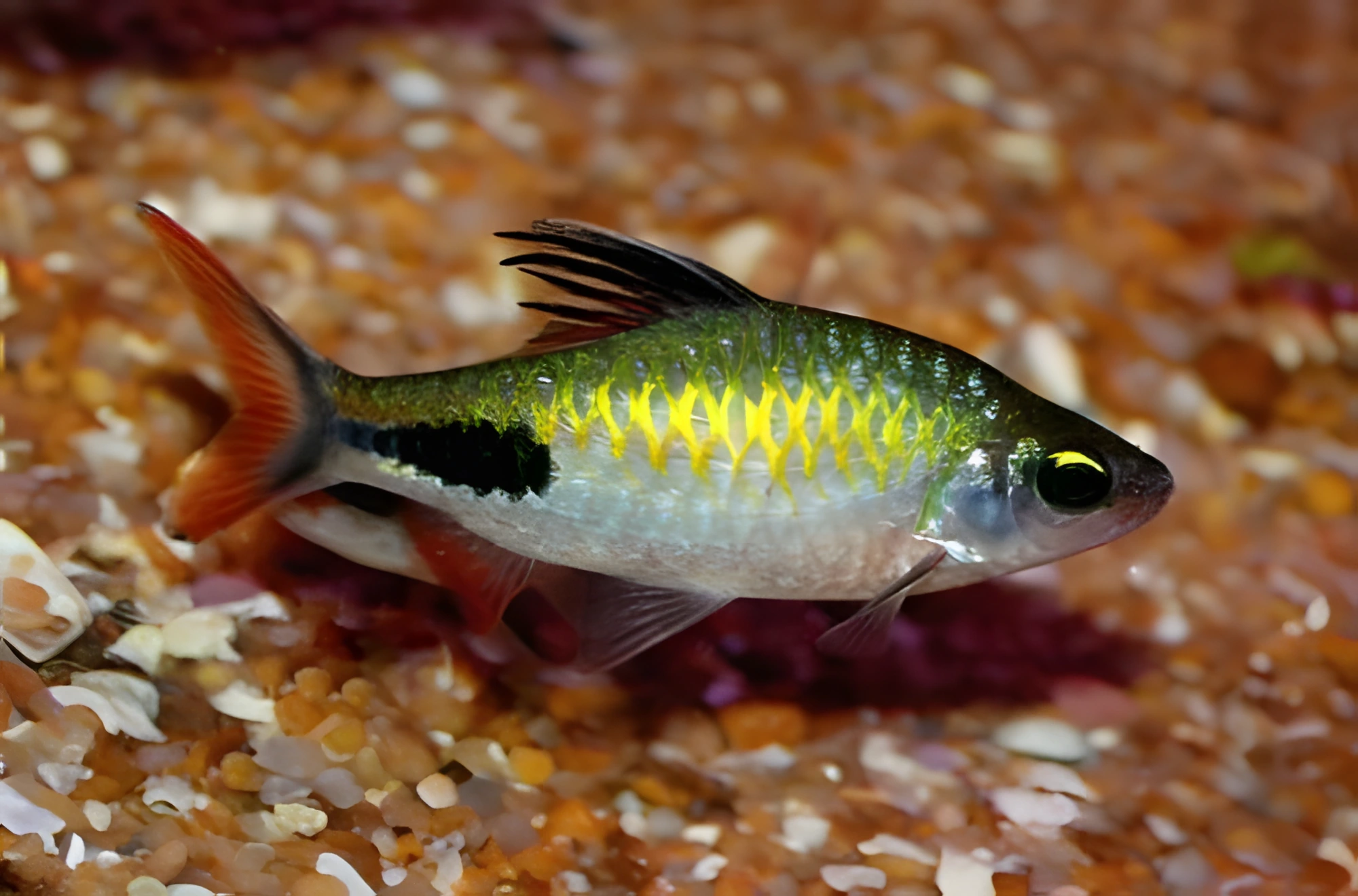
It is a close relative of Dawkinsia barb and the Exclamation Point Barb, which is evident in the noticeable external similarity between these fish. Adults reach approximately 9 cm in length. Their coloration is quite vibrant: the upper part of the body shimmers with shades of green, from emerald to light green, while the belly has a silvery sheen. The anal and caudal fins are red. The dorsal fin is dark, characterized by filamentous rays. A black stripe is noticeable at the base of the caudal fin. Sexual dimorphism is weakly expressed, however, during the spawning period, males develop small tubercles on their heads and a pink 'blush', which distinguishes them from females.
Habitat
Its origin is associated with the southern part of India, where it is endemic to the Tamiraparani River basin, including its main tributaries Kodayar and Paraliyar. These rivers, originating in the Western Ghats mountains, flow into the Laccadive Sea. The fish prefer to inhabit the mountainous sections of these river systems. Such places are characterized by rocky substrates, an abundance of snags, and rich riparian vegetation. It should be noted that water levels and hydrochemical properties can vary significantly depending on the season.
Behavior and Compatibility
This is a peaceful schooling fish. It is recommended to keep them in a group of at least 8–10 individuals. They coexist perfectly with other non-aggressive and calm fish species of similar size that can thrive in the same conditions.
Care and Maintenance
For long-term keeping of this species, an aquarium of at least 200 liters will be required, which is optimal for a small school of Rohan's Barbs. The aquarium's decor can be arbitrary. However, the fish will look most natural and harmonious in a design that mimics their natural environment – a riverine biotope with moderate current, a substrate of sand, stones, and boulders, as well as several snags resembling roots or tree branches. Vegetation is not a mandatory element, but its presence is welcome. It is important to remember that these fish are inhabitants of flowing waters, so they tolerate the accumulation of organic waste poorly and require a high level of dissolved oxygen. Many of these requirements can be met by an efficient filtration system that not only cleans the water but also creates the necessary current. Nevertheless, to maintain the health of the fish, it is necessary to regularly clean the aquarium with a siphon, remove plaque from surfaces, weekly change 30–50% of the water volume with fresh water, ensure equipment maintenance, and maintain stable pH and dGH parameters.
Diet
The diet of Rohan's Barb can include most common aquarium foods, such as dry flakes and granules. They also readily eat fresh, live, or frozen brine shrimp and bloodworms. It is recommended to choose foods that enhance the vibrancy of their coloration.
Breeding and Reproduction
Breeding Rohan's Barb does not present particular difficulties; fry can even appear in a community tank, although in this case, their survival rate will be extremely low. During spawning, females lay dozens of eggs, which are immediately fertilized by males. The incubation period lasts from 24 to 48 hours, after which the fry begin to swim freely within a day. Since these fish lack parental instincts, adults may eat their own eggs immediately after spawning. The same fate often awaits the hatched fry. To ensure the survival of the offspring, a separate breeding tank with the same water conditions is used, into which fertilized eggs or already hatched fry are transferred. The breeding tank equipment includes a simple sponge filter (airlift filter) and a heater. It is recommended to maintain subdued lighting, so a separate light source is not required. The presence of decorations in such an aquarium is irrelevant.
Diseases
In a balanced aquarium ecosystem that meets the needs of this species, diseases are rare. Most often, ailments are provoked by deteriorating environmental conditions, contact with already sick fish, or mechanical damage. If the fish shows clear signs of illness, medicinal treatment should be applied. More detailed information on symptoms and therapy methods can be found in the “Aquarium Fish Diseases” section.
How to choose
When choosing Rohan's Barb, preference should be given to active individuals with clean fins and no visible body damage. A healthy fish should show curiosity, have bright coloration appropriate for its age, and actively respond to feeding. Avoid purchasing fish with signs of emaciation, sunken bellies, cloudy eyes, or film on their scales.
- purchase only from reputable places where fish are kept in clean water with good filtration;
- pay attention to their behavior in the store: healthy individuals stay in a school, do not show signs of apathy or constant hovering at the surface;
- keep in mind that at a young age, the species may be externally similar to closely related barbs, so it is important to ensure correct identification by the characteristic teardrop-shaped spot at the base of the tail.
Frequently asked questions
The essentials: size, tank volume, water parameters and care
How big does Rohan's Barb get?
An adult reaches 8–9 cm in length. Plan the tank around the maximum size: the fish quickly outgrows a cramped setup.
What size aquarium does Rohan's Barb need?
The minimum recommended volume is 200 L. A smaller tank speeds up nitrate build-up and raises stress levels.
What water parameters does Rohan's Barb need?
Temperature 19–25 °C, pH 6–7.5, hardness 2–10 dGH. Stability matters more than exact values: sudden swings are harder on the fish than a small deviation from the ideal.
How long does Rohan's Barb live?
Around 4 years when kept properly. Lifespan depends directly on tank volume, water quality and a varied diet.
Is Rohan's Barb aggressive?
Temperament: peaceful (regular). Keep this in mind when choosing tank mates.
How many Rohan's Barb should be kept together?
Recommended setup: group (8–10 individuals). Ignoring this is a common cause of stress and disease.
What does Rohan's Barb eat?
Diet type: any (universal). Feed small portions that are finished within a couple of minutes — overfeeding does more harm than underfeeding.
What is the scientific name of Rohan's Barb?
The scientific name of the species is Dawkinsia rohani, family Cyprinids (Cyprinidae). It also appears in the literature as: Puntius rohani.