Temperature22 – 25 °C
Natural range
- Thailand area
- Sumatra area
CyprinidsConservation status: Least concern LC
Other scientific names: Barbus eugrammus, Barbus fasciatus, Barbus tetrazona, Puntius eugrammus, Puntius fasciatus, Puntius johorensis
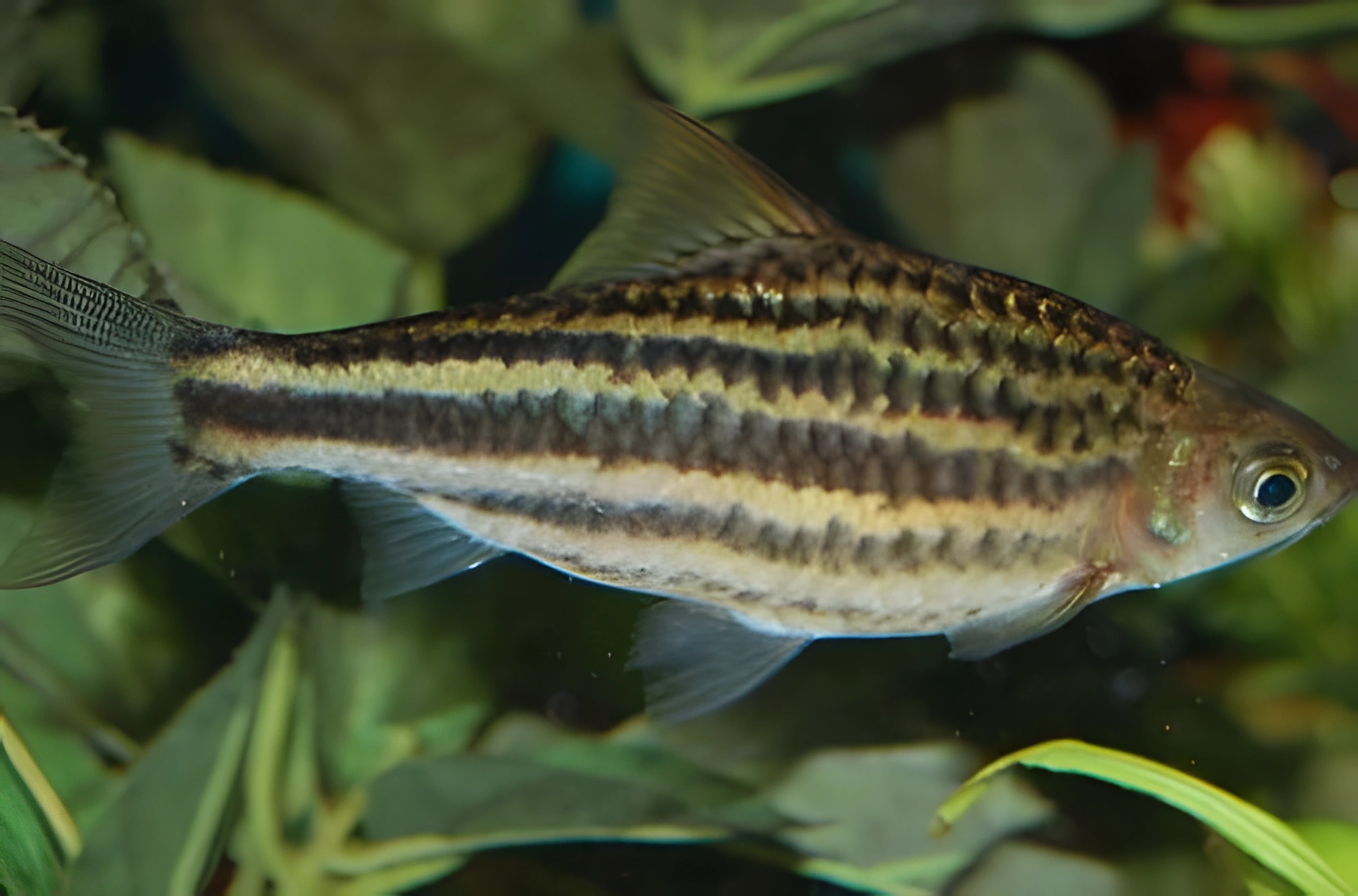
Desmopuntius johorensis, also known as the Five-banded Barb or Striped Barb, belongs to the Cyprinidae family. This fish is attractive due to its unique body pattern. Thanks to its unpretentiousness and peaceful nature, it can be a wonderful addition to a community tank.
- Required aquarium volume
- 150 L
- Size in aquarium
- 12 cm
- Temperature
- 22 – 25 °C
- Temperament
- Peaceful (regular)
Parameters
Water pHSlightly acidic (5) – Neutral (7)
Water dHVery soft (1) – Medium hardness (10)
Water salinityno salt (freshwater)
Size in aquarium12 cm
Lifespan5 years
TemperamentPeaceful (regular)
Toward small fishnot a predator
Required aquarium volume150 L
Lightingdimmed
Substratesoft sandy (including silted)
Water flownone or stagnant (no flow)
FeedingAny (universal)
CareGroup (8–10 individuals)
Description
These fish have a slender, elongated body; in females, it appears taller. Near the mouth, four thread-like barbels can be seen, two on each side, which help them explore the substrate in search of food. Their coloration is pinkish-golden with longitudinal dark stripes running along the entire body. Females are generally less brightly colored and appear paler than males. Outwardly, the species is almost identical to the Linear Barb and the Three-banded Barb.
Habitat
The natural habitat of this species extends across the waters of Southeast Asia, including Thailand and the Indonesian island of Sumatra. They prefer peat swamps and small river channels with slow currents, where there is dense bottom or coastal vegetation. The water in these places often takes on a brown tint due to the accumulation of organic decomposition products, such as fallen leaves, grass, and algae. Their diet primarily consists of small aquatic insects, their larvae, and zooplankton.
Behavior and Compatibility
This peaceful and compatible fish is, however, prone to timidity and prefers to stay in shoals. It coexists well with most species from Southeast Asian waters that have a similar temperament. It is crucial to categorically avoid cohabitation with aggressive fish, even if they are smaller than the Five-banded Barb.
Care and Maintenance
A crucial aspect is the preparation of aquarium water, which should be soft and have a slightly acidic reaction. To achieve the necessary parameters, it is recommended to use special reagents and test kits available in pet stores and online. Between 10% and 20% of the total water volume should be renewed weekly. It is worth noting that in an established aquarium, the water naturally becomes slightly acidic due to the oxidation of fish waste products and leftover food, which may eliminate the need for constant artificial regulation of these parameters. The minimum equipment set includes a filter, aerator, heater, and lighting set to soft light. For aquarium decoration, a soft substrate of fine sand, even if slightly silty, with an abundance of low-growing rooted plants, is suitable. It is important to avoid excessive overgrowth of the aquatic space so that the fish have enough room to swim. Floating plants will be beneficial as they help create additional shading. Hiding places such as tree roots and branches or various snags are also necessary.
Diet
Their diet can include all types of food: dry, frozen, and live. The ideal combination would be alternating dry flakes or pellets with portions of frozen or live foods, such as daphnia, bloodworms, or brine shrimp. If access to live foods is difficult, preference should be given to dry mixes, but ensure they contain protein supplements, such as freeze-dried bloodworms. It is also recommended to supplement the diet with vegetable flakes served with the main food.
Breeding and Reproduction
Breeding these fish is not particularly difficult. Often, fry appear in the community tank even without any intervention from the aquarist. During spawning, the female scatters eggs directly onto the substrate, after which the male fertilizes them. However, parental instincts in barbs are weakly expressed, and they often eat their own eggs. To prevent this, a fine-mesh net can be placed on the bottom, through which the eggs can fall, or the bottom can be densely planted with fine-leaved vegetation. Fry hatch in approximately 2 days, and by the third day, they begin to swim actively. At this stage, it is advisable to move them to a separate tank, as they can become easy prey for other aquarium inhabitants. Young fish should be fed micro-foods or finely crushed dry flakes.
Diseases
The Striped Barb is quite hardy, and health problems usually only arise in weakened individuals due to poor nutrition or unsuitable keeping conditions. Infection is also possible through contact with already sick fish. Detailed information on symptoms and treatment methods can be found in the "Aquarium Fish Diseases" section.
How to choose
When choosing a Five-banded Barb, preference should be given to active individuals with clean fins and no visible skin damage. It is important to pay attention to the absence of signs of emaciation, such as a sunken belly, and to ensure that the fish in the aquarium do not show signs of apathy or unnatural behavior, such as constantly hovering at the water surface.
- Avoid buying fish with whitish coatings, ulcers, or an unnaturally bloated abdomen.
- Choose individuals from a shoal, as single fish in a store are often under severe stress.
- Ask the seller what the fish are fed and ensure they show interest in food during feeding.
Frequently asked questions
The essentials: size, tank volume, water parameters and care
How big does Five-banded Barb get?
An adult reaches 12 cm in length. Plan the tank around the maximum size: the fish quickly outgrows a cramped setup.
What size aquarium does Five-banded Barb need?
The minimum recommended volume is 150 L. A smaller tank speeds up nitrate build-up and raises stress levels.
What water parameters does Five-banded Barb need?
Temperature 22–25 °C, pH 5–7, hardness 1–10 dGH. Stability matters more than exact values: sudden swings are harder on the fish than a small deviation from the ideal.
How long does Five-banded Barb live?
Around 5 years when kept properly. Lifespan depends directly on tank volume, water quality and a varied diet.
Is Five-banded Barb aggressive?
Temperament: peaceful (regular). Keep this in mind when choosing tank mates.
How many Five-banded Barb should be kept together?
Recommended setup: group (8–10 individuals). Ignoring this is a common cause of stress and disease.
What does Five-banded Barb eat?
Diet type: any (universal). Feed small portions that are finished within a couple of minutes — overfeeding does more harm than underfeeding.
What is the scientific name of Five-banded Barb?
The scientific name of the species is Desmopuntius johorensis, family Cyprinids (Cyprinidae). It also appears in the literature as: Barbus eugrammus, Barbus fasciatus, Barbus tetrazona.