Temperature20 – 25 °C
Natural range
- Sumatra area
- Lake Maninjau area
CyprinidsConservation status: Least concern LC
Other scientific names: Barbus oliogolepis, Capoeta oligolepis, Puntius oligolepis
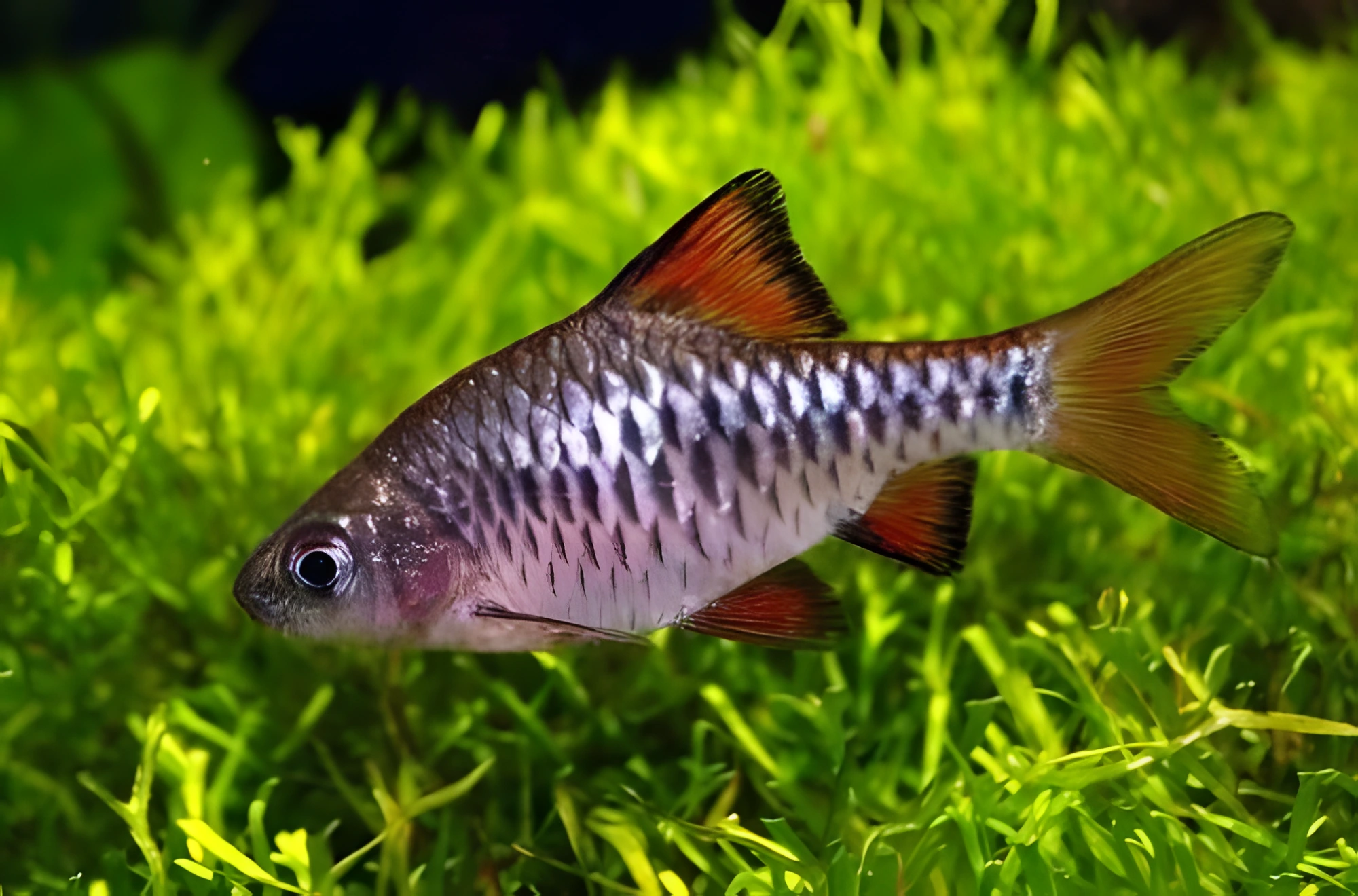
Oliotius oligolepis, also known as the Checkerboard Barb (scientific name Oliotius oligolepis), belongs to the Cyprinidae family. This aquarium fish is popular due to its unpretentiousness and ease of care. It coexists well with many widely known species.
- Required aquarium volume
- 60 L
- Size in aquarium
- 4 – 5 cm
- Temperature
- 20 – 25 °C
- Temperament
- Peaceful (regular)
Parameters
Water pHSlightly acidic (6) – Neutral (7.5)
Water dHVery soft (2) – Hard (12)
Water salinityno salt (freshwater)
Size in aquarium4 – 5 cm
Lifespan4 years
TemperamentPeaceful (regular)
Toward small fishnot a predator
Required aquarium volume60 L
Lightingdimmed
Substrateany, but dark
Water flowweak
FeedingAny (universal)
CareSchooling (usually from 5–6 individuals and more)
Description
This species of barb is one of the most miniature: adult individuals reach only 4 cm in length. Females, as a rule, are larger than males. Males, although smaller in size, have a significantly brighter and more saturated body coloration. The main shade of their scales is pinkish with a metallic sheen. The surface of the scales is dotted with dark specks, creating a characteristic checkerboard pattern. The fins are red and have a dark edging.
Habitat
This species inhabits exclusively the island of Sumatra, being endemic to it. It can be found in Lake Meninjau, located in the caldera of an ancient volcano, possibly also in tributary rivers, but the exact boundaries of its distribution remain unknown. It is important to note that all fish currently sold are bred in artificial conditions in commercial aquariums; there are no supplies from the wild.
Behavior and Compatibility
This fish is peaceful, active, and prefers to stay in schools of 8–10 individuals. Such group behavior not only reduces their timidity but also significantly improves the intensity of their coloration, especially in males, who compete for the attention of females. Checkerboard Barbs get along well with other species of similar size and temperament, including representatives of carp, characin, livebearer, and some catfish species.
Care and Maintenance
The Checkerboard Barb is highly undemanding. For a group of 8–10 individuals, an aquarium of at least 60 L will be sufficient. The tank's decor can be anything, but with certain conditions in mind. It is recommended to use a dark substrate, which effectively highlights the fish's coloration, and to add some floating plants to create natural shading. Various shelters, such as snags, branches, and tree roots, will also be very useful. The equipment set is standard: a filter, heater, aerator, and a low-power lighting system, as the fish prefer subdued light. Special attention should be paid to water quality. Weekly, 25–30% of the water volume must be replaced, and organic waste (food residues, excrement, fallen plant parts, etc.) should be promptly removed using a siphon to clean the substrate.
Diet
The diet of the Checkerboard Barb can include all types of food: dry, frozen, and live. The basis of the diet is recommended to be protein components, such as bloodworms, daphnia, and other crustaceans, supplemented with a small amount of dry food with vegetable additives. Feeding should be done 2–3 times a day, offering portions that the fish eat within 5 minutes. All food residues must be removed from the aquarium to avoid water pollution.
Breeding and Reproduction
Oliotius oligolepis is an egg-laying species. In a home aquarium, spawning can occur in any season. Females lay eggs near the water surface, among plant thickets, while males fertilize them. After this, the eggs are left unattended. Parental instincts in barbs are poorly developed, so they may eat their eggs immediately after spawning. If the goal is to preserve offspring, it is more advisable to breed them in a separate tank — a spawning aquarium. Floating fine-leaved plants such as Myriophyllum aquaticum, Ceratophyllum demersum, Riccia fluitans, and similar ones are placed in it. Eggs caught in this dense plant network are relatively safe. To protect eggs that fall to the bottom, a coarse substrate with large gaps between particles, such as pebbles or decorative glass beads, is used. These voids serve as additional shelter. Recommended equipment includes a heater, aerator, low-power lamp, and a simple sponge filter. The aquarium is filled with water from the main aquarium. When you notice that the females have noticeably rounded, and the males are actively courting their chosen ones, this signals the beginning of the breeding period, and it's time to transfer the future parents to the spawning aquarium. One pair can lay up to 300 eggs. After spawning, the fish are returned to the main aquarium. Fry hatch after 24–28 hours and begin to swim freely after another day. For feeding the fry, it is recommended to use specialized micro-food, which can be purchased at pet stores.
Diseases
A balanced aquarium ecosystem, providing suitable conditions for a specific species, combined with proper nutrition, serves as the best prevention for various diseases. The emergence of diseases usually indicates an unsatisfactory environmental condition, and this is what needs to be addressed first. However, knowing treatment methods and symptoms of common diseases is also very useful; more detailed information can be found in the section "Diseases of Aquarium Fish."
How to choose
When choosing Oliotius oligolepis, it is important to consider that under stress conditions, typical for pet store aquariums, the fish's coloration may temporarily fade, becoming gray. A healthy individual should be active and stay in a school, as solitary keeping in a store often provokes timidity or atypical aggression. Avoid buying fish with visible fin damage, film on the body, or signs of emaciation.
- pay attention to the integrity of the scales and the cleanliness of the fins without signs of erosion or white spots;
- choose individuals with clear, non-cloudy eye corneas and no bulging eyeballs;
- ensure there is no rapid breathing or unnatural movements, such as swaying in place or attempting to rub against the substrate and decorations.
Frequently asked questions
The essentials: size, tank volume, water parameters and care
How big does Oliotius oligolepis get?
An adult reaches 4–5 cm in length. Plan the tank around the maximum size: the fish quickly outgrows a cramped setup.
What size aquarium does Oliotius oligolepis need?
The minimum recommended volume is 60 L. A smaller tank speeds up nitrate build-up and raises stress levels.
What water parameters does Oliotius oligolepis need?
Temperature 20–25 °C, pH 6–7.5, hardness 2–12 dGH. Stability matters more than exact values: sudden swings are harder on the fish than a small deviation from the ideal.
How long does Oliotius oligolepis live?
Around 4 years when kept properly. Lifespan depends directly on tank volume, water quality and a varied diet.
Is Oliotius oligolepis aggressive?
Temperament: peaceful (regular). Keep this in mind when choosing tank mates.
How many Oliotius oligolepis should be kept together?
Recommended setup: schooling (usually from 5–6 individuals and more). Ignoring this is a common cause of stress and disease.
What does Oliotius oligolepis eat?
Diet type: any (universal). Feed small portions that are finished within a couple of minutes — overfeeding does more harm than underfeeding.
What is the scientific name of Oliotius oligolepis?
The scientific name of the species is Oliotius oligolepis, family Cyprinids (Cyprinidae). It also appears in the literature as: Barbus oliogolepis, Capoeta oligolepis, Puntius oligolepis.