Temperature18 – 26 °C
Natural range
- Indian Subcontinent area
- Southeast Asia area
Cyprinids
Other scientific names: Barbodes sarana, Barbus orphoides, Puntius orphoides, Puntius sarana
Systomus orphoides, known as the "Red-cheeked Barb," belongs to the family Cyprinidae, or carps. This species is almost indistinguishable in appearance from its closest relative, the Olive Barb (Systomus sarana). This is why both are often sold under the same collective name.
- Required aquarium volume
- 720 L
- Size in aquarium
- 20 – 25 cm
- Temperature
- 18 – 26 °C
- Temperament
- Semi-peaceful (including aggression during spawning / intraspecific conflicts)
Parameters
Water pHSlightly acidic (6) – Neutral (7.5)
Water dHVery soft (2) – Very hard (21)
Water salinityno salt (freshwater)
Size in aquarium20 – 25 cm
Lifespan8 years
TemperamentSemi-peaceful (including aggression during spawning / intraspecific conflicts)
Toward small fishnot a predator
Required aquarium volume720 L
Lightingmoderate (regular)
Substratesand or gravel + stones/boulders
Water flowmoderate
FeedingMeat with plant additives (omnivores)
CareSchooling (usually from 5–6 individuals and more)
Description
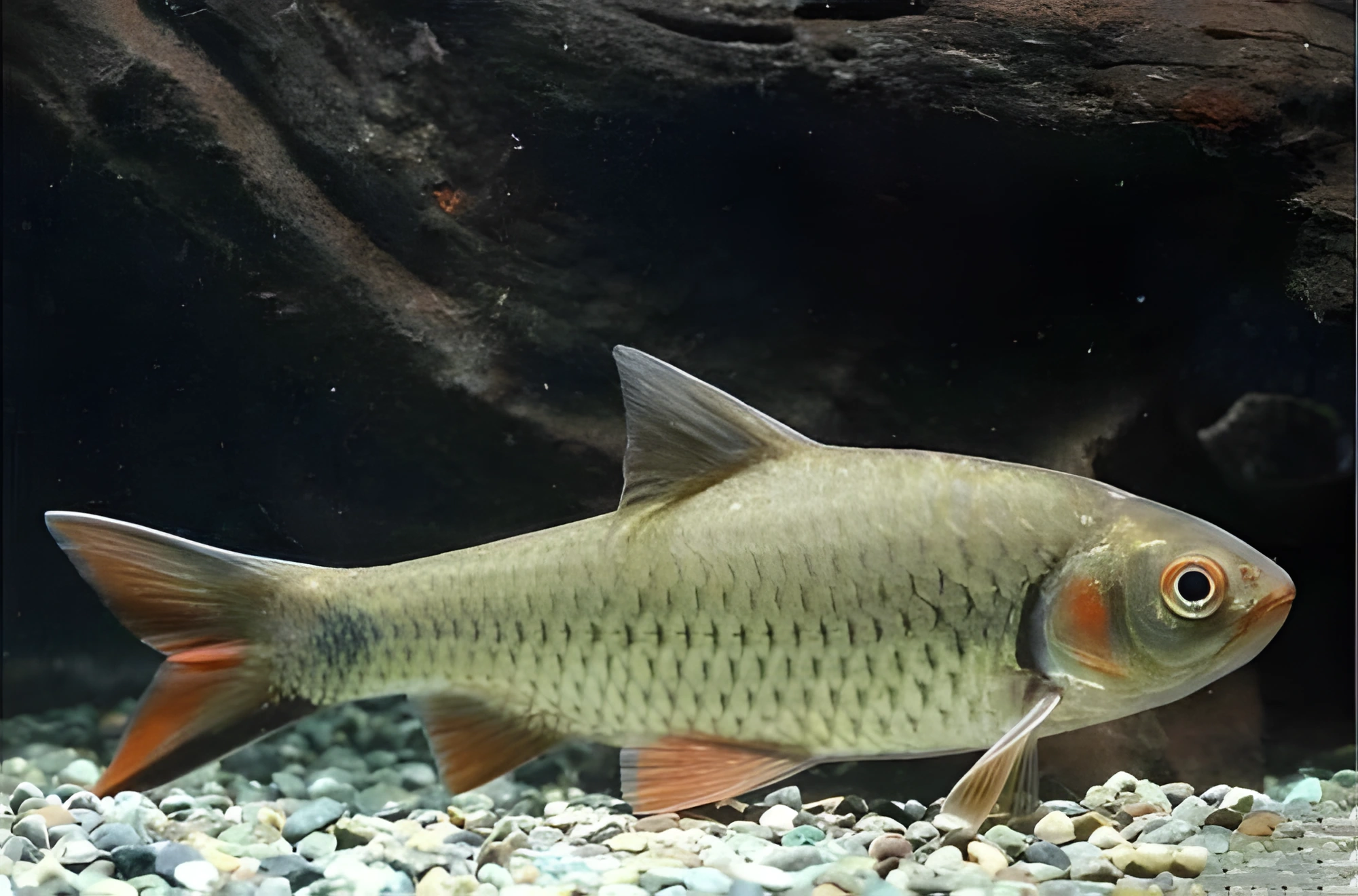
Given its wide range, the Red-cheeked Barb has several geographical forms that differ slightly in coloration and body pattern. These fish typically reach a length of 20–25 cm, and their bodies appear massive and robust. The coloration varies from gray to dark silver. Reddish pigmentation is noticeable on the gill covers and fins. The edges of the caudal fin are black. During the spawning period, males develop characteristic tubercles on their heads. Females, as a rule, appear somewhat larger.
Habitat
The natural habitats of these fish cover vast areas, from the eastern part of the Indian subcontinent through all of Southeast Asia, up to the Malay Peninsula and the Greater Sunda Islands. They inhabit main river channels, as well as numerous tributaries. Most often, they are found in backwaters and other areas with calm water. During the rainy season, they migrate to flooded rainforest territories to spawn. These fish can also be found in bodies of water with moderate currents.
Behavior and Compatibility
In their natural environment, Red-cheeked Barbs live in schools. In a home aquarium, it is recommended to keep a group of 6 or more individuals for their comfortable existence. In such a school, the fish are more focused on interacting with each other, maintaining a hierarchy, and are less likely to show aggression towards other tank inhabitants. If the number of fish in the group is smaller, they may become aggressive towards smaller tank mates.
Care and Maintenance
For a group consisting of 6–8 individuals, the minimum recommended aquarium volume is 500 liters or more. The aquarium decor can be varied, at the aquarist's discretion, or it can be determined by the needs of its other inhabitants. It is important that the aquarium has open swimming areas, both in the water column and near the surface. For long-term and successful keeping, it is necessary to maintain water purity, ensuring its oxygen saturation, as well as a temperature range of 18–26°C. These fish show good adaptability to various hydrochemical water parameters. The presence of an internal current is desirable, which can be provided by a powerful filtration system.
Diet
This species is omnivorous. In their natural environment, their diet consists of both small invertebrates and plant matter. In aquarium conditions, dry foods such as flakes and granules are acceptable. Live foods will be an excellent addition to their daily diet.
Breeding and Reproduction
Reliable information on the breeding of this species in home aquariums is practically nonexistent. In nature, the fish are egg-layers, do not show parental care, and scatter their eggs among vegetation during the rainy season. For commercial purposes in countries of their natural range, breeding is often carried out using hormonal injections. Sexually mature males develop characteristic epithelial tubercles on their heads during the spawning period, and their coloration becomes more intense.
Diseases
The species is sensitive to the accumulation of organic pollutants in the water, which, with poor environmental quality, provokes bacterial infections and a decrease in immunity. Characteristic signs of distress include refusal to eat, rapid breathing, the appearance of whitish spots on the body, or changes in behavior. Prevention involves maintaining high water purity, effective filtration, and regular water changes. When transporting and adapting new individuals, a long quarantine is highly recommended to prevent the introduction of parasites.
How to choose
When purchasing, choose active individuals with clean fins and no visible defects or strange spots on the body. It is important to ensure that the fish show a healthy feeding interest when offered food in the store. Due to the similarity of juveniles with closely related barb species, it is important to carefully examine the coloration, including the characteristic dark edging of the caudal fin. Acquiring a school of six or more individuals is preferable to reduce stress and establish a natural hierarchy.
Frequently asked questions
The essentials: size, tank volume, water parameters and care
How big does Red-cheeked Barb get?
An adult reaches 20–25 cm in length. Plan the tank around the maximum size: the fish quickly outgrows a cramped setup.
What size aquarium does Red-cheeked Barb need?
The minimum recommended volume is 720 L. A smaller tank speeds up nitrate build-up and raises stress levels.
What water parameters does Red-cheeked Barb need?
Temperature 18–26 °C, pH 6–7.5, hardness 2–21 dGH. Stability matters more than exact values: sudden swings are harder on the fish than a small deviation from the ideal.
How long does Red-cheeked Barb live?
Around 8 years when kept properly. Lifespan depends directly on tank volume, water quality and a varied diet.
Is Red-cheeked Barb aggressive?
Temperament: semi-peaceful (including aggression during spawning / intraspecific conflicts). Keep this in mind when choosing tank mates.
How many Red-cheeked Barb should be kept together?
Recommended setup: schooling (usually from 5–6 individuals and more). Ignoring this is a common cause of stress and disease.
What does Red-cheeked Barb eat?
Diet type: meat with plant additives (omnivores). Feed small portions that are finished within a couple of minutes — overfeeding does more harm than underfeeding.
What is the scientific name of Red-cheeked Barb?
The scientific name of the species is Systomus orphoides, family Cyprinids (Cyprinidae). It also appears in the literature as: Barbodes sarana, Barbus orphoides, Puntius orphoides.