Temperature20 – 26 °C
Natural range
- Central Africa area
- Southern Africa area
CyprinidsConservation status: Least concern LC
Other scientific names: Barbodes fasciolatus, Barbus barilioides, Barbus faciolatus, Barbus fasciolatus, Puntius fasciolatus
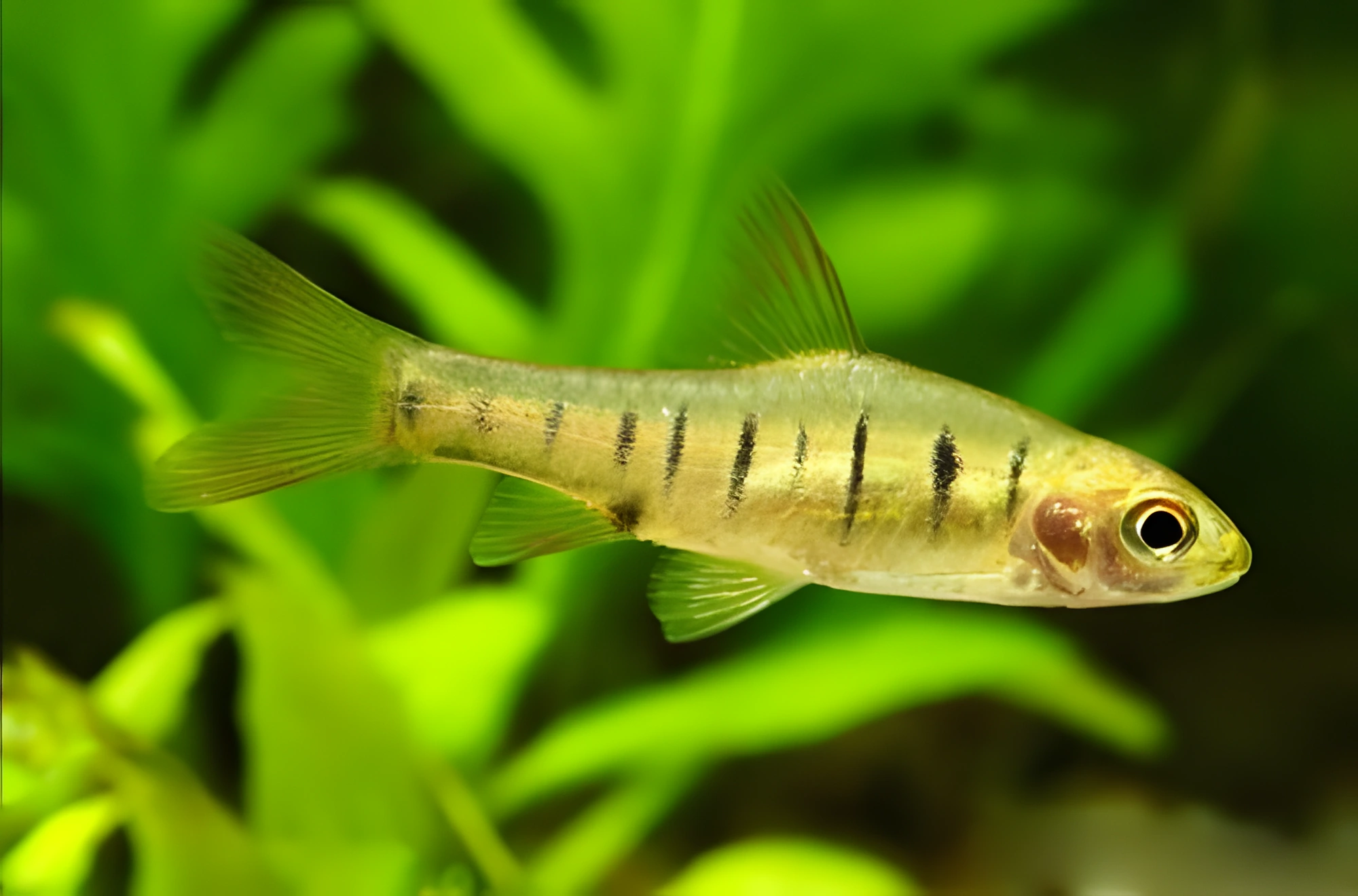
A representative of the Cyprinidae family, known as the Fasciolatus Barb or African Banded Barb (scientific name Enteromius fasciolatus), is a rather rare guest among African barbs. Like its Asian counterparts, this species will not cause trouble for the aquarist, as it is easy to keep and breed; moreover, it coexists perfectly with many other inhabitants. The African Banded Barb is excellent even for beginners.
- Required aquarium volume
- 80 L
- Size in aquarium
- 5 – 6 cm
- Temperature
- 20 – 26 °C
- Temperament
- Peaceful (regular)
Parameters
Water pHSlightly acidic (5) – Neutral (6.5)
Water dHVery soft (1) – Hard (12)
Water salinityno salt (freshwater)
Size in aquarium5 – 6 cm
Lifespan5 years
TemperamentPeaceful (regular)
Toward small fishnot a predator
Required aquarium volume80 L
Lightingdimmed
Substrateany, but dark
Water flowweak
FeedingSmall / appropriate size / pieces
CareGroup (8–10 individuals)
Description
These slender fish, reaching 5–6 cm in length when adult, have a yellow body with translucent fins of the same hue. The distinctive pattern consists of thin vertical stripes extending from head to tail. Sexual dimorphism is weakly expressed: females are generally slightly larger than males, and during the spawning period, they may have a slightly enlarged abdomen.
Habitat
The natural habitat of these fish covers Central and Southern Africa, where they inhabit various biotopes. They can be found in lakes, in flood plain lagoons, in river backwaters, and in streams flowing under the forest canopy. Characteristic features of the habitat include an abundance of aquatic vegetation and slow current. The water here usually has a rich brown tint due to the large amount of dissolved tannins, which are formed during the decomposition of plant organic matter, but it is always rich in oxygen.
Behavior and Compatibility
This peaceful schooling fish coexists well with most other calm species of comparable size. However, it is best to avoid large, and especially aggressive, fish as tankmates. It is important to keep these barbs in a school consisting of at least 8–10 individuals. Within the species group, a hierarchy forms, including dominant and subdominant individuals. If Fasciolatus Barbs live in too small a group, the weakest individual will be constantly attacked, which can ultimately lead to its death. After this, the bullying will continue on the next fish in the hierarchy and so on.
Care and Maintenance
For a small school of these fish, the optimal tank volume starts from 80 liters. It is recommended to use a dark substrate in the aquarium setup. Various snags and decorative elements are suitable for creating shelters. Among plants, shade-loving species such as Anubias, Cryptocorynes, as well as mosses and ferns should be preferred. Floating plants provide additional shading. Lighting should be kept subdued. To emphasize the natural look and give the water the characteristic brown tint of natural bodies of water, you can add dry tree leaves, as described in more detail in the article “What tree leaves can be used in an aquarium.” The successful keeping of these fish largely depends on maintaining stable water parameters within acceptable temperature and hydrochemical values (pH and dGH). Regular aquarium care for African Banded Barbs includes weekly partial water changes with fresh water, cleaning the substrate and decorations from organic deposits, preventive maintenance of equipment, and monitoring of pH, dGH, and oxidizability values. Given that this species prefers stagnant or slow-flowing bodies of water, when choosing a filtration system, it is advisable to opt for models that create minimal water movement (internal current).
Diet
The Fasciolatus Barb readily accepts most common foods intended for aquarium fish. Their daily diet may include dry flakes or granules, supplemented with live or frozen bloodworms, as well as Artemia. It should be noted that these barbs do perfectly well exclusively on high-quality dry foods, but it is important that plant components are necessarily present in their composition.
Breeding and Reproduction
The stimulus for breeding these fish is the establishment of certain water parameters: dGH within 2–5, pH between 6.0–6.5, and a temperature of 24–26°C, provided that the fish receive high-quality and balanced foods. During spawning, females lay hundreds of eggs among dense plant thickets, and the dominant male then fertilizes them. Since parental instincts are not developed at all in Fasciolatus Barbs, the eggs can be eaten by the adult fish themselves. In this regard, the survival rate of fry in a community tank becomes extremely low. To preserve the young, it is recommended to create a separate tank, where the eggs will be carefully moved after spawning. This improvised spawning tank usually has a small volume, about 10 liters, and sometimes even a three-liter jar will suffice. Equipment for such an aquarium includes an airlift filter with a sponge and a heater. A separate light source is not required. Mosses, ferns, or artificial plants can be used for decoration. It should be noted that not all of the hundreds of eggs will be fertilized — this is a perfectly normal phenomenon, as barbs rely on quantity. The incubation period lasts approximately 48 hours, and after another week, the fry begin to actively swim in search of food.
Diseases
In a balanced aquarium ecosystem, closely matching the requirements of this species, diseases are extremely rare. Illnesses often arise due to deteriorating habitat quality, contact with already sick fish, or physical injuries. If these factors could not be avoided, the “Aquarium Fish Diseases” section will provide detailed information on symptoms and treatment methods.
How to choose
When choosing a Fasciolatus Barb, pay attention to the activity and behavior of individuals in the aquarium. Healthy fish should swim in a school, be mobile, and show curiosity. Avoid specimens with signs of emaciation, sunken bellies, or damage to the body and fins, as this species can be susceptible to stress during transport and keeping in unsuitable conditions.
- Inspect the fish for spots, film, or atypical growths that may indicate parasitic infections.
- Make sure that the fish in the store are kept in conditions close to their needs, as prolonged stay in unsuitable water weakens the immune system.
- Choose individuals with a bright, clear stripe pattern, as paleness is often a sign of severe stress or illness.
Frequently asked questions
The essentials: size, tank volume, water parameters and care
How big does Fasciolatus Barb get?
An adult reaches 5–6 cm in length. Plan the tank around the maximum size: the fish quickly outgrows a cramped setup.
What size aquarium does Fasciolatus Barb need?
The minimum recommended volume is 80 L. A smaller tank speeds up nitrate build-up and raises stress levels.
What water parameters does Fasciolatus Barb need?
Temperature 20–26 °C, pH 5–6.5, hardness 1–12 dGH. Stability matters more than exact values: sudden swings are harder on the fish than a small deviation from the ideal.
How long does Fasciolatus Barb live?
Around 5 years when kept properly. Lifespan depends directly on tank volume, water quality and a varied diet.
Is Fasciolatus Barb aggressive?
Temperament: peaceful (regular). Keep this in mind when choosing tank mates.
How many Fasciolatus Barb should be kept together?
Recommended setup: group (8–10 individuals). Ignoring this is a common cause of stress and disease.
What does Fasciolatus Barb eat?
Diet type: small / appropriate size / pieces. Feed small portions that are finished within a couple of minutes — overfeeding does more harm than underfeeding.
What is the scientific name of Fasciolatus Barb?
The scientific name of the species is Enteromius fasciolatus, family Cyprinids (Cyprinidae). It also appears in the literature as: Barbodes fasciolatus, Barbus barilioides, Barbus faciolatus.