Temperature19 – 25 °C
Natural range
- Western Ghats area
- Karnataka area
- Kerala area
- India area
CyprinidsConservation status: Endangered EN
Other scientific names: Puntius assimilis, Puntius lepidus, Systomus assimilis
The fish, known as Dawkinsia Barb or Filament Barb (scientific name Dawkinsia assimilis), is classified in the family Cyprinidae. It was named in honor of the distinguished English evolutionary biologist Richard Dawkins. This species is considered relatively easy to keep and breed in an aquarium, and it coexists well with many other inhabitants. It can even be recommended to beginner aquarists.
- Required aquarium volume
- 240 L
- Size in aquarium
- 9 – 12 cm
- Temperature
- 19 – 25 °C
- Temperament
- Peaceful (regular)
Parameters
Water pHSlightly acidic (6) – Neutral (7)
Water dHVery soft (2) – Medium hardness (10)
Water salinityno salt (freshwater)
Size in aquarium9 – 12 cm
Lifespan4 years
TemperamentPeaceful (regular)
Toward small fishnot a predator
Required aquarium volume240 L
Lightingdimmed or moderate
Substraterocky (rock formations, boulders, etc.)
Water flowweak or moderate
FeedingSmall / appropriate size / pieces
CareGroup (8–10 individuals)
Description
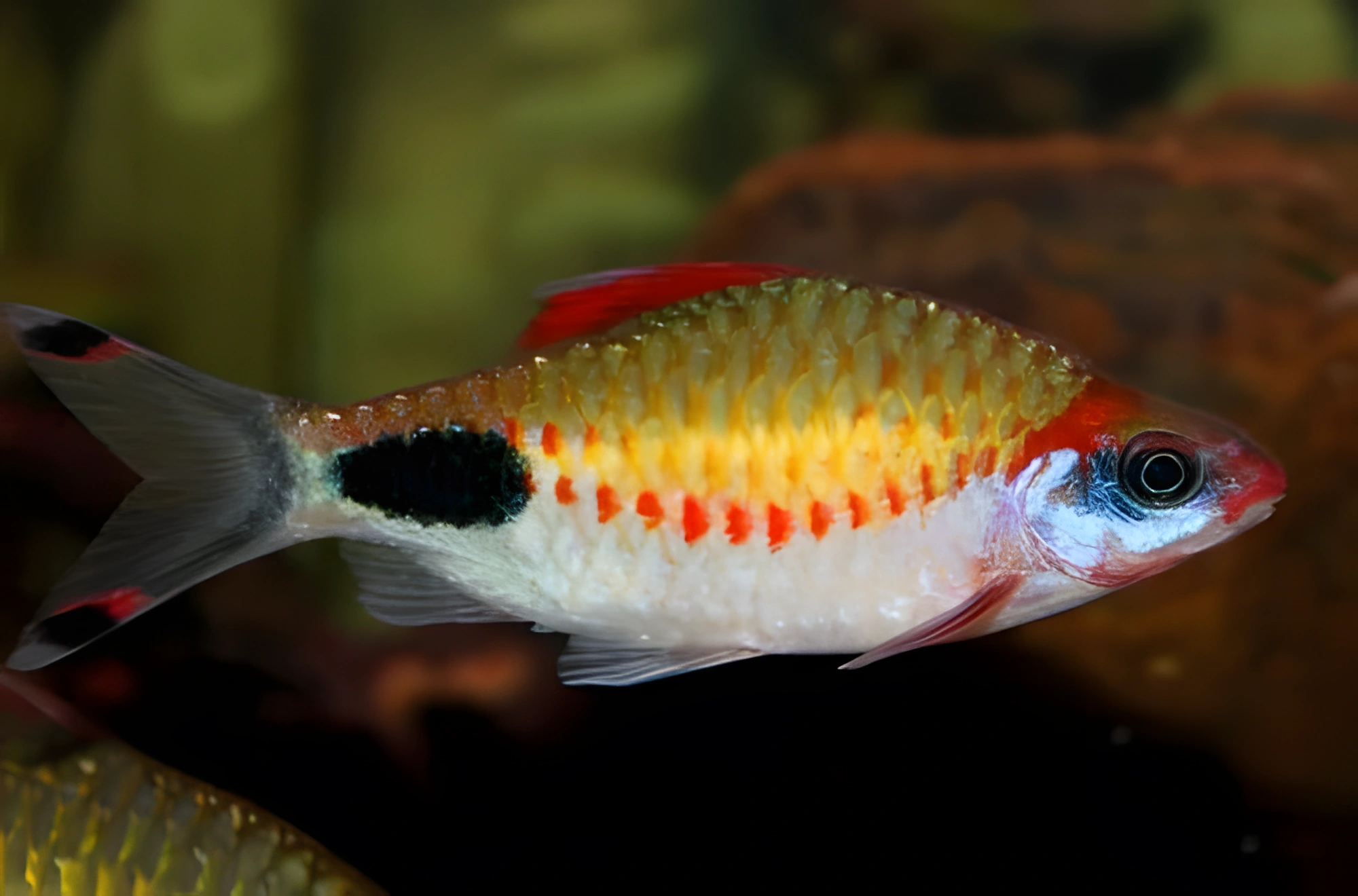
Adults of this species can grow up to 12 cm in length. Outwardly, they bear a significant resemblance to their closest relative, the Filament Barb, which often leads to confusion. Males usually have brighter coloration, although they are smaller than females. A characteristic feature of their body pattern is a scattering of red dots running along the lateral line, as well as a distinct black spot at the base of the caudal fin. This dotted line creates a visual division of the body into two areas: golden above and silvery below. Black and red specks can often be seen at the tips of the caudal fin. During the spawning period, males develop small tubercles on their heads.
Habitat
The natural habitat of this species extends across the western part of the Indian subcontinent, covering the territories of the modern Indian states of Karnataka and Kerala. The Dawkinsia Barb has adapted to life in various biotopes, inhabiting both swift, clear mountain streams and calmer lowland rivers, where the water may be turbid and the current slow.
Behavior and Compatibility
This species of aquarium fish is distinguished by its peaceful and active nature, making it compatible with many non-aggressive freshwater species of similar size. It is recommended to keep them in schools consisting of at least 8–10 individuals of different sexes, and to maintain this number going forward.
Care and Maintenance
For the comfortable existence of a small group of these fish, an aquarium of at least 240 liters will be required. The decor can be chosen at the aquarist's discretion, but an aquarium recreating the atmosphere of a mountain stream is an optimal solution for the Dawkinsia Barb. Such decor implies the presence of a rocky substrate, several large boulders and snags, as well as a limited number of undemanding plants, such as Anubias, aquatic mosses, and ferns. The use of artificial plants is also permissible. Since these fish inhabit flowing waters, they are extremely sensitive to the accumulation of organic matter. Therefore, a prerequisite for successful keeping is maintaining stable water parameters. Standard care procedures include weekly partial water changes (30% to 50% of the total volume), regular cleaning of the substrate and decorations, as well as monitoring and prevention of equipment issues. In addition, it is necessary to constantly monitor parameters such as pH, dGH, and oxidizability.
Diet
Regarding feeding, this species is unpretentious and readily accepts most common aquarium foods, chosen according to size. It is important to remember that the intensity of the fish's coloration directly depends on the quality and composition of the food consumed, so it is preferable to choose products from reputable manufacturers.
Breeding and Reproduction
Given favorable conditions, spawning in these fish occurs quite regularly. Females release eggs into the water column, after which the males fertilize them. The incubation period lasts from 24 to 48 hours, and within a day after hatching, the fry begin to swim actively and search for food. Fish of this species do not exhibit parental instincts and do not care for their offspring; moreover, adults may eat both eggs and fry. Therefore, the survival rate of juveniles in a community tank will be extremely low. To ensure a more controlled breeding process for the Dawkinsia Barb, it is recommended to use a separate spawning tank, where the eggs are transferred immediately after spawning. This can be a small tank of 10 liters or more, in which identical water conditions will be maintained, equipped with a simple air-driven sponge filter and a heater. An additional light source is usually not required; light from the room is quite sufficient.
Diseases
In a balanced aquarium ecosystem, as close as possible to the requirements of this species, diseases are extremely rare. Diseases often arise due to deterioration of the living environment, contact with already sick fish, or physical injuries. If these factors could not be avoided, the "Aquarium Fish Diseases" section will provide detailed information on symptoms and treatment methods.
How to choose
When choosing a Dawkinsia barb, preference should be given to individuals that show high activity and are constantly moving. A healthy fish should have clean, tightly fitting scales, clear eyes without cloudiness, and undamaged fins. It is important to avoid specimens with signs of emaciation, sunken bellies, or unnatural growths on the body. Since the species is often confused with closely related members of the genus Dawkinsia, it is worth paying attention to the characteristic pattern: the presence of a dark spot at the base of the tail and a specific mask around the eyes.
- Inspect the fish for the absence of white film or ulcers on the skin, which may indicate the presence of parasites or bacterial infections.
- Observe their behavior in the store: the fish should stay in a school and show curiosity, rather than hiding in corners or lying on the bottom.
- Ask the seller about the keeping conditions and diet, as an abrupt change in environment can cause stress in young individuals.
- Avoid buying fish that appear lethargic or have difficulty breathing, which may be a consequence of poor filtration or overcrowding in the display tank.
Frequently asked questions
The essentials: size, tank volume, water parameters and care
How big does Dawkinsia Barb get?
An adult reaches 9–12 cm in length. Plan the tank around the maximum size: the fish quickly outgrows a cramped setup.
What size aquarium does Dawkinsia Barb need?
The minimum recommended volume is 240 L. A smaller tank speeds up nitrate build-up and raises stress levels.
What water parameters does Dawkinsia Barb need?
Temperature 19–25 °C, pH 6–7, hardness 2–10 dGH. Stability matters more than exact values: sudden swings are harder on the fish than a small deviation from the ideal.
How long does Dawkinsia Barb live?
Around 4 years when kept properly. Lifespan depends directly on tank volume, water quality and a varied diet.
Is Dawkinsia Barb aggressive?
Temperament: peaceful (regular). Keep this in mind when choosing tank mates.
How many Dawkinsia Barb should be kept together?
Recommended setup: group (8–10 individuals). Ignoring this is a common cause of stress and disease.
What does Dawkinsia Barb eat?
Diet type: small / appropriate size / pieces. Feed small portions that are finished within a couple of minutes — overfeeding does more harm than underfeeding.
What is the scientific name of Dawkinsia Barb?
The scientific name of the species is Dawkinsia assimilis, family Cyprinids (Cyprinidae). It also appears in the literature as: Puntius assimilis, Puntius lepidus, Systomus assimilis.