Temperature20 – 26 °C
Natural range
- Southwestern Sri Lanka area
- Sri Lanka area
CyprinidsConservation status: Vulnerable VU
Other scientific names: Barbus nigrofasciatus, Puntius nigrofasciatus
Pethia nigrofasciata, also known as the Black Ruby Barb or Purplehead Barb, belongs to the family Cyprinidae. This fish is distinguished by its beauty and high level of activity. It is perfectly adapted to life in a home aquarium, as the vast majority of individuals offered for sale have been bred in captivity rather than caught in the wild. This species coexists successfully with many peaceful tropical fish.
- Required aquarium volume
- 50 L
- Size in aquarium
- 6 cm
- Temperature
- 20 – 26 °C
- Temperament
- Peaceful, active/mobile
Parameters
Water pHSlightly acidic (6) – Neutral (6.5)
Water dHSoft (5) – Hard (12)
Water salinityno salt (freshwater)
Size in aquarium6 cm
Lifespan5 years
TemperamentPeaceful, active/mobile
Toward small fishnot a predator
Required aquarium volume50 L
Lightingdimmed
Substratefine sand
Water flownone or stagnant (no flow)
FeedingSinking (plant-based)
CareSchooling (usually from 5–6 individuals and more)
Description
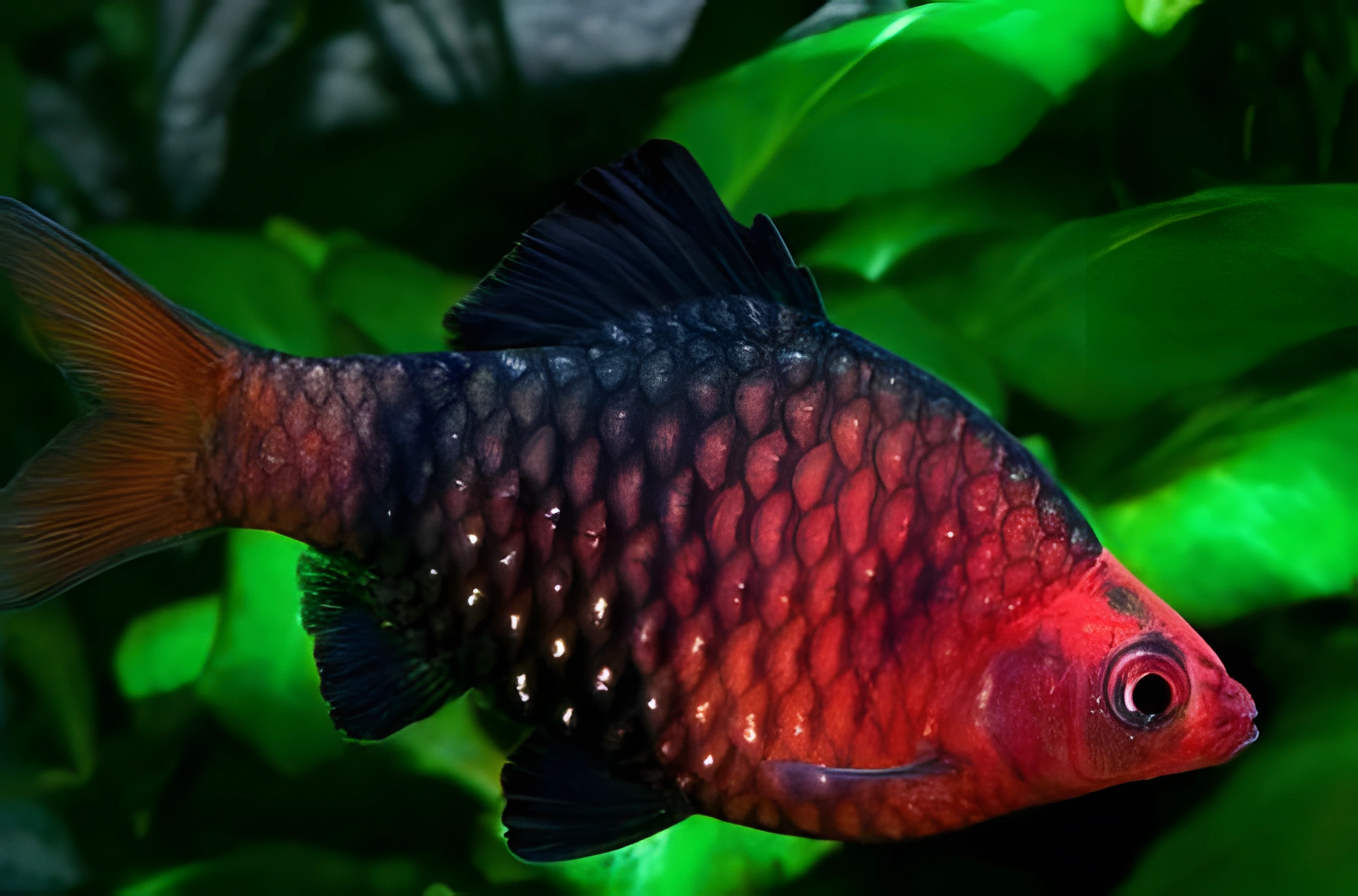
The body of this fish is laterally compressed and quite deep, covered with large, shiny scales. The main coloration is a golden-pink hue, through which wide dark transverse stripes run. In males during the breeding season, the head can acquire a dark ruby color, while the rest of the body often becomes entirely dark. Each scale has a shiny dark outline. Females are generally significantly lighter than males, and their predominant color is light yellow.
The male differs from the female by its smaller size and brighter, more intense body coloration, which is especially noticeable during the breeding season.
Habitat
This species is endemic to waters located in the southwestern part of Sri Lanka, where remnants of humid tropical forests can still be found. It should be noted that as of 2006, the area of the original jungle had shrunk to 4.6%. The Black Ruby Barb prefers to inhabit clear streams and channels characterized by dense vegetation and flowing under the forest canopy. The water in these places often acquires a light brown tint due to the high content of dissolved organic matter, such as grass remnants and fallen leaves. The typical substrate here is sandy, covered with a layer of fallen leaves.
Behavior and Compatibility
This agile and compatible schooling fish prefers to be in a group of 6–10 individuals of its own species. It is well compatible with many peaceful representatives of the Cyprinidae and Characidae families. However, its high activity can create unfavorable conditions for some very slow or small fish.
Care and Maintenance
Preparing an aquarium for these fish is quite simple. As a minimum necessary equipment, a filter, heater, and lighting system can be highlighted, which should be set to subdued light. The water should be slightly acidic and of medium hardness; for its preparation and parameter control, it is recommended to use special reagents and test kits, which are available in pet stores and specialized online stores. It is recommended to renew 10–20% of the total water volume in the tank weekly and clean the substrate with a siphon, removing uneaten food residues, excrement, and other organic matter. The choice of decor is not critical. The most natural design looks with dark sandy substrate, supplemented with several shelters made of snags, branches, or tree roots, as well as rooted and floating plants. It is important to avoid excessive overgrowth of the aquarium, as the fish need sufficient space for swimming and prefer the middle and lower (bottom) zones.
Diet
Barbs readily accept a variety of quality foods, whether flakes or granules, especially if they contain plant additives. It is important to ensure variety in the diet, as well as include a sufficient amount of protein products.
Breeding and Reproduction
Like most cyprinids, the Black Ruby Barb scatters its eggs directly on the substrate and does not care for its offspring. In an established aquarium with adult fish, the appearance of fry is quite probable, and no special conditions are required for this. Nevertheless, parents tend to eat both eggs and their own offspring. To ensure the preservation of the eggs, the bottom can be lined with a fine mesh or low, densely growing plants can be planted. Java moss is an optimal choice, as it is unpretentious and reliably protects the eggs from encroachment. Fry should be moved to a separate tank, for example, a three-liter jar, and fed with micro-food, such as paramecia or finely crushed flakes.
Diseases
Fish of this species are susceptible to most common diseases, but this usually only occurs under unsuitable keeping conditions, poor nutrition, or contact with already sick fish. More detailed information on symptoms and treatment methods can be found in the "Aquarium Fish Diseases" section.
How to choose
When choosing Black Ruby Barbs in a store, pay attention to the activity and appearance of the individuals. Healthy fish should be active, curious, and confidently hold their position in the water column. Avoid specimens with signs of lethargy, apathetic behavior, or attempts to constantly gasp for air at the surface. Examine the fish's body: scales should be tightly pressed, without ulcers, spots, film, or white dots resembling semolina grains. Fins should be spread, without signs of splitting, rot, or damage. Avoid fish with an unnaturally sunken belly, which may indicate emaciation or internal parasites, as well as individuals with skeletal or head deformities. When buying schooling fish, it is best to choose a group of 6–10 individuals to reduce stress during relocation and adaptation. Keep in mind that in store conditions, due to stress, the coloration of barbs may be pale, but the overall physical condition of the fish should remain impeccable.
Frequently asked questions
The essentials: size, tank volume, water parameters and care
How big does Black Ruby Barb get?
An adult reaches 6 cm in length. Plan the tank around the maximum size: the fish quickly outgrows a cramped setup.
What size aquarium does Black Ruby Barb need?
The minimum recommended volume is 50 L. A smaller tank speeds up nitrate build-up and raises stress levels.
What water parameters does Black Ruby Barb need?
Temperature 20–26 °C, pH 6–6.5, hardness 5–12 dGH. Stability matters more than exact values: sudden swings are harder on the fish than a small deviation from the ideal.
How long does Black Ruby Barb live?
Around 5 years when kept properly. Lifespan depends directly on tank volume, water quality and a varied diet.
Is Black Ruby Barb aggressive?
Temperament: peaceful, active/mobile. Keep this in mind when choosing tank mates.
How many Black Ruby Barb should be kept together?
Recommended setup: schooling (usually from 5–6 individuals and more). Ignoring this is a common cause of stress and disease.
What does Black Ruby Barb eat?
Diet type: sinking (plant-based). Feed small portions that are finished within a couple of minutes — overfeeding does more harm than underfeeding.
What is the scientific name of Black Ruby Barb?
The scientific name of the species is Pethia nigrofasciata, family Cyprinids (Cyprinidae). It also appears in the literature as: Barbus nigrofasciatus, Puntius nigrofasciatus.