Temperature17 – 24 °C
Natural range
- Democratic Republic of the Congo area
Cyprinids
Other scientific names: Capoeta hulstaerti, Puntius hulstaerti
Barbus hulstaerti, known as the Butterfly Barb or Moth Barb, belongs to the family Cyprinidae. This fish attracts attention with its beauty and does not cause much trouble in maintenance, but it is not often found for sale. For a long time, 25 years, supplies of this species were suspended, but in 2006 they were resumed. The reason for such a long break lies in the epidemics that affected the Democratic Republic of Congo — the only place where this unique species lives.
- Required aquarium volume
- 40 L
- Size in aquarium
- 3 – 3.5 cm
- Temperature
- 17 – 24 °C
- Temperament
- Peaceful (regular)
Parameters
Water pHSlightly acidic (5) – Neutral (6.5)
Water dHVery soft (1) – Soft (5)
Water salinityno salt (freshwater)
Size in aquarium3 – 3.5 cm
Lifespan4 years
TemperamentPeaceful (regular)
Toward small fishnot a predator
Required aquarium volume40 L
Lightingdimmed or moderate
Substratesoft silted
Water flowweak
FeedingSmall / appropriate size / pieces
CareGroup (8–10 individuals)
Description
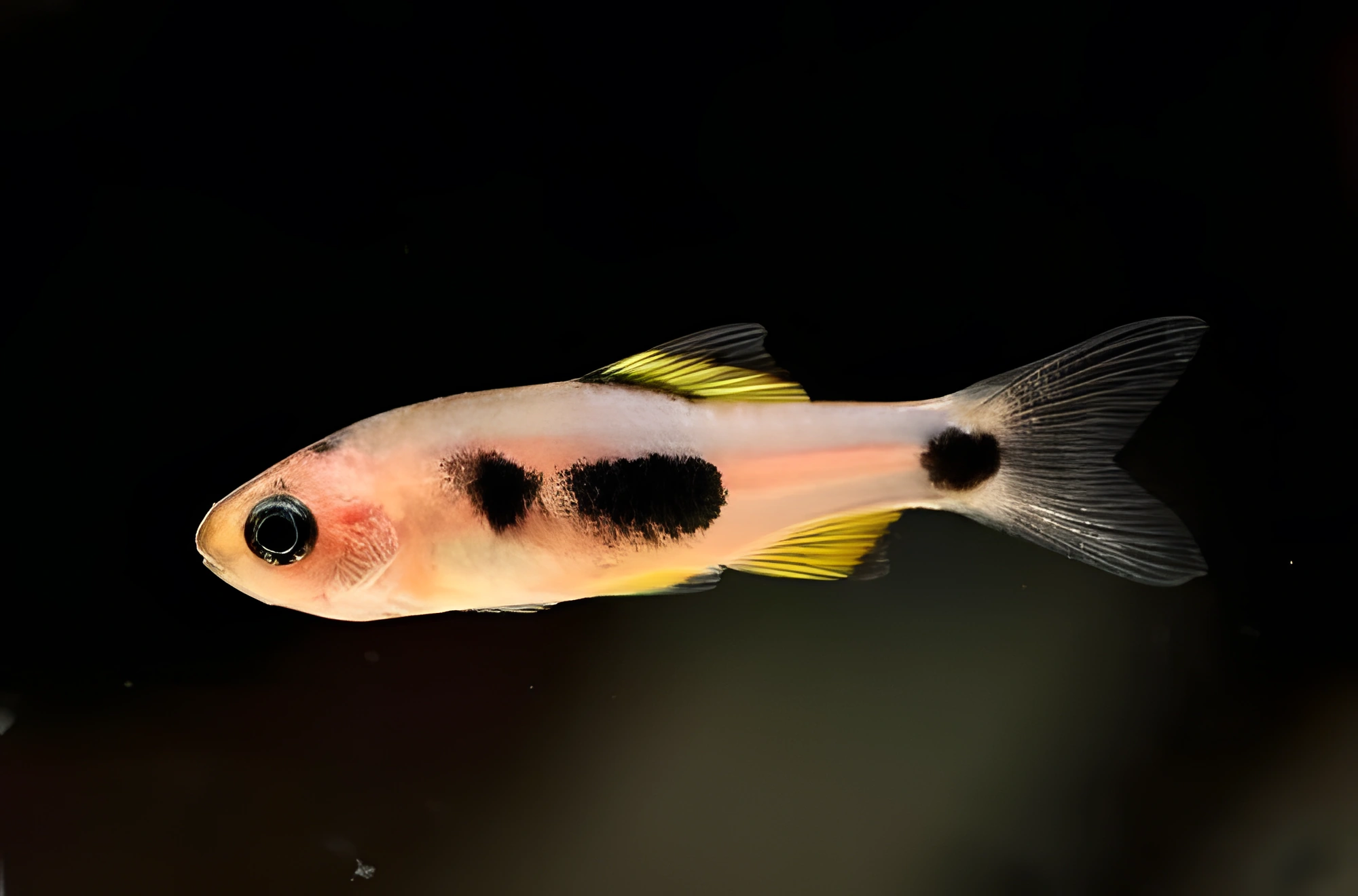
Adults reach a length of approximately 3 cm. The silvery-pink body coloration is complemented by yellow fins. The pattern consists of several noticeable dark spots. Sexual dimorphism is weakly expressed; males and females are almost impossible to distinguish.
Habitat
The natural habitat of this species is the African continent, specifically a limited area in the north of the Democratic Republic of Congo, in the Mongala River basin (which is a right tributary of the Congo River). The fish inhabit small streams and rivers that flow under dense canopies of tropical forest, as well as swampy areas. These natural conditions are characterized by a large number of aquatic plants, and the bottom is covered with a thick layer of fallen and decomposing vegetation. It releases tannins, which give the water a characteristic brown tint.
Behavior and Compatibility
This is a peaceful and active fish, capable of coexisting with other species of comparable size. Accordingly, it is necessary to avoid proximity to large and especially aggressive fish, which can both frighten and catch Moth Barbs and eat them. It is recommended to keep a group of at least 8–10 individuals. Intraspecific relationships are built on the dominance of an alpha male. Less dominant males may sometimes seek refuge from excessive attention, so the presence of shelters in the aquarium is extremely important.
Care and Maintenance
For a small group of Butterfly Barbs, an aquarium of 40 liters or more is suitable. It is advisable to use a sandy substrate in the design, place several shelters made of snags, and provide dense thickets of shade-loving aquatic plants, including floating species, or their high-quality artificial counterparts. Lighting should be subdued. The natural feel of the design can be enhanced by dry tree leaves laid on the bottom. They will not only add decorativeness to the aquarium but also provide the water with the characteristic “tea” tint inherent in the natural habitats of these fish. For more detailed information, you can refer to the article “Which tree leaves can be used in an aquarium.” Success in keeping them largely depends on maintaining stable water parameters and performing standard care procedures. These include: weekly partial water changes, removal of organic residues (such as uneaten food and waste products), regular equipment maintenance, and monitoring of pH, dGH, and oxidizability.
Diet
This species is omnivorous; it accepts most common foods (such as dry, frozen, live) of appropriate size. When choosing food, it is advisable to give preference to products from trusted and well-known manufacturers, as the quality of nutrition directly affects the overall health of the fish.
Breeding and Reproduction
The breeding period occurs twice a year: from March to June and from September to November. Despite the fact that this species has been kept in aquariums for a long time, the seasonality of breeding has been preserved. During the mating period, females lay eggs in the water column, after which the dominant male (sometimes several males) fertilizes them. Parental instincts are not developed in these fish, but, unlike other barbs, adult individuals are not prone to eating their eggs and fry, although in some cases this is still possible. The incubation period lasts up to 10 days. After 2–3 days, the fry begin to move freely in search of food. It should be noted that, although the risk of being eaten by their own parents is low, the survival rate of Butterfly Barb fry remains quite low. The main reasons for this are the threat from other species (if they are present in the aquarium) and a lack of food, as the young are unable to compete for food, and even if they manage to get to it, the food particles may be too large. To increase the survival rate of the fry, it is recommended to use a spawning tank, where either the eggs are transferred after spawning, or the already hatched fry. For this purpose, a small tank of 10 liters or more with identical water parameters will suffice. The equipment set usually includes a simple air-lift filter with a sponge and a heater. A separate light source is not required; on the contrary, a low light level is preferred. The design can be arbitrary. The young should be fed with specialized foods for aquarium fish fry and/or Artemia nauplii.
Diseases
In a balanced aquarium ecosystem, closely matching the requirements of this species, diseases are extremely rare. Illnesses often arise due to deteriorating habitat quality, contact with already sick fish, or physical injuries. If these factors could not be avoided, the “Aquarium Fish Diseases” section will provide detailed information on symptoms and treatment methods.
How to choose
The Butterfly Barb is a rare species in the aquarium trade, so when purchasing, it is important to ensure proper identification of the fish. Healthy individuals should be active, show interest in their surroundings, and stay in a school. Avoid fish with signs of emaciation, damaged fins, or visible spots on the body, which may indicate diseases. Given the shy nature of the species, they may appear sluggish in the store, but they should show feeding activity when fed.
- When inspecting, pay attention to the clarity of the pattern and the brightness of the coloration, which are indicators of good condition.
- Ask the seller about the keeping conditions and diet, as an abrupt change in water parameters can negatively affect adaptation.
- Avoid acquiring single individuals, as stress from loneliness critically reduces the immunity and lifespan of this species.
- Check for signs of infections, such as rapid breathing or unnatural movements, which may be a consequence of improper care in the retail aquarium.
Frequently asked questions
The essentials: size, tank volume, water parameters and care
How big does Butterfly Barb get?
An adult reaches 3–3.5 cm in length. Plan the tank around the maximum size: the fish quickly outgrows a cramped setup.
What size aquarium does Butterfly Barb need?
The minimum recommended volume is 40 L. A smaller tank speeds up nitrate build-up and raises stress levels.
What water parameters does Butterfly Barb need?
Temperature 17–24 °C, pH 5–6.5, hardness 1–5 dGH. Stability matters more than exact values: sudden swings are harder on the fish than a small deviation from the ideal.
How long does Butterfly Barb live?
Around 4 years when kept properly. Lifespan depends directly on tank volume, water quality and a varied diet.
Is Butterfly Barb aggressive?
Temperament: peaceful (regular). Keep this in mind when choosing tank mates.
How many Butterfly Barb should be kept together?
Recommended setup: group (8–10 individuals). Ignoring this is a common cause of stress and disease.
What does Butterfly Barb eat?
Diet type: small / appropriate size / pieces. Feed small portions that are finished within a couple of minutes — overfeeding does more harm than underfeeding.
What is the scientific name of Butterfly Barb?
The scientific name of the species is Barbus hulstaerti, family Cyprinids (Cyprinidae). It also appears in the literature as: Capoeta hulstaerti, Puntius hulstaerti.