Temperature25 – 30 °C
Natural range
- Sri Lanka area
CyprinidsConservation status: Critically endangered CR
Other scientific names: Barbichthys asokae, Barbus asoka, Puntius asoka
The Asoka Barb, known in scientific literature as Systomus asoka, belongs to the carp family (Cyprinidae). This species is endemic and found exclusively in the river systems of Sri Lanka, located in South Asia. It prefers to inhabit sections of rivers characterized by fairly swift, and sometimes turbulent, currents. Adult fish find refuge in the headwaters, choosing relatively deep areas – up to two meters – where they stay near the bottom among rocky substrates. Notably, juveniles, or fry, behave differently: they live in the lower reaches, preferring shallow waters with calm currents, and often form large schools.
- Required aquarium volume
- 500 L
- Size in aquarium
- 25 cm
- Temperature
- 25 – 30 °C
- Temperament
- Peaceful (regular)
Parameters
Water pHNeutral (6.5) – Neutral (7.5)
Water dHVery soft (2) – Hard (15)
Water salinityno salt (freshwater)
Size in aquarium25 cm
Lifespan7 years
TemperamentPeaceful (regular)
Toward small fishnot a predator
Required aquarium volume500 L
Lightingmoderate or bright
Substraterocky (rock formations, boulders, etc.)
Water flowmoderate or strong
FeedingAny (universal)
CareSmall group (5–6 individuals)
Description
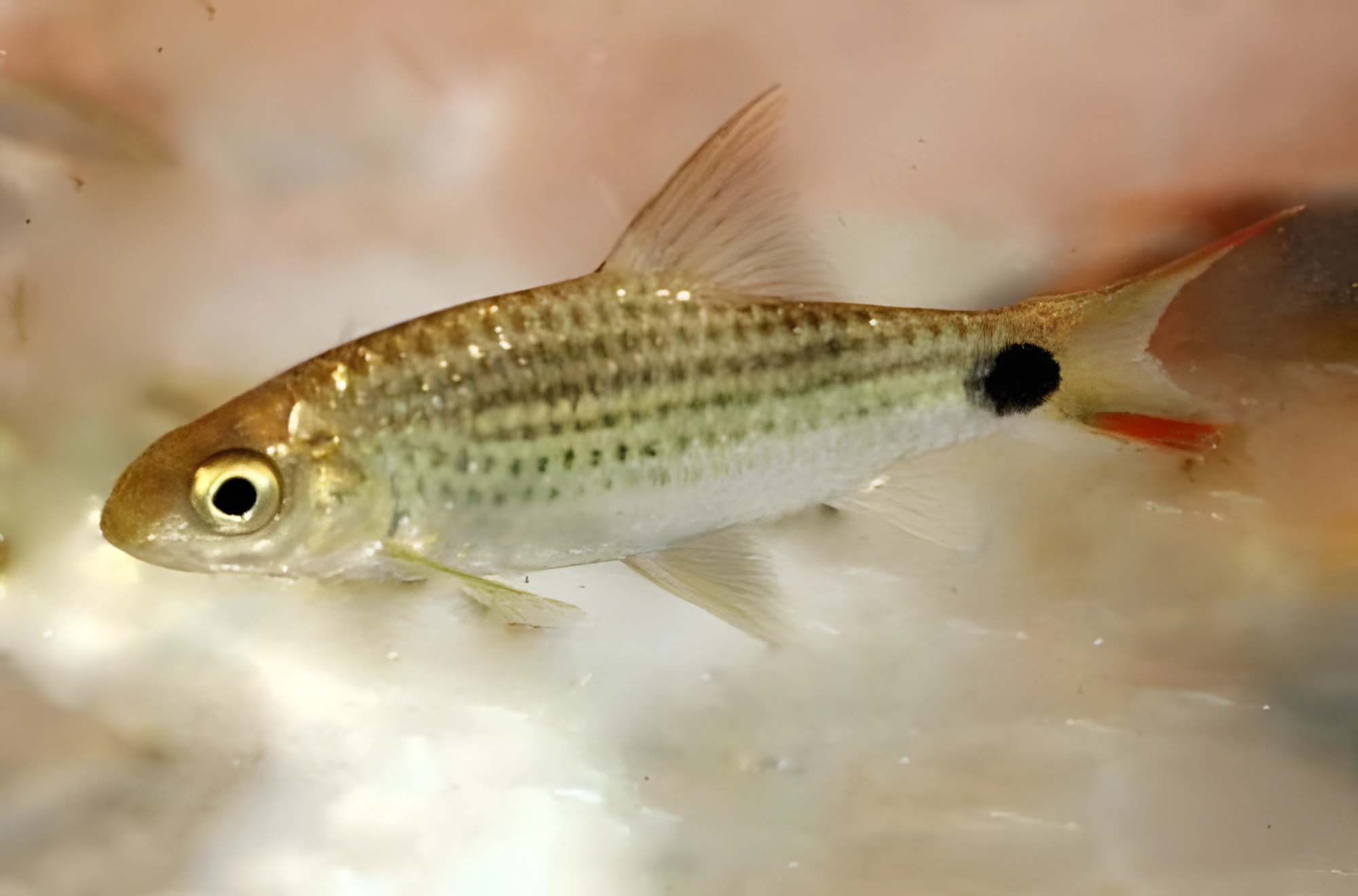
These fish grow up to 25 cm in length. Their body is elongated, and their head is large. The fins are short and translucent, and the coloration is silvery, complemented by a dotted pattern of horizontal stripes. A distinct black spot is noticeable at the base of the caudal fin. Sexual dimorphism in this species is weakly expressed; males and females show practically no differences in appearance.
Habitat
The species is endemic to Sri Lanka, inhabiting the upper reaches of the Kelani River and the Sitawaka River. The fish prefer areas with fast currents, clean, and well-aerated water. In nature, adults stay at depths of 1–2 meters over a rocky or sandy bottom, while juveniles inhabit shallow coastal zones.
Behavior and Compatibility
A peaceful but active fish, this barb coexists well with members of its own species and with other non-aggressive fish capable of adapting to conditions with moderate or strong currents.
Care and Maintenance
For a group of 5–6 adult Asoka Barbs, an aquarium of 500–600 liters is recommended. The aquascape should aim to recreate the atmosphere of a mountain river: large boulders and rock formations will be very suitable. A few snags, securely anchored in the substrate, can also be added. It is fundamentally important to provide internal current in the aquarium; this can be achieved with a powerful filtration system or by installing separate powerheads. For successful long-term keeping, it is necessary to constantly maintain stable water parameters and a high level of dissolved oxygen. As for diet, the fish are undemanding; they can be offered dry sinking foods (granules, tablets), enriched with all necessary vitamins and trace elements.
Diet
These fish are not demanding about their diet. Sinking dry foods, such as granules or tablets, are an optimal choice, provided they contain all the necessary vitamins and trace elements for health.
Breeding and Reproduction
Data on breeding in captivity is limited, and the species is considered difficult to reproduce. Partial water changes with distilled water are sometimes used as a spawning stimulus. The eggs are scattered chaotically throughout the aquarium, so a separator net on the bottom is recommended to protect the offspring from being eaten by the parents. After spawning is complete, the parents should be removed.
Diseases
The species is sensitive to water quality and the accumulation of nitrogenous compounds, making effective filtration a mandatory condition for keeping them. Characteristic diseases include skin and gill flukes, trichodinosis, and mycobacteriosis. Prevention is based on maintaining stable environmental parameters, regular water changes, and preventing hypoxia.
How to choose
When purchasing, choose active, mobile specimens without visible damage to fins or scales. As the species is endangered in the wild, it is important to ascertain the fish's origin—preference should be given to specimens bred in captivity. Avoid individuals showing signs of emaciation, sluggish behavior, or apathy.
Frequently asked questions
The essentials: size, tank volume, water parameters and care
How big does Asoka Barb get?
An adult reaches 25 cm in length. Plan the tank around the maximum size: the fish quickly outgrows a cramped setup.
What size aquarium does Asoka Barb need?
The minimum recommended volume is 500 L. A smaller tank speeds up nitrate build-up and raises stress levels.
What water parameters does Asoka Barb need?
Temperature 25–30 °C, pH 6.5–7.5, hardness 2–15 dGH. Stability matters more than exact values: sudden swings are harder on the fish than a small deviation from the ideal.
How long does Asoka Barb live?
Around 7 years when kept properly. Lifespan depends directly on tank volume, water quality and a varied diet.
Is Asoka Barb aggressive?
Temperament: peaceful (regular). Keep this in mind when choosing tank mates.
How many Asoka Barb should be kept together?
Recommended setup: small group (5–6 individuals). Ignoring this is a common cause of stress and disease.
What does Asoka Barb eat?
Diet type: any (universal). Feed small portions that are finished within a couple of minutes — overfeeding does more harm than underfeeding.
What is the scientific name of Asoka Barb?
The scientific name of the species is Systomus asoka, family Cyprinids (Cyprinidae). It also appears in the literature as: Barbichthys asokae, Barbus asoka, Puntius asoka.