Temperature19 – 25 °C
Natural range
- Southern India area
- Western Ghats area
CyprinidsConservation status: Endangered EN
Other scientific names: Barbus arulius, Puntius arulius, Systomus arulius
The Arulius Barb, scientifically known as Dawkinsia arulius and belonging to the family Cyprinidae, does not impress with its bright coloration or unique body pattern. However, its lively activity and unpretentiousness attract attention, making observing it quite interesting. Thanks to its hardiness and ease of keeping and breeding, this fish is well-suited even for beginner aquarists.
- Required aquarium volume
- 250 L
- Size in aquarium
- 10 – 12 cm
- Temperature
- 19 – 25 °C
- Temperament
- Peaceful, active/mobile
Parameters
Water pHSlightly acidic (6) – Neutral (7.5)
Water dHVery soft (2) – Medium hardness (10)
Water salinityno salt (freshwater)
Size in aquarium10 – 12 cm
Lifespan7 years
TemperamentPeaceful, active/mobile
Toward small fishnot a predator
Required aquarium volume250 L
Lightingmoderate (regular)
Substraterocky (rock formations, boulders, etc.)
Water flowmoderate or strong
FeedingAny (universal)
CareGroup (8–10 individuals)
Description
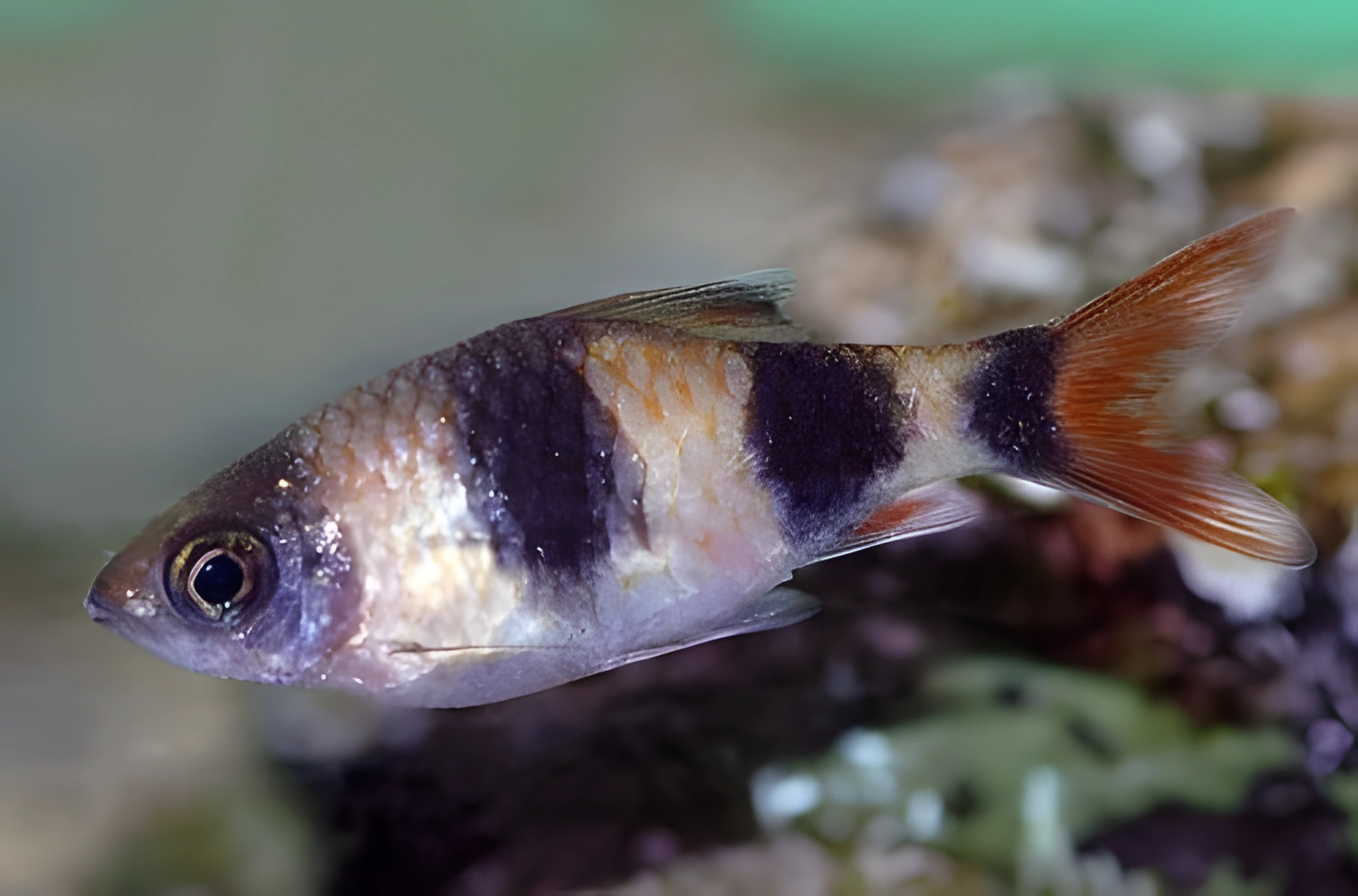
On its large, yet robust, light-toned body, there are wide vertical dark stripes that run from the back and slightly fade towards the belly. The fins, especially the caudal fin, have a reddish tint. Males stand out with more intense coloration compared to females, although they are smaller in size. As they reach sexual maturity, white spots or tubercles can be observed in the mouth area of males.
Habitat
The species originates from South India, where the Arulius Barb inhabits clear, flowing, oxygen-rich waters. These are typically small streams and rivers with rocky bottoms composed of gravel, pebbles, and boulders. During the summer, this area is subject to monsoons, leading to significant changes in water levels. Unfortunately, human economic activity has caused significant damage to the species' natural habitat, contributing to a decline in wild populations, and in some areas, they have completely disappeared.
Behavior and Compatibility
This peaceful, active schooling species requires keeping in a group of at least 8 individuals. Arulius Barbs get along well with almost all fish of similar size and temperament. However, it is recommended to avoid cohabitation with very large and aggressive species, as well as with small and/or slow-moving fish.
Care and Maintenance
For a school of 8–10 individuals, an aquarium of about 250 liters will be required. When decorating it, preference should be given to robust plants with well-developed root systems, capable of withstanding strong water currents; floating plants are not recommended. Due to the characteristics of the current, a sand substrate is not used; instead, it is better to use stones, boulders, or gravel. The choice of other decorative elements is at the discretion of the aquarist. Optimal water parameters for these fish are slightly acidic values, close to neutral, with low hardness. More detailed information on pH and dGH values, as well as methods for their correction, can be found in the "Hydrochemical composition of water" section. Barbs are very sensitive to the accumulation of organic waste and oxygen deficiency, so the main attention when setting up an aquarium should be given to the filtration system. Choose the most powerful filter that suits your capabilities. In addition to water purification, it helps create the necessary internal current, making conditions for the Arulius Barb as comfortable as possible. Although many filtration systems aerate the water, installing additional oxygen diffusers will not be superfluous. Other equipment includes a heater and lighting fixtures, which are most often supplied with the aquarium lid. Regular care includes weekly water changes of 30–50% of the total volume with fresh water, as well as periodic cleaning of the substrate from organic deposits and, if necessary, removing plaque from the glass with a scraper.
Diet
To maintain the health of the Arulius Barb, a balanced diet consisting of approximately equal parts of live and dry foods is recommended. The fish readily accept bloodworms, daphnia, as well as various flakes and granules. When using exclusively dry foods, it is important to ensure that their composition is enriched with protein. A lack of protein components can cause health problems due to a deficiency of essential micronutrients. Feeding is done 2–3 times a day, in portions that the fish can consume within 5 minutes. It is important to promptly remove any uneaten food remnants from the aquarium.
Breeding and Reproduction
Fish do not have well-developed parental instincts; after spawning, they are prone to eating their own eggs. Therefore, a separate tank should be used for successful breeding. A spawning aquarium of about 15–20 liters should be equipped with a rocky substrate over which a fine-mesh net will be stretched. Through this net, the eggs can fall, becoming inaccessible to the parents. As additional protection for the offspring, dense thickets of small-leaved, low-growing plants and mosses can also be used. The aquarium is filled with "mature" water from the main tank. For equipment, a simple sponge filter, heater, and aerator are sufficient; creating a strong internal current is not recommended in this case. Lighting is not critical, as spawning often occurs in dim light. The breeding period can begin at any time, so it is advisable to always keep the spawning tank ready. When several females are visibly rounded, they, along with selected males, are transferred to the prepared spawning tank. After the process is complete, the parents are returned. Fry hatch after 1–2 days and begin free swimming after another 24 hours. In their first days of life, they need to be fed microscopic foods, such as Artemia nauplii or microworms.
Diseases
The most common cause of diseases is suboptimal keeping conditions. In turn, a stable and balanced biological system in the aquarium significantly reduces the risk of their manifestation. More detailed information on symptoms and treatment methods can be found in the "Aquarium Fish Diseases" section.
How to choose
When choosing an Arulius barb, it is important to pay attention to the general health and activity of the individuals. A healthy fish should be active, show interest in its surroundings, and not have signs of emaciation. Carefully examine the skin: there should be no ulcers, white spots, fin damage, or signs of parasitic infections on the body. Avoid purchasing fish that appear sluggish, stay at the water surface, or, conversely, constantly hide in the corners of the aquarium.
Consider the following features when purchasing:
- acquire a group of 6–10 individuals, as solitary keeping causes severe stress for this species;
- remember that pale coloration in the store is often a sign of stress, not disease, however, the color should intensify when conditions normalize;
- sexually mature males in spawning condition may have small white tubercles around the mouth area, which is normal and not a sign of infection.
Frequently asked questions
The essentials: size, tank volume, water parameters and care
How big does Arulius Barb get?
An adult reaches 10–12 cm in length. Plan the tank around the maximum size: the fish quickly outgrows a cramped setup.
What size aquarium does Arulius Barb need?
The minimum recommended volume is 250 L. A smaller tank speeds up nitrate build-up and raises stress levels.
What water parameters does Arulius Barb need?
Temperature 19–25 °C, pH 6–7.5, hardness 2–10 dGH. Stability matters more than exact values: sudden swings are harder on the fish than a small deviation from the ideal.
How long does Arulius Barb live?
Around 7 years when kept properly. Lifespan depends directly on tank volume, water quality and a varied diet.
Is Arulius Barb aggressive?
Temperament: peaceful, active/mobile. Keep this in mind when choosing tank mates.
How many Arulius Barb should be kept together?
Recommended setup: group (8–10 individuals). Ignoring this is a common cause of stress and disease.
What does Arulius Barb eat?
Diet type: any (universal). Feed small portions that are finished within a couple of minutes — overfeeding does more harm than underfeeding.
What is the scientific name of Arulius Barb?
The scientific name of the species is Dawkinsia arulius, family Cyprinids (Cyprinidae). It also appears in the literature as: Barbus arulius, Puntius arulius, Systomus arulius.