Temperature20 – 25 °C
Natural range
- Java area
- Sumatra area
LoachesConservation status: Least concern LC
Other scientific names: Balitoropsis bartschi, Homaloptera javanica, Homaloptera maxinae, Homaloptera nigra, Homaloptera zollingeri
The fish known as Zollinger's Balitorid, or Balitoropsis zollingeri by its scientific name, belongs to the family Balitoridae, which includes river loaches. It was named in honor of the Swiss botanist Heinrich Zollinger (1818–1859), whose research led to the discovery of many species on the islands of the Indonesian archipelago.
- Required aquarium volume
- 100 L
- Size in aquarium
- 6 – 7 cm
- Temperature
- 20 – 25 °C
- Temperament
- Peaceful (regular)
Parameters
Water pHSlightly acidic (6) – Neutral (7.5)
Water dHVery soft (2) – Hard (15)
Water salinityno salt (freshwater)
Size in aquarium6 – 7 cm
Lifespan5 years
TemperamentPeaceful (regular)
Toward small fishnot a predator
Required aquarium volume100 L
Lightingweak (low)
Substraterocky (rock formations, boulders, etc.)
Water flowmoderate or strong
FeedingSinking (any)
CareSmall group (5–6 individuals)
Description
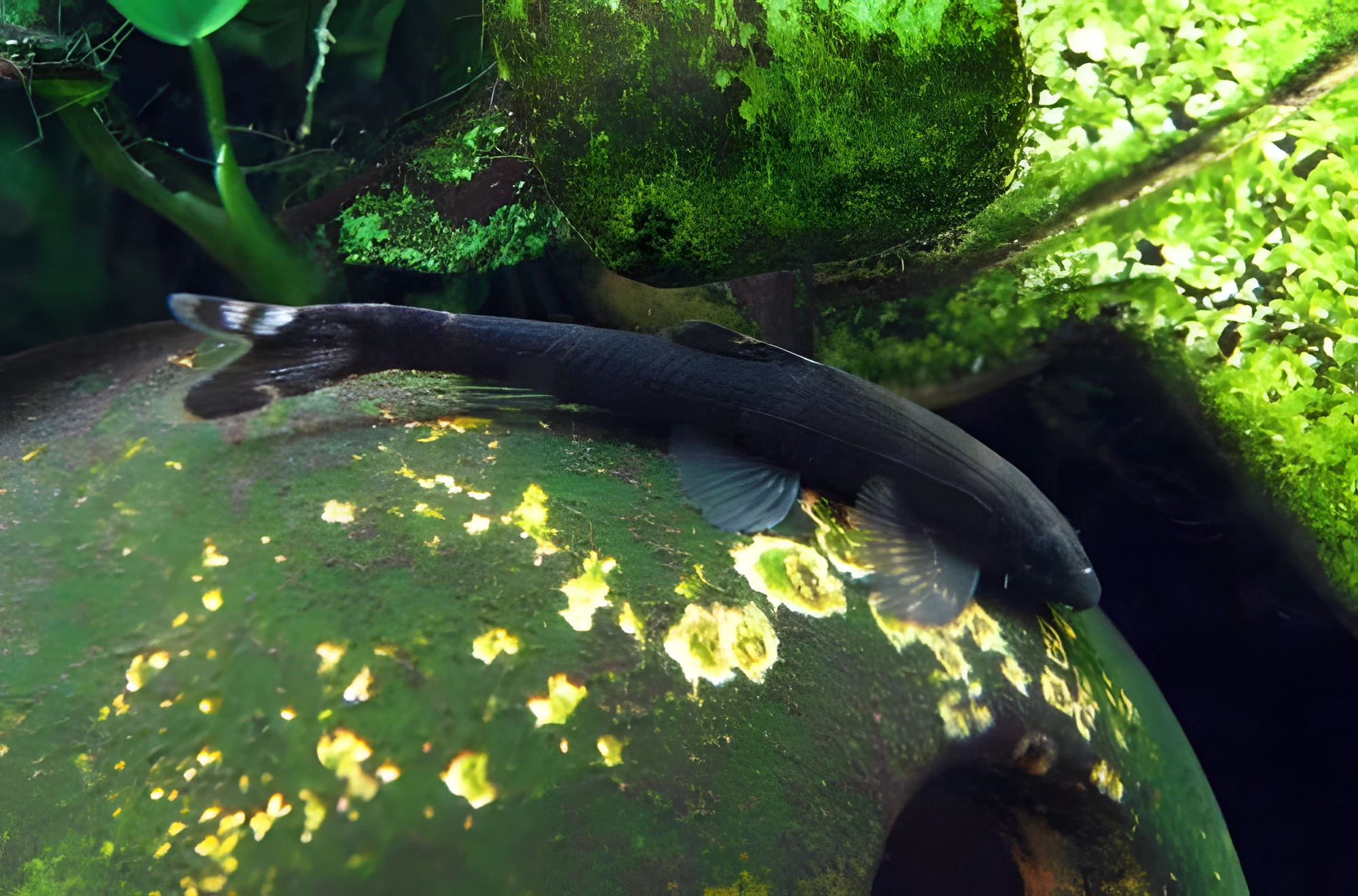
Loaches of the genus Balitoropsis are often called “aquatic lizards” due to their reptilian-like appearance. Interestingly, Zollinger's Balitorid is sometimes sold under the name “Black Water Gecko.” Adult specimens can reach a length of 6–7 cm. The unique body structure of this fish is perfectly adapted for life in fast-flowing conditions: its body is elongated and flattened. Horizontally positioned pectoral and pelvic fins allow it to firmly cling to hard surfaces, so the fish more often crawls along the bottom rather than swims. Its coloration is black, adorned with rows of annular white stripes.
Habitat
Its natural habitat is Southeast Asia, specifically the islands of Java, Sumatra, Borneo, and Peninsular Malaysia. These fish inhabit fast-flowing streams and rivers, preferring shallow coastal areas with rocky bottoms.
Behavior and Compatibility
Zollinger's Balitorid is characterized by a calm, peaceful nature, however, its specific habitat requirements can complicate the selection of suitable tank mates. Compatible species are most often found among other representatives of the loach family.
Care and Maintenance
An aquarium for a group of 5–6 individuals should have a volume of at least 100 L. It is extremely important to ensure constant circulation of clean water with a high content of dissolved oxygen. A water exchange rate of 10–15 times per hour is considered ideal, which will require the installation of powerful pumps or internal filters with excessive capacity. The aquarium setup should be minimalistic, with a rocky substrate, large boulders, and several snags or other heavy decor that will be stable against strong currents. When choosing live plants, preference should be given to Anubias, as well as some varieties of decorative mosses and ferns that can grow on rocks or snags.
Diet
In their natural environment, these fish feed on what is known as “biofilm” — a layer of algae that forms on rocks, and the microorganisms living within it. Traditional floating and sinking foods, such as flakes or pellets, are unlikely to be suitable, as strong currents will quickly carry them into the filtration system. It is much more preferable to use specialized gel products that can be attached to decor elements, or tablets and sticks designed to be fixed to the bottom.
Breeding and Reproduction
In the natural environment, the reproduction of these fish is seasonal, and spawning is stimulated by changes in external conditions, such as temperature, water chemistry, and diet. Recreating such conditions in an artificial environment is quite a challenging task. At the time of writing, there have been no recorded successful cases of breeding this species in home aquariums.
Diseases
Health problems in Zollinger's Balitorid usually arise only in cases of injury or when kept in unsuitable conditions, which weakens the immune system and can provoke various diseases. At the first signs of symptoms, the water chemistry should first be checked for exceeding permissible levels or the presence of dangerous concentrations of toxic substances (such as nitrites, nitrates, ammonia, etc.). After eliminating all deviations and bringing the water parameters back to normal, treatment can begin. More detailed information on symptoms and treatment methods can be found in the “Aquarium Fish Diseases” section.
How to choose
When choosing Zollinger's Balitorid, special care should be taken, as this species often goes on sale in an emaciated state after transportation. A healthy fish should have a rounded abdomen, not a sunken one, which is a critical sign of prolonged starvation. It is important to avoid individuals with skin damage, whitish plaque, or signs of inflammation, as well as fish that appear sluggish or exhibit unnatural behavior.
- Assess activity: the fish should be active, but not frantic, and show interest in searching for food on surfaces.
- Check for external defects, such as spinal curvature or fin damage, which often occur due to improper keeping.
- Pay attention to breathing rate: overly rapid gill cover movement may indicate stress or the presence of parasites.
Since this species is a specialized inhabitant of flowing waters, it is recommended to purchase only those individuals that appear plump and actively explore the bottom of the aquarium. Due to the difficulties in adapting to captive conditions, it is preferable to choose fish that have undergone quarantine with the supplier.
Frequently asked questions
The essentials: size, tank volume, water parameters and care
How big does Zollinger's Balitorid get?
An adult reaches 6–7 cm in length. Plan the tank around the maximum size: the fish quickly outgrows a cramped setup.
What size aquarium does Zollinger's Balitorid need?
The minimum recommended volume is 100 L. A smaller tank speeds up nitrate build-up and raises stress levels.
What water parameters does Zollinger's Balitorid need?
Temperature 20–25 °C, pH 6–7.5, hardness 2–15 dGH. Stability matters more than exact values: sudden swings are harder on the fish than a small deviation from the ideal.
How long does Zollinger's Balitorid live?
Around 5 years when kept properly. Lifespan depends directly on tank volume, water quality and a varied diet.
Is Zollinger's Balitorid aggressive?
Temperament: peaceful (regular). Keep this in mind when choosing tank mates.
How many Zollinger's Balitorid should be kept together?
Recommended setup: small group (5–6 individuals). Ignoring this is a common cause of stress and disease.
What does Zollinger's Balitorid eat?
Diet type: sinking (any). Feed small portions that are finished within a couple of minutes — overfeeding does more harm than underfeeding.
What is the scientific name of Zollinger's Balitorid?
The scientific name of the species is Balitoropsis zollingeri, family Balitoridae. It also appears in the literature as: Balitoropsis bartschi, Homaloptera javanica, Homaloptera maxinae.