Temperature18 – 26 °C
Natural range
- India area
Labyrinth fishConservation status: Data deficient DD
Other scientific names: Badis badis, Badis dario, Labrus dario
The Scarlet Badis, also known as Dario dario (its scientific name), belongs to the Badidae family. On this website, the species is classified into the Labyrinth Fish group (which includes the Gourami and Betta families) for ease of identification. In reality, these fish have a distant relationship with them, linked by a common ancient ancestor.
- Required aquarium volume
- 40 L
- Size in aquarium
- 1.2 – 3 cm
- Temperature
- 18 – 26 °C
- Temperament
- Peaceful (regular)
Parameters
Water pHNeutral (6.5) – Slightly alkaline (8.5)
Water dHSoft (5) – Very hard (20)
Water salinityno salt (freshwater)
Size in aquarium1.2 – 3 cm
Lifespan4 years
TemperamentPeaceful (regular)
Toward small fishnot a predator
Required aquarium volume40 L
Lightingdimmed
Substratesoft silted
Water flownone or stagnant (no flow)
FeedingSmall / appropriate size / pieces
CareHarem (1 male and several females)
Description
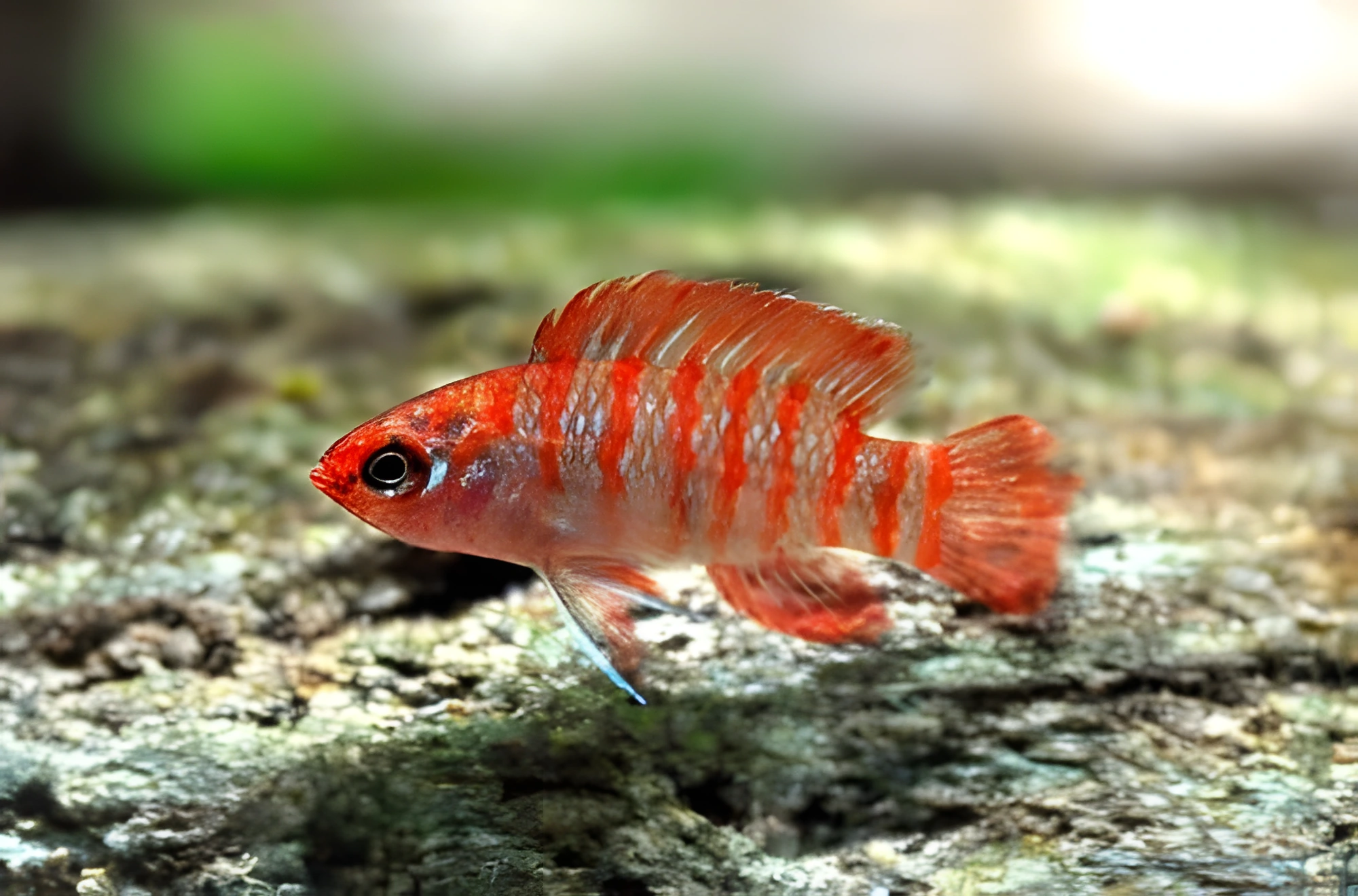
These fish are distinguished by their very modest size. Adult males rarely exceed 2 cm in length, while females reach only 1.5 cm. Males also attract attention with their bright red coloration and vertical blue pigmentation on their sides, with blue hues also visible on their fins. Females, in contrast, have a more subdued gray palette, sometimes with dark stripes on their bodies.
Habitat
Originating from Asia, this fish is mainly found in India, in the Brahmaputra River basin. It inhabits small rivers with clear flowing water, where the bottom consists of sand or gravel, and plants grow densely along the banks. In its natural habitat, Scarlet Badis can be found alongside popular aquarium plants such as Vallisneria, Hygrophila, Limnophila, Rotala, Ottelia, and many other species.
Behavior and Compatibility
Due to their tiny size, Scarlet Badis cannot coexist with large or aggressive fish. Active tank mates also pose a problem, as they will be serious competitors for food. Within the species, relationships between individuals resemble the behavior of Betta fish: males show hostility towards each other, and in small aquariums, territorial disputes and fights over females are inevitable. Therefore, it is recommended to keep one male with several females. In spacious aquariums with well-designed layouts, keeping several groups of males is permissible, provided there are equally spaced spawning sites.
Care and Maintenance
For a small group of these fish, consisting of 3–4 individuals, an aquarium of 40 L or more is sufficient. For decor, it is preferable to use a soft substrate and an abundance of aquatic plants. Excellent choices would be species characteristic of the Scarlet Badis's natural habitat, as mentioned earlier, as well as Cryptocorynes, Anubias, various types of mosses, and ferns. Natural driftwood and certain tree leaves will be a useful addition. For long-term keeping, it is crucial to prevent the accumulation of organic waste, as this can lead to poor water quality and trigger sharp fluctuations in pH and GH parameters, which is especially critical for small aquariums. The key to maintaining water purity is a continuously operating filtration system and regular aquarium maintenance. Specifically, a portion of the water must be replaced with fresh water every week, while simultaneously cleaning the substrate of fish waste, uneaten food, and other debris. In their natural environment, Dario dario feed on small zooplankton; in a home aquarium, it is advisable to offer similar foods, such as daphnia or artemia, available in dry, freeze-dried, frozen, or live forms. These fish can also be accustomed to dry foods, such as flakes or granules. It is important to note that bloodworms can lead to obesity in Dario dario, which subsequently increases the risk of various diseases.
Diet
In nature, these fish feed on small zooplankton. In a home aquarium, it is advisable to offer them similar foods, such as daphnia or artemia, which can be in dry, freeze-dried, frozen, or live forms. These fish can also adapt to dry foods, such as flakes or granules. It is worth noting that feeding bloodworms can lead to obesity in Dario dario, which, in turn, increases the risk of various diseases. Under favorable conditions, offspring may appear even in the main aquarium. For breeding, it is optimal to use one pair or a harem consisting of one male and several females. If there are several males in the tank, it is likely that only one will become dominant and participate in reproduction. When the spawning period begins, the male starts courtship, which can last several days. Typically, the female lays her eggs on the underside of a plant leaf, after which she leaves the clutch. The male remains, protecting the surrounding territory until the fry hatch. The incubation period lasts 2–3 days. Over the next week, the fry feed on the remnants of their yolk sac, and then begin to swim freely in search of food. Since the fry are very small, they can only consume microscopic food. Initially, this is infusoria, then artemia nauplii, or special powders and suspensions designed for feeding aquarium fish fry. It is most convenient to raise the fry in a separate tank.
Breeding and Reproduction
Under favorable conditions, breeding is possible even in a community tank. For successful breeding, it is recommended to use one pair or a harem consisting of a male and several females. If there are multiple males, there is a high probability that only one will become dominant and participate in the breeding process. With the onset of the spawning period, the male begins courtship, which can last several days. Typically, the female lays her eggs on the underside of a plant leaf, after which she swims away. The male remains near the clutch, guarding the territory until the fry hatch. The incubation period lasts 2–3 days. Over the subsequent week, the fry consume the reserves of their yolk sac, and then begin to swim freely in search of food. Due to their extremely small size, the fry can only accept microscopic foods: initially infusoria, then artemia nauplii, or specialized powders and suspensions for feeding aquarium fish fry. The feeding process is most conveniently carried out in a separate tank. Sources: wikipedia.org, fishbase.se
Diseases
Fish are susceptible to common diseases under poor keeping conditions, such as ich and bacterial infections. The main risk factor is stress due to unstable water parameters or competition for food, which quickly weakens their immune system. The species is sensitive to water composition and filtration quality, so any sudden spikes in ammonia or nitrites are unacceptable. Caution should be exercised during treatment: badids are sensitive to copper-based medications, so dosages must be strictly limited.
How to choose
When purchasing, it is important to assess the fish's plumpness, as emaciated individuals often refuse food in the aquarium and perish. A healthy fish should be active in its hiding spot, have bright coloration (for males), and clean fins without signs of erosion or film. Avoid individuals with sunken bellies, as this may indicate chronic malnutrition or the presence of internal parasites. In stores, fish often appear pale due to stress but should quickly regain their color when calm.
Frequently asked questions
The essentials: size, tank volume, water parameters and care
How big does Scarlet Badis get?
An adult reaches 1.2–3 cm in length. Plan the tank around the maximum size: the fish quickly outgrows a cramped setup.
What size aquarium does Scarlet Badis need?
The minimum recommended volume is 40 L. A smaller tank speeds up nitrate build-up and raises stress levels.
What water parameters does Scarlet Badis need?
Temperature 18–26 °C, pH 6.5–8.5, hardness 5–20 dGH. Stability matters more than exact values: sudden swings are harder on the fish than a small deviation from the ideal.
How long does Scarlet Badis live?
Around 4 years when kept properly. Lifespan depends directly on tank volume, water quality and a varied diet.
Is Scarlet Badis aggressive?
Temperament: peaceful (regular). Keep this in mind when choosing tank mates.
How many Scarlet Badis should be kept together?
Recommended setup: harem (1 male and several females). Ignoring this is a common cause of stress and disease.
What does Scarlet Badis eat?
Diet type: small / appropriate size / pieces. Feed small portions that are finished within a couple of minutes — overfeeding does more harm than underfeeding.
What is the scientific name of Scarlet Badis?
The scientific name of the species is Dario dario, family Badidae. It also appears in the literature as: Badis badis, Badis dario, Labrus dario.