Temperature16 – 24 °C
Natural range
- Guizhou Province area
- China area
LoachesConservation status: Least concern LC
Other scientific names: Gastromyzon leveretti
Beaufortia, or the Butterfly Hillstream Loach, scientifically known as Beaufortia kweichowensis, belongs to the family Balitoridae, which includes river loaches. The fish owes its name to the Dutch zoologist Lieven Ferdinand de Beaufort, who discovered it. Its unusual body shape attracts the attention of many aquarists, but it should be noted that this species is not suitable for beginners due to specific requirements for keeping conditions.
- Required aquarium volume
- 60 L
- Size in aquarium
- 6 – 7 cm
- Temperature
- 16 – 24 °C
- Temperament
- Peaceful (regular)
Parameters
Water pHNeutral (6.5) – Slightly alkaline (8)
Water dHVery soft (2) – Hard (15)
Water salinityno salt (freshwater)
Size in aquarium6 – 7 cm
Lifespan6 years
TemperamentPeaceful (regular)
Toward small fishnot a predator
Required aquarium volume60 L
Lightingmoderate or bright
Substraterocky (rock formations, boulders, etc.)
Water flowstrong
FeedingPlant-based (algae, vegetables)
CareSmall group (3–4 individuals)
Description
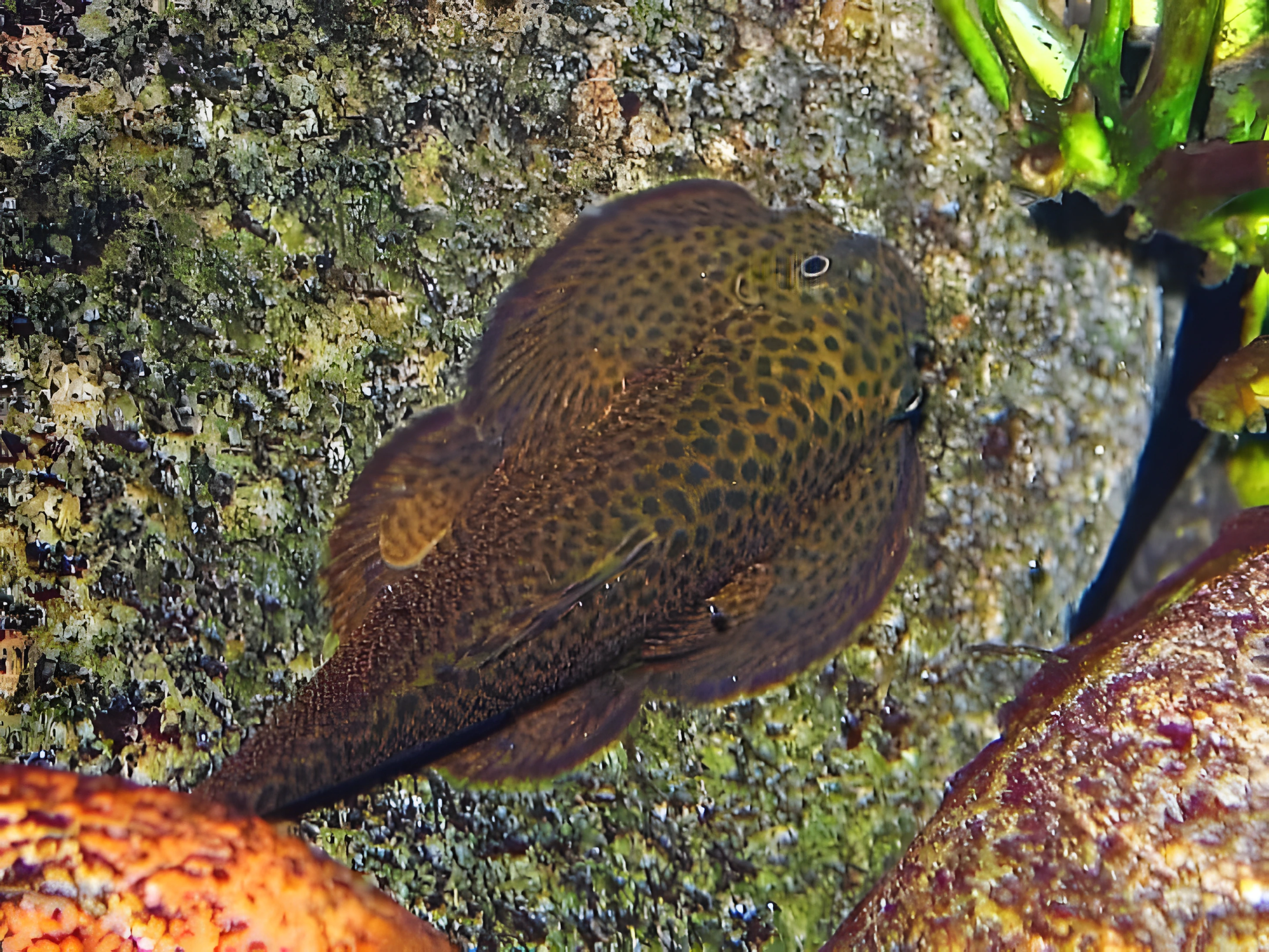
The evolution of this fish's unique disc-shaped and highly flattened body, complemented by large fan-like fins, is due to the peculiarities of its habitat. This shape allows Beaufortia to firmly attach to the surface of rocks, effectively resisting strong currents. Outwardly, it resembles classic Gastromyzon, which live in similar conditions, which is why it is often mistakenly attributed to this group. Adults reach a length of 6–7 cm. Sexual dimorphism is weakly expressed; females are only slightly larger than males. The body coloration is brown, with characteristic black speckles over the entire surface.
Habitat
The natural habitat of Beaufortia is in modern China. Wild specimens were first discovered in Guizhou province, located in a mountainous region in the southwest of the country. These fish inhabit numerous mountain streams characterized by fast currents and an abundance of rapids. Their habitat is distinguished by rocky substrates and a complete absence of aquatic vegetation. Shallow and well-lit bodies of water create favorable conditions for the growth of algae, which cover stones and boulders with a thin layer. This biofilm, which serves as a home for various microorganisms, is their main food source.
Behavior and Compatibility
Beaufortia demonstrates a calm attitude towards representatives of other species that do not show aggression. However, due to its specific requirements for keeping conditions, choosing tank mates becomes a difficult task. In their natural environment, these fish live in small groups, so it is recommended to acquire 3–4 individuals. In large aggregations, a clear internal hierarchy is formed, but intraspecific conflicts are not observed. Females tend to stay together, while the alpha male occupies the most preferred spot, not allowing others near it. Subdominant males share the remaining space on the bottom.
Care and Maintenance
For a single pair of fish, an aquarium of at least 60 liters is considered optimal. The decor uses gravel and rocky substrates, as well as large smooth stones and similar elements. The presence of aquatic plants is not mandatory. Natural snags can promote active algae growth. Since the Butterfly Hillstream Loach lives in flowing waters, it needs very clean, oxygen-rich water. In addition, it is important to ensure internal current. For example, for a 50-liter aquarium, the filter capacity should be 500 liters per hour, although in small volumes, a less intense current is acceptable to avoid excessive swirling.
Diet
An important aspect of Beaufortia's diet is the inclusion of algae, the growth of which should ideally be stimulated directly in the aquarium. Alternatively, a separate tank with bright lighting can be used, where various objects are covered with algae and then alternately placed in the main aquarium. If it is not possible to maintain an additional tank, it is necessary to purchase special gel-based plant-based foods. A small amount of gel should be applied to the side of a stone located against the current. The use of dry foods is not recommended, as they will be carried away by the current, polluting the water.
Breeding and Reproduction
As of the preparation of this article, no successful cases of Beaufortia breeding in home aquarium conditions have been recorded. It is sold either from commercial fish farms or caught in the wild.
Diseases
The main cause of most diseases is somehow related to keeping conditions. Insufficient current, low oxygen levels, excess organic waste, cloudy water with unsuitable pH and GH values, and poor-quality food — all of these, both individually and in combination, are highly likely to lead to a deterioration in fish health. As a rule, various bacterial infections or protozoan infestations are secondary, arising as a result of weakened immunity caused by improper keeping conditions. Thus, it can be stated that a healthy Butterfly Hillstream Loach is a direct consequence of a favorable habitat. Source of scientific data: The Catalogue of Life
How to choose
When choosing individuals, attention should be paid to their activity and the condition of their skin. A healthy fish should exhibit natural behavior: actively moving across surfaces, scraping off growths, or firmly adhering to glass and stones. Avoid specimens with visible fin damage, ulcers, film, or an unnaturally swollen abdomen.
- Examine the belly: in a healthy individual, it should be flat, not sunken, which may indicate emaciation.
- Check the reaction: the fish should react quickly to approach and try to hide or fix itself on a surface.
- Ensure there are no signs of stress, such as pale coloration or rapid breathing, which are often observed under poor keeping conditions in retail aquariums.
Frequently asked questions
The essentials: size, tank volume, water parameters and care
How big does Butterfly Hillstream Loach get?
An adult reaches 6–7 cm in length. Plan the tank around the maximum size: the fish quickly outgrows a cramped setup.
What size aquarium does Butterfly Hillstream Loach need?
The minimum recommended volume is 60 L. A smaller tank speeds up nitrate build-up and raises stress levels.
What water parameters does Butterfly Hillstream Loach need?
Temperature 16–24 °C, pH 6.5–8, hardness 2–15 dGH. Stability matters more than exact values: sudden swings are harder on the fish than a small deviation from the ideal.
How long does Butterfly Hillstream Loach live?
Around 6 years when kept properly. Lifespan depends directly on tank volume, water quality and a varied diet.
Is Butterfly Hillstream Loach aggressive?
Temperament: peaceful (regular). Keep this in mind when choosing tank mates.
How many Butterfly Hillstream Loach should be kept together?
Recommended setup: small group (3–4 individuals). Ignoring this is a common cause of stress and disease.
What does Butterfly Hillstream Loach eat?
Diet type: plant-based (algae, vegetables). Feed small portions that are finished within a couple of minutes — overfeeding does more harm than underfeeding.
What is the scientific name of Butterfly Hillstream Loach?
The scientific name of the species is Beaufortia kweichowensis, family River Loaches (Balitoridae). It also appears in the literature as: Gastromyzon leveretti.