Temperature10 – 35 °C
Natural range
- Azraq Oasis area
- Jordan area
KillifishConservation status: Critically endangered CR
Other scientific names: Aphaniops sirhani, Lebias sirhani
Aphanius sirhani, also known as the Azraq killifish, belongs to the family Cyprinodontidae. This attractive fish has a complicated history in its natural habitat: its natural range had almost disappeared by the early 90s due to human activity. Fortunately, thanks to the coordinated efforts of international environmental organizations, the situation has stabilized today.
- Required aquarium volume
- 100 L
- Size in aquarium
- 5 cm
- Temperature
- 10 – 35 °C
- Temperament
- Territorial (often aggressive)
Parameters
Water pHNeutral (7.5) – Slightly alkaline (8.5)
Water dHMedium hardness (10) – Very hard (26)
Water salinityno salt (freshwater)
Size in aquarium5 cm
Lifespan3 years
TemperamentTerritorial (often aggressive)
Toward small fishnot a predator
Required aquarium volume100 L
Lightingbright
Substratefine-grained (fine crushed stone, gravel, etc.)
Water flowweak or moderate
FeedingAny (universal)
CarePair (male/female)
Description
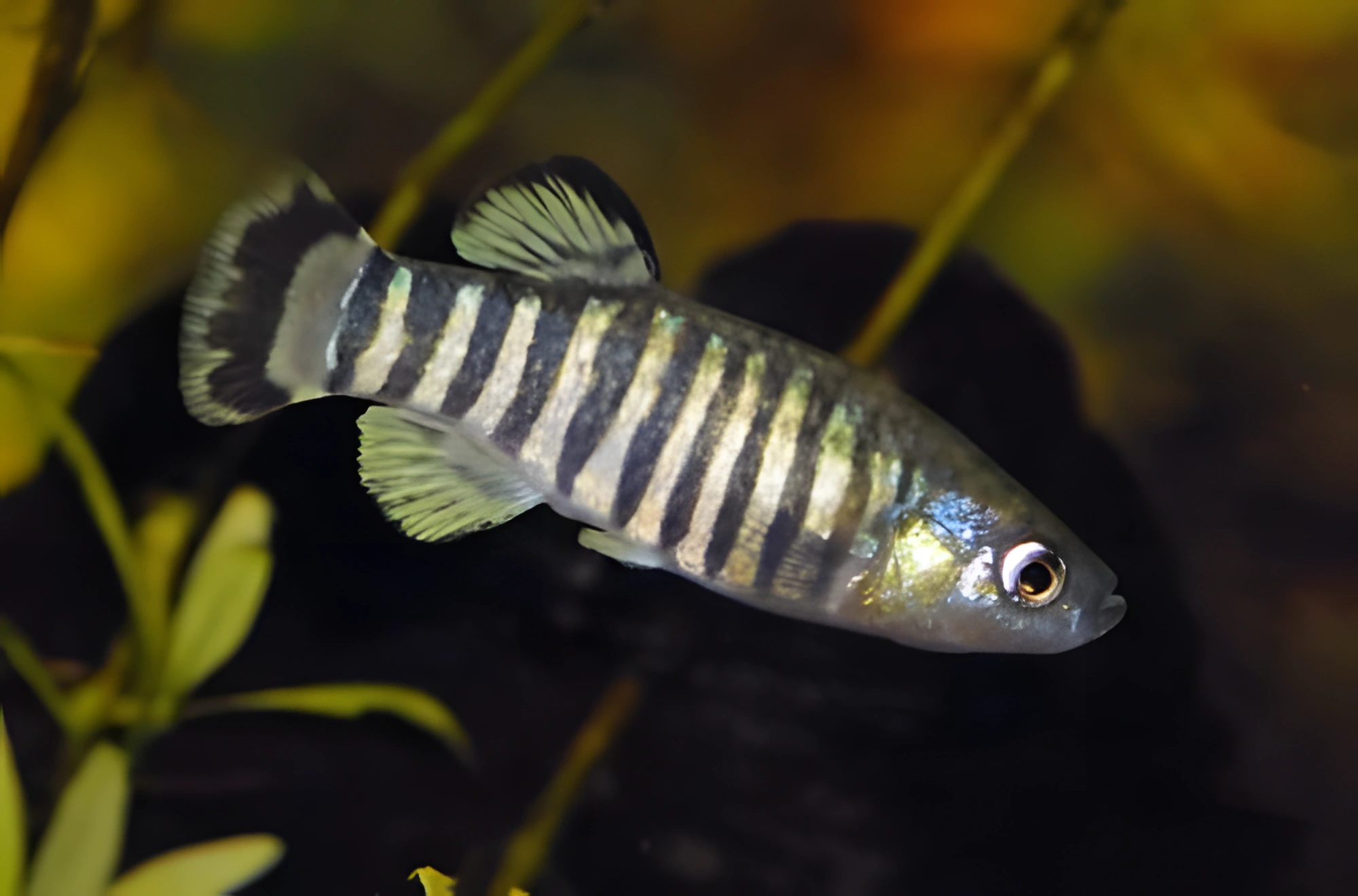
This miniature fish has a slightly elongated body. Females are larger, reaching a length of about 5 cm; their coloration is pale silver with several black spots. Males, in contrast, are smaller and more brightly colored, their bodies adorned with alternating vertical dark and light stripes. Their fins are yellow, with a wide black border, and are located closer to the caudal part.
Habitat
The killifish's homeland is the ancient Azraq Oasis, located in the Syrian Desert within modern-day Jordan. For centuries, this oasis served as the sole source of fresh water in the region and was a key point on caravan routes. Until the 1980s, it covered over 12 km² of wetlands, rich in vegetation and diverse animal life. Many large mammals, such as lions, cheetahs, rhinos, hippos, and elephants, inhabited these lands, although some of them became extinct long before the 80s. The oasis was replenished by two significant underground springs. However, from the 1960s, numerous deep-well pumps were installed to supply water to Amman, leading to a decrease in water levels. By 1992, the springs had completely dried up, and the area of the wetlands had shrunk tenfold, leading to the disappearance of most of the flora and fauna. After international environmental organizations raised the alarm, a program to save surviving species and partially restore the oasis, at least to 10% of its original area, by artificially pumping water, began in the 2000s. The protected Azraq Wetland Reserve now operates at this site.
Behavior and Compatibility
Due to specific water composition requirements and aggressive behavior during spawning, this fish is not an ideal candidate for a community tank. The best option is to keep it in a species-only tank. Males show significant aggression towards each other, especially during the breeding season, with an alpha male quickly emerging, and others having to avoid him. To prevent intraspecific conflicts, it is recommended to keep one male with 2–3 females.
Care and Maintenance
Keeping these fish is not difficult, and in warm climates, they successfully breed in outdoor ponds. For a home aquarium, basic equipment is sufficient: a lighting system and a filter with low flow power, as this fish cannot tolerate strong or even moderate currents. Aquarium heating is not mandatory. A school of fish will feel comfortable in a tank of 100 liters or more. The aquarium decor should include many hiding places: these can be piles of stones, driftwood, or decorative elements such as artificial castles or sunken ships. These shelters are especially important for females and subdominant males during spawning. Any substrate can be used, but coarse sand or fine gravel is preferred. Various mosses, ferns, and some hardy species, such as hornwort, are well-suited as plants. Care consists of weekly water changes of about 10% and periodic cleaning of the substrate as organic waste accumulates. The Azraq Killifish prefers slightly alkaline or neutral water (pH) with a high dGH level; soft, slightly acidic water can be fatal to it. The optimal temperature range is 10 to 30°C. However, during the winter months, the temperature should not exceed 20°C, as higher temperatures significantly shorten life expectancy and hinder reproduction.
Diet
Being an omnivorous species, in its natural environment, the fish feeds on small aquatic crustaceans, worms, insects and their larvae, as well as other zooplankton. Its diet also includes algae and other vegetation. When kept in an aquarium, it is important to combine dry and meaty foods, such as live or frozen daphnia, artemia, bloodworms, and also include vegetable supplements, for example, spirulina flakes. Proper nutrition is extremely important for successful reproduction, as a lack of protein and plant components can have far-reaching negative consequences.
Breeding and Reproduction
Creating favorable conditions in the aquarium and maintaining appropriate water parameters makes breeding at home quite feasible. The peak of the breeding season occurs in the summer and early autumn months. During this time, the male acquires brighter coloration, chooses a specific territory, and invites females. Any rival daring to approach his boundaries will be immediately expelled. Sometimes the male shows excessive activity, forcing females to seek shelter if they are not yet ready to spawn. Spawning occurs gradually: females lay one egg or a small cluster, attaching them to plants with thin threads. After spawning, the parents do not care for the offspring and, moreover, may eat their own eggs. Therefore, the eggs, along with the plant, are carefully moved to a separate tank with identical water conditions. The incubation period lasts from 6 to 14 days, depending on the water temperature. Fry feed on artemia nauplii and other finely dispersed food, such as flakes or granules ground to a flour consistency.
Diseases
No specific diseases exclusively characteristic of this species have been recorded. Like other members of the family, the fish is sensitive to water quality and the accumulation of organic waste. When kept in unsuitable conditions, especially with a prolonged absence of seasonal temperature fluctuations, the fish's immunity decreases, which increases the risk of bacterial infections and parasitic infestations. Prevention includes regular water changes, maintaining stable environmental parameters, and providing an appropriate resting period at lower temperatures.
How to choose
The species is extremely rare and endangered, so its acquisition in ordinary pet stores is practically impossible. Individuals should be sought through specialized killifish communities or professional breeders. When purchasing, it is important to ensure that the fish do not have visible damage, ulcers, white coating, or signs of emaciation. A healthy individual should be active, have clean fins, and display the characteristic coloration for the species.
Frequently asked questions
The essentials: size, tank volume, water parameters and care
How big does Azraq Killifish get?
An adult reaches 5 cm in length. Plan the tank around the maximum size: the fish quickly outgrows a cramped setup.
What size aquarium does Azraq Killifish need?
The minimum recommended volume is 100 L. A smaller tank speeds up nitrate build-up and raises stress levels.
What water parameters does Azraq Killifish need?
Temperature 10–35 °C, pH 7.5–8.5, hardness 10–26 dGH. Stability matters more than exact values: sudden swings are harder on the fish than a small deviation from the ideal.
How long does Azraq Killifish live?
Around 3 years when kept properly. Lifespan depends directly on tank volume, water quality and a varied diet.
Is Azraq Killifish aggressive?
Temperament: territorial (often aggressive). Keep this in mind when choosing tank mates.
How many Azraq Killifish should be kept together?
Recommended setup: pair (male/female). Ignoring this is a common cause of stress and disease.
What does Azraq Killifish eat?
Diet type: any (universal). Feed small portions that are finished within a couple of minutes — overfeeding does more harm than underfeeding.
What is the scientific name of Azraq Killifish?
The scientific name of the species is Aphanius sirhani, family Killifish (Cyprinodontidae). It also appears in the literature as: Aphaniops sirhani, Lebias sirhani.