Temperature22 – 25 °C
Natural range
- Lake Sentani area
- New Guinea area
Rainbowfish
This fish is known by several common names. Most often, it is called the Red Rainbowfish or Glossolepis incisa. Its scientific name is Glossolepis incisa, and it belongs to the family Melanotaeniidae, or Rainbowfishes.
- Required aquarium volume
- 150 L
- Size in aquarium
- 15 cm
- Temperature
- 22 – 25 °C
- Temperament
- Peaceful (regular)
Parameters
Water pHNeutral (7) – Slightly alkaline (8)
Water dHMedium hardness (8) – Very hard (20)
Water salinityno salt (freshwater)
Size in aquarium15 cm
Lifespan6 years
TemperamentPeaceful (regular)
Toward small fishnot a predator
Required aquarium volume150 L
Lightingmoderate (regular)
Substrateany (no restrictions)
Water flowweak
FeedingAny (universal)
CareMedium group (6–8 individuals)
Description
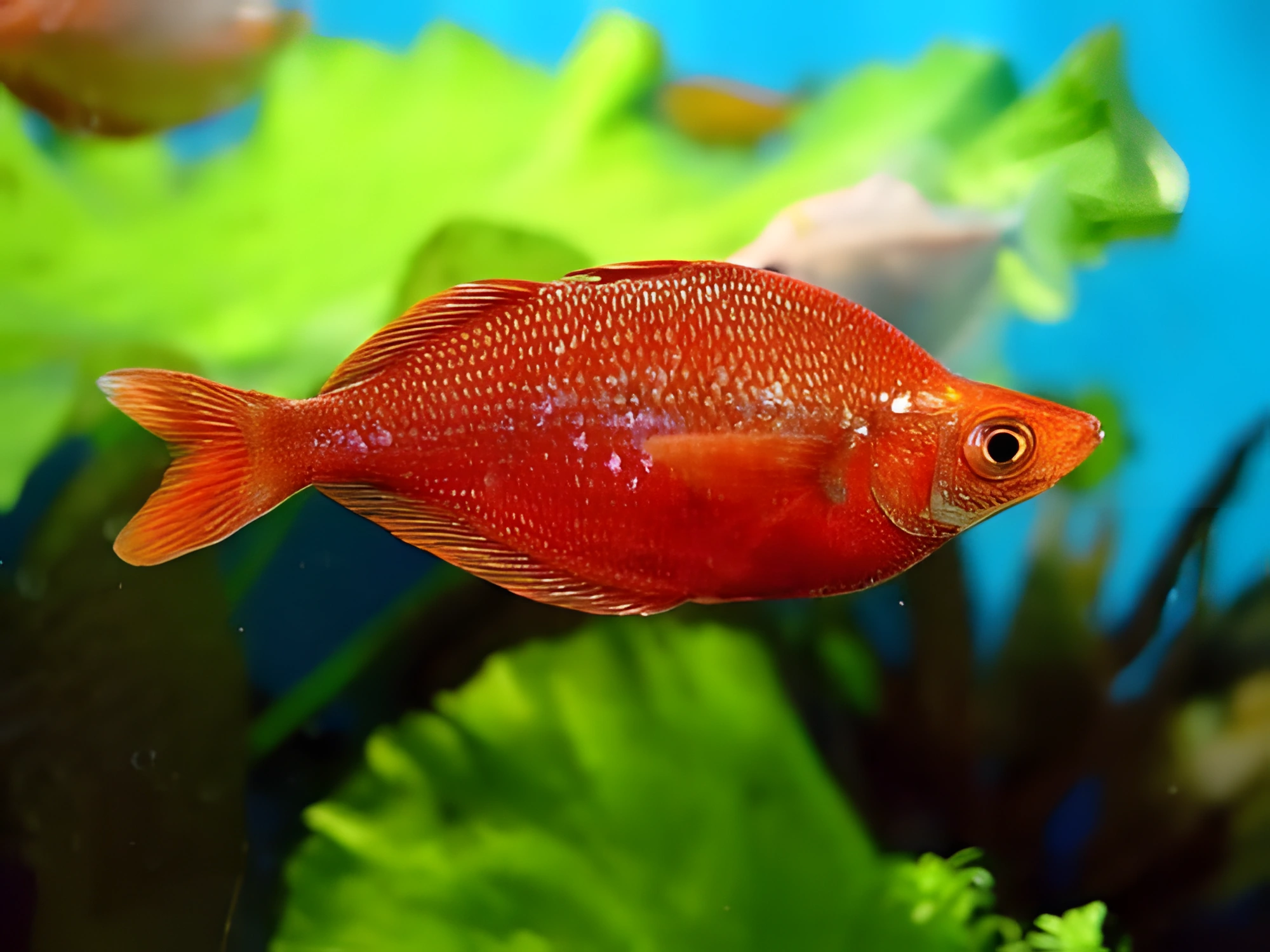
These fish reach a length of approximately 15 cm. Males are distinguished by their rich red coloration, while females have a yellowish-olive hue. Interestingly, when the fish are kept in conditions close to the lower limit of the acceptable temperature range, all males display characteristic red tones. However, if the temperature is higher, only the dominant (alpha) male retains its vibrant coloration.
Habitat
Endemic to the island of New Guinea, this species inhabits Lake Sentani, as well as nearby bodies of water. The Red Rainbowfish prefers shallow waters and shoals where there is dense aquatic and coastal vegetation. A distinctive feature of Lake Sentani is the stability of its aquatic environment, where hydrochemical parameters and temperature remain almost unchanged throughout the year.
Behavior and Compatibility
These fish are peaceful and active. They coexist well with many well-known species, but due to their mobility and relatively large size, they can cause some disturbance to smaller and slower tankmates. It is recommended to keep them in a school consisting of at least 6–8 individuals of both sexes. With fewer numbers, the Red Rainbowfish can become timid and spend a significant portion of its time hiding among thickets.
Care and Maintenance
For a school of several individuals, an aquarium of 150 liters or more will be required. The aquarium's decor can be arbitrary, but it should include both areas with dense vegetation and open zones for swimming. The Red Rainbowfish, being native to still waters, does not tolerate strong currents well. Therefore, internal equipment, especially filters, should be adjusted to minimize water movement in the aquarium. Another key aspect of caring for this species is maintaining stable conditions. Where possible, sudden fluctuations in temperature, as well as pH and GH parameters, should be avoided.
Diet
The Red Rainbowfish has no special dietary requirements. It readily accepts all popular types of food of suitable size — dry, live, or frozen. It is important to provide a varied diet, as a combination of different types of food positively affects the overall tone of the fish, which, in turn, contributes to brighter coloration.
Breeding and Reproduction
Breeding this species is quite simple, and the fish can produce offspring year-round. Spawning lasts for about two days, usually occurring among low-growing plants with stiff leaves or in moss thickets. Over a hundred eggs are attached to these surfaces. Parents generally do not eat their offspring, unlike other aquarium inhabitants. If necessary, the eggs can be carefully transferred to a separate tank with identical water conditions. The incubation period lasts approximately 7–8 days. Tiny fry initially require microscopic food, such as infusoria. After about a week, they can be fed Artemia nauplii or special powdered food for tropical fish fry.
Diseases
Health problems in these fish arise only as a result of injuries or when kept in unsuitable conditions, which weakens their immune system and provokes the development of various diseases. If the first symptoms appear, it is primarily necessary to check the water quality for any exceeding parameters or dangerous concentrations of toxic substances such as nitrites, nitrates, or ammonium. After detecting deviations, all water parameters should be stabilized to normal, and only then should treatment begin. More detailed information on symptoms and treatment methods can be found in the "Aquarium Fish Diseases" section. Data source: FishBase
How to choose
When purchasing, choose active, mobile individuals with bright coloration appropriate for their sex. Avoid fish with damaged fins, film, body ulcers, or signs of emaciation, as these species are sensitive to water quality and stress during transportation. It is advisable to acquire fish from aquariums where they are kept in a school, as single individuals in a store often experience severe stress and appear timid.
Frequently asked questions
The essentials: size, tank volume, water parameters and care
How big does Red Rainbowfish get?
An adult reaches 15 cm in length. Plan the tank around the maximum size: the fish quickly outgrows a cramped setup.
What size aquarium does Red Rainbowfish need?
The minimum recommended volume is 150 L. A smaller tank speeds up nitrate build-up and raises stress levels.
What water parameters does Red Rainbowfish need?
Temperature 22–25 °C, pH 7–8, hardness 8–20 dGH. Stability matters more than exact values: sudden swings are harder on the fish than a small deviation from the ideal.
How long does Red Rainbowfish live?
Around 6 years when kept properly. Lifespan depends directly on tank volume, water quality and a varied diet.
Is Red Rainbowfish aggressive?
Temperament: peaceful (regular). Keep this in mind when choosing tank mates.
How many Red Rainbowfish should be kept together?
Recommended setup: medium group (6–8 individuals). Ignoring this is a common cause of stress and disease.
What does Red Rainbowfish eat?
Diet type: any (universal). Feed small portions that are finished within a couple of minutes — overfeeding does more harm than underfeeding.
What is the scientific name of Red Rainbowfish?
The scientific name of the species is Glossolepis incisa, family Rainbowfishes (Melanotaeniidae).