Temperature24 – 26 °C
Natural range
- Lake Malawi area
- East Africa area
Predators CichlidsConservation status: Least concern LC
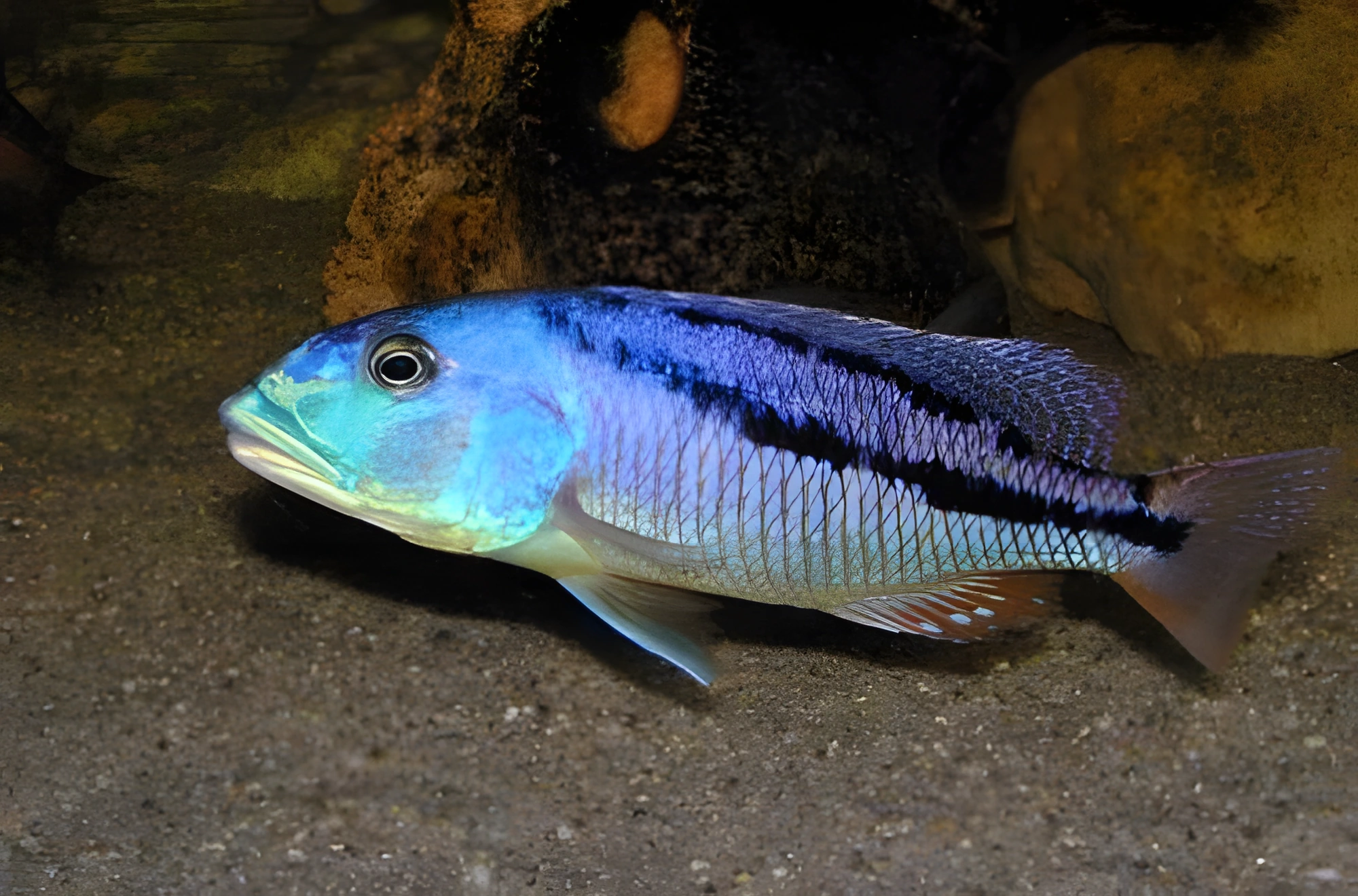
Aristochromis christyi, scientifically named Aristochromis christyi, is a representative of the Cichlidae family. Despite its predatory lifestyle, this fish is known for its peaceful disposition, posing a threat only to smaller aquarium inhabitants. Its keeping will not cause particular difficulties if a sufficiently spacious tank is available.
- Required aquarium volume
- 500 L
- Size in aquarium
- 25 – 30 cm
- Temperature
- 24 – 26 °C
- Temperament
- Semi-peaceful (including aggression during spawning / intraspecific conflicts)
Parameters
Water pHNeutral (7.4) – Alkaline (9)
Water dHMedium hardness (10) – Very hard (30)
Water salinityno salt (freshwater)
Size in aquarium25 – 30 cm
Lifespan8 years
TemperamentSemi-peaceful (including aggression during spawning / intraspecific conflicts)
Toward small fishpredator
Required aquarium volume500 L
Lightingmoderate (regular)
Substratesandy (regular, light)
Water flowweak
FeedingFor carnivores (live fish, insects, etc.)
CareHarem (1 male and several females)
Description
Adult Aristochromis reach a length of 25–30 cm. Their large head with a massive mouth clearly indicates their predatory nature. The fish's body has an elongated shape, with the dorsal and anal fins shifted towards the tail, allowing for rapid bursts of speed. Males are distinguished by bluish hues in their coloration, while females are smaller and have a gray color. A characteristic feature common to both sexes is a black stripe running from head to tail. It is worth noting that in males, this stripe temporarily disappears during spawning.
Habitat
The natural habitat of Aristochromis christyi is the famous African Lake Malawi, where this species is found everywhere. The fish prefer so-called "intermediate zones," combining rocky areas with open sandy spaces, often dotted with individual rock formations.
Behavior and Compatibility
In a relatively small aquarium (about 500 liters), only solitary keeping is possible. In more spacious tanks, these fish can coexist with other large individuals or members of their own species, provided that there is only one male in the group. Males of this species are prone to aggression towards each other. It is also important to remember that any fish up to 10 cm long can become potential prey.
Care and Maintenance
For one adult Aristochromis christyi, an aquarium of at least 500–600 liters will be required. When decorating the tank, it is important to provide ample open spaces, preferably with a sandy bottom. Along the sides of the aquarium, it is recommended to place piles of stones or other decorative elements imitating rock formations. Plants are not necessary. Successful long-term keeping is possible by observing conditions that are as close as possible to the natural environment of Lake Malawi: this implies a stable hydrochemical composition of the water and minimal temperature fluctuations. Maintaining high water quality is ensured by regular aquarium maintenance procedures, including water changes and waste removal, as well as an effective filtration system. Filtration bears a significant load, as carnivorous fish produce a large amount of waste.
Diet
As a predator, Aristochromis christyi prefers to hunt from ambush. It can stalk prey both in rock crevices and in open water. In the latter case, the fish uses a very unusual strategy: it slowly approaches the victim, trying to remain unnoticed, or pretends to be dead, lying on its side. As soon as the prey is within reach, a lightning-fast attack follows. Despite its predatory nature, in a home aquarium, there is no need to feed it exclusively live organisms. The diet can include pieces of mussels, shrimp, and meat from other fish. Dry granules are occasionally offered to replenish vitamins and trace elements.
Breeding and Reproduction
Successful breeding of Aristochromis christyi in an artificial aquarium environment requires certain experience and significant resources, in particular, a very large tank (around 1000–1500 liters) capable of accommodating several fish and providing them with sufficient hiding places. The male Aristochromis christyi is polygamous, so to form a group, he will need at least three females. The presence of other males is excluded, as this will inevitably lead to territorial conflicts. During courtship, the male shows strong persistence and even aggression. If the female is not ready to spawn and has no opportunity to hide from his attention, she may be injured. Being in a group reduces this risk, as the male's attention is distributed among several "targets." During spawning, the female lays several eggs on a flat surface, such as a flat stone, and after fertilization immediately takes them into her mouth, where they will remain throughout the incubation period (3–4 weeks). The female continues to protect the hatched fry for some time until they grow larger. This strategy of carrying offspring developed during evolution as an adaptation to a highly competitive habitat and is characteristic of all Lake Malawi cichlids.
Diseases
The main cause of diseases often lies in the keeping conditions: if they go beyond acceptable limits, immunity decreases, making the fish vulnerable to various infections inevitably present in the environment. At the first suspicion of illness, it is important first of all to check the water parameters and ensure there are no dangerous concentrations of nitrogen cycle products. Often, restoring normal, suitable conditions promotes recovery. However, in some cases, medication may be required. Detailed information on symptoms and treatment methods is presented in the "Aquarium Fish Diseases" section.
How to choose
When selecting individuals, preference should be given to active fish with clean skin and fins without signs of damage or plaque. Avoid specimens with sunken bellies, signs of emaciation, or unnatural behavior, such as apathy or constant presence at the water's surface. Since the species is a large predator, it is important to assess the keeping conditions in the store: overcrowded aquariums often provoke stress and the development of infections.
- Examine the eyes: they should be clear, without cloudiness or bulging.
- Check breathing: gill covers should move rhythmically, without excessive frequency or difficulty.
- Clarify the diet: healthy fish show interest in food and actively respond to external stimuli.
It is important to consider that this is a territorial species, so when purchasing several individuals, it is necessary to provide them with sufficient space to delineate zones of influence. It is recommended to acquire juveniles to form a group, as adult individuals may show pronounced aggression when introduced into an established community. When choosing, focus on individuals raised in aquarium conditions, as they adapt more easily to the offered feeds.
Frequently asked questions
The essentials: size, tank volume, water parameters and care
How big does Aristochromis christyi get?
An adult reaches 25–30 cm in length. Plan the tank around the maximum size: the fish quickly outgrows a cramped setup.
What size aquarium does Aristochromis christyi need?
The minimum recommended volume is 500 L. A smaller tank speeds up nitrate build-up and raises stress levels.
What water parameters does Aristochromis christyi need?
Temperature 24–26 °C, pH 7.4–9, hardness 10–30 dGH. Stability matters more than exact values: sudden swings are harder on the fish than a small deviation from the ideal.
How long does Aristochromis christyi live?
Around 8 years when kept properly. Lifespan depends directly on tank volume, water quality and a varied diet.
Is Aristochromis christyi aggressive?
Temperament: semi-peaceful (including aggression during spawning / intraspecific conflicts). This is a predatory species — any fish small enough to fit in its mouth will eventually be eaten.
How many Aristochromis christyi should be kept together?
Recommended setup: harem (1 male and several females). Ignoring this is a common cause of stress and disease.
What does Aristochromis christyi eat?
Diet type: for carnivores (live fish, insects, etc.). Feed small portions that are finished within a couple of minutes — overfeeding does more harm than underfeeding.
What is the scientific name of Aristochromis christyi?
The scientific name of the species is Aristochromis christyi, family Cichlids (Cichlidae).