Temperature26 – 31 °C
Natural range
- West Africa area
- Cameroon area
- Angola area
- Senegal area
KillifishConservation status: Least concern LC
Other scientific names: Aplocheilichthys bensonii, Aplocheilichthys spilauchena, Aplocheilichthys tschiloangensis, Aplocheilichthys typus, Aplocheilus spilauchen, Epiplatys spilauchen
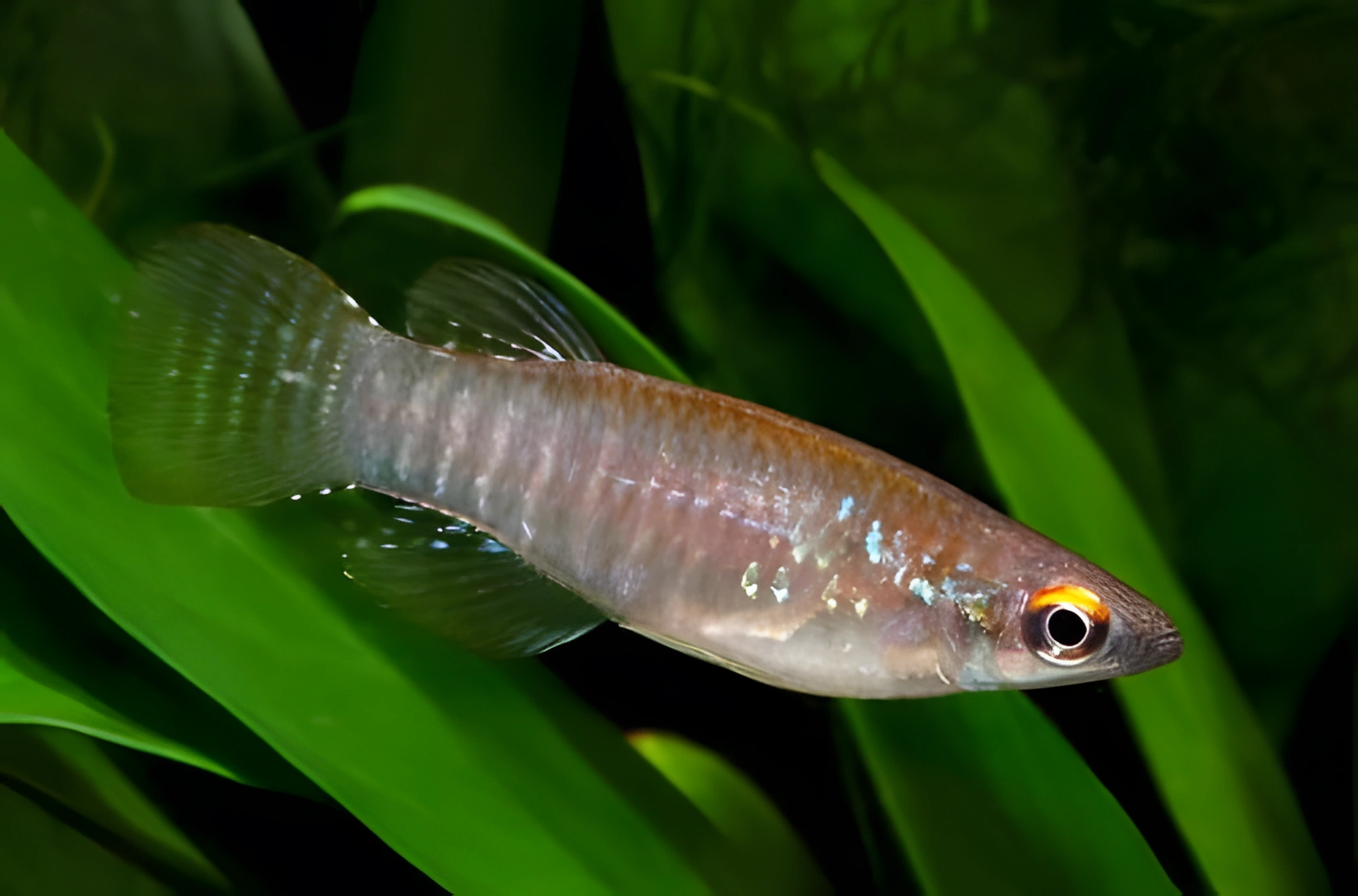
Aplocheilichthys spilauchen, known scientifically as Aplocheilichthys spilauchen, is a member of the Poeciliidae family. This small but elegant fish attracts attention with its unusual coloration. It looks particularly striking in aquariums with subdued lighting and dark substrate. These fish are often offered as freshwater species, but in reality, their natural habitat is brackish water.
- Required aquarium volume
- 40 L
- Size in aquarium
- 7 cm
- Temperature
- 26 – 31 °C
- Temperament
- Peaceful, active/mobile
Parameters
Water pHNeutral (7.5) – Slightly alkaline (8.5)
Water dHHard (12) – Very hard (20)
Water salinitylow (3–5 g/L)
Size in aquarium7 cm
Lifespan5 years
TemperamentPeaceful, active/mobile
Toward small fishnot a predator
Required aquarium volume40 L
Lightingdimmed
Substrateany, but dark
Water flowmoderate
FeedingMeat / protein (live, frozen, fresh)
CareSchooling (usually from 5–6 individuals and more)
Description
These fish reach a small size, up to 7 cm, have an elongated, cylindrical body, and short fins. Their head is somewhat flattened from above. Their coloration is characterized by creamy, light brown tones with iridescent silvery-blue vertical stripes on the front part of the body. In males, these stripes are noticeably present at the base of the tail, and their fins are distinguished by richer colors.
Males have a more pronounced arched back and more intense coloration. Transverse stripes are observed not only on the front part of their body but also closer to the base of the tail.
Habitat
This species is found in brackish coastal areas of West Africa. Their range includes countries such as Cameroon, Angola, Senegal, and Nigeria, where they inhabit river estuaries, for example, the Kwanza and Senegal rivers. Although Aplocheilichthys spilauchen is not a migratory species, they can swim both upstream and into marine waters, but this happens extremely rarely. In natural conditions, the diet of these fish includes insect larvae, small aquatic invertebrates, crustaceans, and river worms.
Behavior and Compatibility
These schooling fish have a peaceful and friendly disposition, coexisting well with their own kind and with other non-aggressive species. However, active or large fish can become a source of threat to them, as they can frighten the timid Aplocheilichthys. The resulting stress can lead to serious consequences, up to a complete refusal to eat.
Care and Maintenance
Despite their resilience in the natural environment, these fish require special attention in closed aquarium systems. Their keeping requires very clean water, which implies the use of a productive filter and weekly water changes of at least 25% of the volume. Among other minimal equipment, a heater, lighting system, and aerator will be needed. It is important to note that although Aplocheilichthys spilauchen can survive in freshwater, this can weaken its immune system and increase the risk of diseases. Optimal conditions are created in brackish water, which can be prepared by adding marine salt in a proportion of 2–3 level teaspoons for every 10 liters. In the aquarium design, it is desirable to recreate their natural habitat: dark substrate (coarse sand or fine gravel) and dense thickets of fine-leaved plants, arranged in groups along the side and back walls. Lighting should be subdued.
Diet
Representatives of this species are carnivorous; their diet consists exclusively of protein food. In a home aquarium, live or frozen foods such as bloodworms, fly or mosquito larvae can be offered, and Artemia are well suited for fry.
Breeding and Reproduction
Successful breeding of Aplocheilichthys spilauchen in home conditions is associated with certain difficulties and requires experience from the aquarist. Spawning can occur both in a community tank and in a separate one if other species are present in the former. The stimulus for the start of the breeding period is the gradual creation of specific conditions: the water level should not exceed 16–18 cm, the water should be brackish, soft (5°dH), and slightly acidic (pH 6.5), and the temperature maintained in the range of 25–27°C. The spawning tank must contain fine-leaved plants. After a short courtship, the female lays eggs on the plants, and the male fertilizes them. The parents should be immediately returned to the community tank to avoid eating the eggs. If spawning occurred in the community tank, the plants with eggs must be moved to a separate breeding tank with identical water parameters. Fry appear in approximately 15 days and require feeding with infusoria. It is important to carefully monitor water purity, as this diet quickly leads to its contamination.
Diseases
Fish show resistance to many common diseases if their keeping conditions are optimal. Health problems can arise due to the use of freshwater, poor quality or unbalanced food, and for other reasons. More detailed information on symptoms and treatment methods can be found in the “Aquarium Fish Diseases” section.
How to choose
When purchasing, caution should be exercised, as this species is often mistakenly offered as a purely freshwater fish. Choose active individuals with clean, transparent fins and no visible body damage. Avoid specimens with signs of emaciation, sunken bellies, or sluggish behavior, as fish are sensitive to conditions in retail tanks. It is advisable to clarify the water parameters in which the fish are kept with the seller to minimize stress during adaptation to the new aquarium.
Frequently asked questions
The essentials: size, tank volume, water parameters and care
How big does Aplocheilichthys spilauchen get?
An adult reaches 7 cm in length. Plan the tank around the maximum size: the fish quickly outgrows a cramped setup.
What size aquarium does Aplocheilichthys spilauchen need?
The minimum recommended volume is 40 L. A smaller tank speeds up nitrate build-up and raises stress levels.
What water parameters does Aplocheilichthys spilauchen need?
Temperature 26–31 °C, pH 7.5–8.5, hardness 12–20 dGH. Stability matters more than exact values: sudden swings are harder on the fish than a small deviation from the ideal.
How long does Aplocheilichthys spilauchen live?
Around 5 years when kept properly. Lifespan depends directly on tank volume, water quality and a varied diet.
Is Aplocheilichthys spilauchen aggressive?
Temperament: peaceful, active/mobile. Keep this in mind when choosing tank mates.
How many Aplocheilichthys spilauchen should be kept together?
Recommended setup: schooling (usually from 5–6 individuals and more). Ignoring this is a common cause of stress and disease.
What does Aplocheilichthys spilauchen eat?
Diet type: meat / protein (live, frozen, fresh). Feed small portions that are finished within a couple of minutes — overfeeding does more harm than underfeeding.
What is the scientific name of Aplocheilichthys spilauchen?
The scientific name of the species is Aplocheilichthys spilauchen, family Poeciliidae. It also appears in the literature as: Aplocheilichthys bensonii, Aplocheilichthys spilauchena, Aplocheilichthys tschiloangensis.